What this gullibility tendency quiz measures
This am I gullible quiz estimates how often credulity, authority trust, manipulation susceptibility, and wishful confirmation patterns showed up in your habits over the past few months. Twenty original frequency items group into four domains inspired by gullibility research from Stephen Greenspan (2009) and Teunisse and colleagues (2020) on credulity, social influence, and decision-making traps: credulity bias, authority trust, manipulation susceptibility, and wishful confirmation. Each item also maps to a fear-of-intimacy stack layer so you can see whether vulnerability pull-back, trust hesitation, self-disclosure limits, or closeness anxiety pairs with quick trust or politeness. Your gullibility tendency index averages these patterns into a 0 to 100 score where higher numbers mean more gullibility signals on this screener.
Credulity bias
Believing dramatic stories, forwarding unverified messages, and skipping quick fact checks.
Authority trust
Trusting badges, follower counts, crowd consensus, and status without checking credentials.
Manipulation susceptibility
Yielding to urgency, flattery, limited-time offers, and guilt when saying no feels mean.
Wishful confirmation
Ignoring red flags, reading hope into ambiguous signals, and dismissing criticism of people you like.
How it works
Three steps from first question to your gullibility tendency report with fear-of-intimacy stack. Click Start Quiz to open the interactive quiz in a full-screen modal.
Answer 20 frequency items
Rate how often each verification and trust pattern showed up in the past few months, from Never to Almost always. You click Next after each answer; nothing auto-advances.
Items map to gullibility domains and intimacy stack
Your answers accumulate percentages for credulity bias, authority trust, manipulation susceptibility, and wishful confirmation, plus four fear-of-intimacy stack layers.
View band and dual charts
Results show Lower, Mixed, or Higher Gullibility Tendency with domain bars and a fear-of-intimacy stack chart. Higher index means more gullibility signals on this screener.
Take the am I gullible quiz
Rate 20 statements about verification habits, authority trust, pressure tactics, and hope-driven denial. Your answers produce a gullibility tendency index from 0 to 100, a fear-of-intimacy stack index, four domain scores, and a band label for reflection or trusted-friend conversation.
Opens in a focused modal. No account required. Results stay on screen.
What your gullibility tendency result means
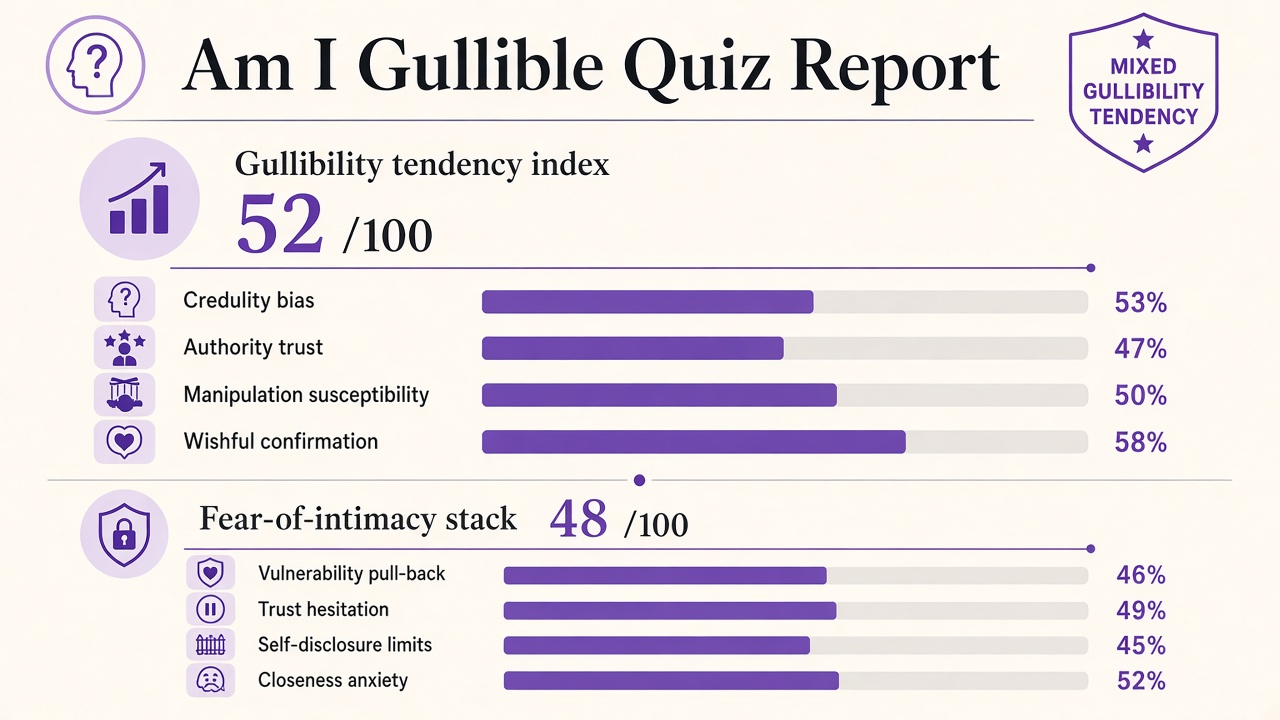
Your gullibility tendency index is the normalized total across all 20 items on a 0 to 100 scale, with reverse scoring on verification and boundary items so higher scores mean more gullibility signals overall. The fear-of-intimacy stack index uses the same answers mapped to vulnerability, trust, disclosure, and closeness anxiety layers where higher stack scores mean more avoidance patterns. Domain bars show endorsement rates so you can see whether credulity, authority trust, pressure susceptibility, or wishful thinking drives your result most.
| Band | Index range | Typical reading |
|---|---|---|
| Lower Gullibility Tendency | 0 to 35 | Fewer gullibility signals; busy weeks or new romance can still spike a few items temporarily |
| Mixed Gullibility Tendency | 36 to 65 | Blend of healthy trust and verification gaps; domain and stack charts show where habits feel strongest |
| Higher Gullibility Tendency | 66 to 100 | Frequent credulity, authority trust, pressure susceptibility, or wishful confirmation on this screener |
What your gullibility tendency report looks like
After all 20 items, you get a gullibility tendency index from 0 to 100, a band label, four gullibility domain bars, and a fear-of-intimacy stack chart with vulnerability pull-back, trust hesitation, self-disclosure limits, and closeness anxiety layers. Percentages reflect how you report your own verification and trust habits, not a verdict on your intelligence.
What this quiz can and cannot tell you
Can tell you
- How often credulity, authority trust, pressure susceptibility, and wishful confirmation patterns showed up in your self-report
- A gullibility tendency index and fear-of-intimacy stack index with domain bars
- Which gullibility domain or intimacy stack layer feels strongest in your current habits
- A starting point for pause-and-verify habits or conversation with a trusted friend
Cannot tell you
- Whether you will fall for the next scam or romance fraud without your own context
- Whether you have cognitive impairment or any clinical diagnosis
- Whether your trust habits are wise or unwise without the specific situation and stakes
- What specific boundaries others want without honest conversation and consumer protection guidance
Gullibility research, verification habits, and the fear-of-intimacy stack
Psychologist Stephen Greenspan published a framework for gullibility in 2009 in the Annals of the New York Academy of Sciences, describing how credulity, social pressure, and situational stress combine to produce costly trust errors. Researchers such as Joseph Forgás and colleagues studied how mood and social influence shape belief updating, while Teunisse, Overman, and colleagues published a Gullibility Scale in 2020 in the Journal of Research in Personality measuring susceptibility to misleading claims and undue influence.
The Quiz Hub built this am I gullible quiz as an original self-report screener inspired by those gullibility themes plus FOIS-style intimacy avoidance layers from Descutner and Thelen (1991), not a reproduction of any single published gullibility scale. Readers often compare it to sibling tools on this site. Our am I cynical quiz screens motive skepticism and trust erosion rather than verification habits. The am I fake quiz measures performance masking and social conformity rather than credulity or scam pressure. The fear of intimacy quiz covers general vulnerability pull-back across closeness desire.
| The Quiz Hub test | What it adds |
|---|---|
| Am I cynical quiz | Motive skepticism and ideal disillusionment, not credulity or authority trust frequency |
| Am I fake quiz | Performance masking and self alienation, not manipulation susceptibility or wishful confirmation |
| Am I entitled quiz | Special treatment and blame shifting, not verification or scam pressure habits |
| Fear of intimacy quiz | General intimacy avoidance across vulnerability and trust, not gullibility tendency |
| How innocent are you quiz | Innocence and sheltered-experience domains, not credulity or scam pressure frequency |
| This gullible quiz | Gullibility tendency index plus fear-of-intimacy stack for credulity, authority trust, pressure, and hope |
Sample item types include frequency ratings such as whether you forwarded a message before verifying it, or whether you ignored warning signs because you wanted a person or opportunity to be real. High credulity bias with high closeness anxiety on the stack often lands in Mixed or Higher Gullibility Tendency bands. Politeness at work with romance hope at home can split domain scores. Read how we review quizzes in our editorial policy or browse more tools on our personality psychology hub.
Am I gullible quiz FAQ
What does the am I gullible quiz measure?
Twenty original frequency items ask how often credulity bias, authority trust, manipulation susceptibility, and wishful confirmation patterns showed up in the past few months. Each item also maps to a fear-of-intimacy stack layer: vulnerability pull-back, trust hesitation, self-disclosure limits, and closeness anxiety. You receive a gullibility tendency index from 0 to 100 where higher scores mean more gullibility signals on this screener, plus a parallel stack index.
Does a higher gullibility tendency index mean I am stupid?
No. On this screener, a higher index means you endorsed more items about believing without checking, trusting badges or crowds, yielding to pressure, or ignoring red flags because you wanted an outcome to be true. Kindness, loneliness, and politeness can raise scores without reflecting intelligence. This quiz cannot diagnose cognitive impairment or any clinical condition.
What is the fear-of-intimacy stack on this quiz?
The fear-of-intimacy stack is a second results chart inspired by FOIS-style intimacy avoidance themes from Descutner and Thelen (1991), adapted to gullibility framing. Each of the 20 items maps to one of four stack layers showing how closeness guarding may pair with quick trust or discomfort pushing back: hiding vulnerability, testing trust, limiting disclosure, or worrying about social risk. Higher stack scores mean more avoidance patterns on these items.
How is this different from the am I cynical quiz?
The am I cynical quiz uses agree-disagree items about motive skepticism, trust erosion, pessimistic expectations, and ideal disillusionment from cynical hostility research themes. This am I gullible quiz uses a past-few-months frequency frame about verification habits, authority trust, scam pressure, and hope-driven denial inspired by gullibility research from Stephen Greenspan (2009) and Teunisse and colleagues (2020).
How is this different from the how innocent are you quiz?
The how innocent are you quiz screens innocence and sheltered-experience themes with a playful self-image frame across seven Likert domains. This gullible quiz focuses on credulity, authority trust, manipulation susceptibility, and wishful confirmation with a fear-of-intimacy stack rather than purity or worldliness labels.
Can this quiz tell me if I will fall for the next scam?
No. The gullibility tendency index describes self-reported verification and trust habits on this abbreviated screener. Mood, loneliness, and new relationships all shape how quickly you believe others. Use consumer protection resources and trusted friends when money or safety is involved, not quiz scores alone.
Who reviewed this content?
Dr. James Whitfield, PhD, reviewed the test framing and result explanations. See our editorial policy for review standards.
Reviewed by