
What this am I fake quiz measures
This am I fake quiz estimates how often inauthentic or mask-heavy habit patterns show up in your self-report. Twenty-two original frequency items group into four domains drawn from humanistic and psychoanalytic themes in Carl Rogers on incongruence between felt experience and self-concept and Karen Horney on the idealized self: performance masking, social conformity facade, omission and half-truths, and self alienation. Each item also maps to a fear-of-intimacy stack layer so you can see whether vulnerability pull-back, trust hesitation, self-disclosure limits, or closeness anxiety rides alongside curated personas. Your inauthenticity index averages these patterns into a 0 to 100 score where higher numbers mean more frequent endorsement.
Performance masking
Polished personas, curated posts, rehearsed small talk, role-playing likability, and fear that unfiltered moods would cost respect.
Social conformity facade
Laughing along, mirroring group opinions, hiding odd tastes, saying you are fine, and agreeing to unwanted plans.
Omission and half-truths
Leaving out unflattering details, softened truths, delayed mistake disclosure, and staying vague about feelings.
Self alienation
Feeling like a stranger after people pleasing, doubting which traits are real, hollow after social wins, and losing your wants without a crowd.
How it works
Three steps from first question to your inauthenticity report with fear-of-intimacy stack. Click Start Quiz to open the interactive quiz in a full-screen modal.
Answer 22 frequency items
Rate how often each habit shows up, from Never to Almost always. You click Next after each answer; nothing auto-advances.
Items map to inauthenticity domains and intimacy stack
Your answers accumulate percentages for performance masking, social conformity facade, omission habits, and self alienation, plus four fear-of-intimacy stack layers.
View band, domain bars, and stack chart
Results show Lower, Mixed, or Higher Inauthenticity Signals with domain bars, stack layers, and reflection prompts.
Take the am I fake quiz
Rate 22 statements about masking, conformity, omission habits, and self alienation. Your answers produce an inauthenticity index from 0 to 100, four domain scores, a fear-of-intimacy stack chart, and a band label for reflection.
Opens in a focused modal. No account required. Results stay on screen.
What your inauthenticity result means
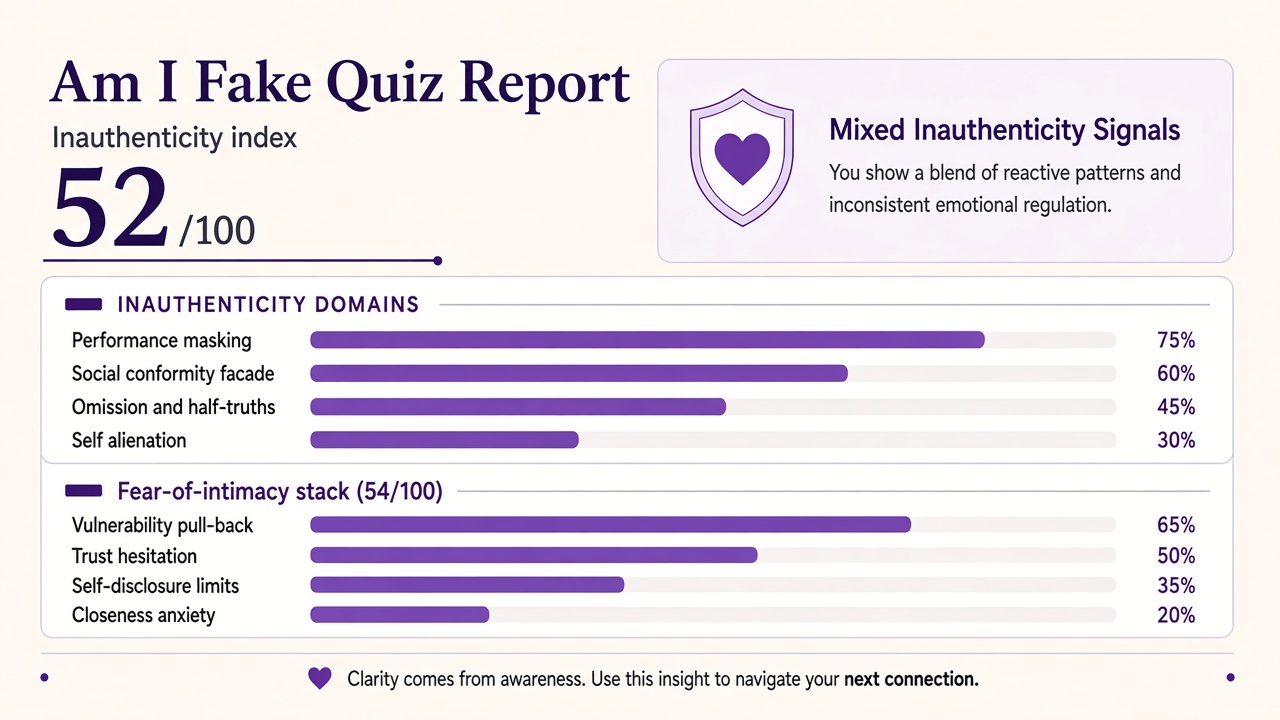
Your inauthenticity index is the normalized total across all 22 items on a 0 to 100 scale. Higher scores mean more frequent endorsement of performance masking, conformity facades, omission habits, and self alienation items on this screener. Domain bars show endorsement rates so you can see whether curated personas, group mirroring, half-truths, or feeling hollow drives your result most. The fear-of-intimacy stack chart shows parallel layers for vulnerability pull-back, trust hesitation, self-disclosure limits, and closeness anxiety when mask-heavy habits include guarded closeness.
| Band | Index range | Typical reading |
|---|---|---|
| Lower Inauthenticity Signals | 0 to 35 | Fewer mask-heavy habit signals; normal social polish can still score here |
| Mixed Inauthenticity Signals | 36 to 65 | Blend of ordinary adaptation and recurring masking or self alienation; domain and stack charts show where you struggle most |
| Higher Inauthenticity Signals | 66 to 100 | Frequent performance masking, conformity facades, omission habits, or hollow-after-socializing feelings; check stack if closeness feels guarded too |
What your fake quiz report looks like
After all 22 items, you get an inauthenticity index from 0 to 100, a band label, four domain bars for performance masking, social conformity facade, omission and half-truths, and self alienation, plus a fear-of-intimacy stack chart with vulnerability, trust, disclosure, and closeness anxiety layers.
What this quiz can and cannot tell you
Can tell you
- How often inauthentic or mask-heavy habit patterns showed up in this self-report screener
- An inauthenticity index and four domain bars for masking, conformity, omission, and self alienation
- A fear-of-intimacy stack showing which closeness-guarding layer feels strongest
- A starting point for therapy, coaching, or comparing with sibling tests
Cannot tell you
- Whether you are permanently fake or a fraud
- Whether masking is rooted in trauma, neurodivergence, or cultural code-switching without professional context
- Whether partners or friends agree with your self-view
- What treatment you need without licensed professional guidance
Masking, congruence, and intimacy guarding
People search am I fake when they wonder whether they perform likability, hide real opinions, or feel hollow after everyone seemed impressed. Psychologist Carl Rogers described incongruence as a gap between organismic experience and the self you present. Karen Horney wrote about the idealized self that crowds out the real self when approval feels unsafe. Bren Brown popularized authenticity language for adults who are tired of armor that once kept them safe.
The Quiz Hub built this am I fake quiz as an original self-report screener inspired by those themes plus FOIS-style intimacy avoidance layers from Descutner and Thelen (1991), not a reproduction of any single published instrument. Readers often compare it to sibling tools on this site. Our people pleaser quiz screens approval seeking and boundary strain across relationships broadly. The fear of intimacy quiz measures general vulnerability pull-back across closeness, not performance masking or self alienation. The am I insecure quiz screens self-worth and comparison habits rather than curated personas.
| The Quiz Hub test | What it adds |
|---|---|
| People pleaser quiz | Approval seeking and conflict avoidance across relationships, without self-alienation or omission domains |
| Fear of intimacy quiz | General intimacy avoidance across vulnerability and trust, not performance masking or conformity facades |
| Am I insecure quiz | Self-worth and comparison screener without mask-heavy social performance framing |
| Am I immature quiz | Regulation gaps and accountability habits, not curated personas or self alienation |
| Self-sabotage quiz | Undermining success and relationship patterns, not everyday social masking habits |
| This am I fake quiz | Inauthenticity index plus fear-of-intimacy stack for performance masking, social conformity facade, omission habits, and self alienation |
Sample item types include frequency ratings such as whether you curate posts to look happier than you feel, or whether you mirror opinions in a group until you are not sure what you actually think. High performance masking with high self-disclosure limits on the stack often lands in Mixed or Higher Inauthenticity Signals bands. Strong authenticity on reverse-scored items with selective conformity can score in Lower Inauthenticity Signals even when friends still want more honesty after conflict. Read how we review quizzes in our editorial policy or browse more tools on our personality psychology hub.
Am I fake quiz FAQ
What does being fake mean in everyday life?
Psychologists such as Carl Rogers describe inauthenticity as a gap between how you feel inside and the persona you show others. Karen Horney wrote about the idealized self that crowds out the real self when approval feels unsafe. This am I fake quiz measures self-reported frequency on those themes plus a parallel fear-of-intimacy stack.
What does this am I fake quiz measure?
Twenty-two original frequency items ask how often you notice performance masking, social conformity facades, omission habits, or self alienation. Scores map to four inauthenticity domains plus a parallel fear-of-intimacy stack with vulnerability pull-back, trust hesitation, self-disclosure limits, and closeness anxiety layers. You receive an inauthenticity index from 0 to 100 where higher scores mean more mask-heavy habit signals on this screener, plus a stack index for intimacy guarding patterns.
What is the fear-of-intimacy stack on this quiz?
The fear-of-intimacy stack is a second results chart inspired by FOIS-style intimacy avoidance themes from Descutner and Thelen (1991), adapted to inauthenticity framing. Each of the 22 items also maps to one of four stack layers: vulnerability pull-back, trust hesitation, self-disclosure limits, and closeness anxiety. The stack index summarizes how often guarded closeness rides alongside curated personas or half-truths.
How is this different from the people pleaser quiz?
The am I a people pleaser quiz uses 22 frequency items focused on approval seeking, conflict avoidance, self-neglect, and guilt about boundaries without self-alienation domains. This am I fake quiz uses how-often frequency items focused on performance masking, conformity facades, omission habits, and feeling like a stranger to yourself, plus a dual-chart report with intimacy stack layers.
Can this quiz tell me if I am fake forever?
No. Masking habits can change with feedback, therapy, and safer relationships. This screener describes pattern signals you notice right now, not a permanent label or diagnosis. Treat results as a starting point for reflection, not proof of character.
Who reviewed this content?
Dr. James Whitfield, PhD, reviewed the test framing and result explanations. See our editorial policy for review standards.
Reviewed by
