
What this job-at-risk signal quiz measures
This am I getting fired quiz estimates how often workplace pattern signals that employees associate with termination risk show up in your self-report. Twenty-two original frequency items group into four domains drawn from organizational psychology research on job insecurity by Johnny Hellgren and Magnus Sverke (2002) and workforce reduction studies by Wayne Cascio (1993): manager feedback signals, exclusion and visibility, performance scrutiny, and role uncertainty. Each item also maps to a fear-of-intimacy stack layer so you can see whether vulnerability pull-back, trust hesitation, self-disclosure limits, or closeness anxiety rides alongside job stress. Your job-at-risk signal index averages these patterns into a 0 to 100 score where higher numbers mean more frequent signals on this screener.
Manager feedback signals
Vague warnings, written documentation, praise drying up, and unfavorable comparisons in check-ins.
Exclusion and visibility
Skipped meetings, reassigned projects, email loops you no longer lead, and replacement hiring worries.
Performance scrutiny
Amplified mistakes, shifting targets, dread before submitting work, and unclear success standards.
Role uncertainty
Layoff rumors, shrinking responsibilities, elimination fears, and scanning leadership announcements.
How it works
Three steps from first question to your job-at-risk report with fear-of-intimacy stack. Click Start Quiz to open the interactive quiz in a full-screen modal.
Answer 22 frequency items
Rate how often each job security pattern shows up when you think about work lately, from Never to Almost always. You click Next after each answer; nothing auto-advances.
Items map to job domains and intimacy stack
Your answers accumulate percentages for manager feedback, exclusion visibility, performance scrutiny, and role uncertainty, plus four fear-of-intimacy stack layers.
View band, domain bars, and stack chart
Results show Lower, Mixed, or Higher Job-At-Risk Signals with domain bars, stack layers, and reflection prompts. Higher bands include crisis resources for overwhelming anxiety.
Take the am I getting fired quiz
Rate 22 statements about manager red flags, meeting exclusion, scrutiny spikes, and restructuring rumors. Your answers produce a job-at-risk signal index from 0 to 100, four domain scores, a fear-of-intimacy stack chart, and a band label for reflection or career planning.
Opens in a focused modal. No account required. Results stay on screen.
What your job-at-risk signal result means
Your job-at-risk signal index is the normalized total across all 22 items on a 0 to 100 scale. Higher scores mean more frequent manager feedback red flags, exclusion cues, scrutiny spikes, or role uncertainty items on this screener. Domain bars show endorsement rates so you can see whether vague warnings, meeting exclusion, shifting targets, or layoff rumor scanning drives your result most. The fear-of-intimacy stack chart shows parallel layers for vulnerability pull-back, trust hesitation, self-disclosure limits, and closeness anxiety when job stress shapes how you handle bonds outside work.
| Band | Index range | Typical reading |
|---|---|---|
| Lower Job-At-Risk Signals | 0 to 35 | Fewer termination-risk pattern signals; one tough review or reorg can still spike items temporarily |
| Mixed Job-At-Risk Signals | 36 to 65 | Blend of normal workplace stress and cues worth tracking; domain and stack charts show where signals feel strongest |
| Higher Job-At-Risk Signals | 66 to 100 | Frequent manager red flags, exclusion, scrutiny, or restructuring rumors on this screener; action planning may help |
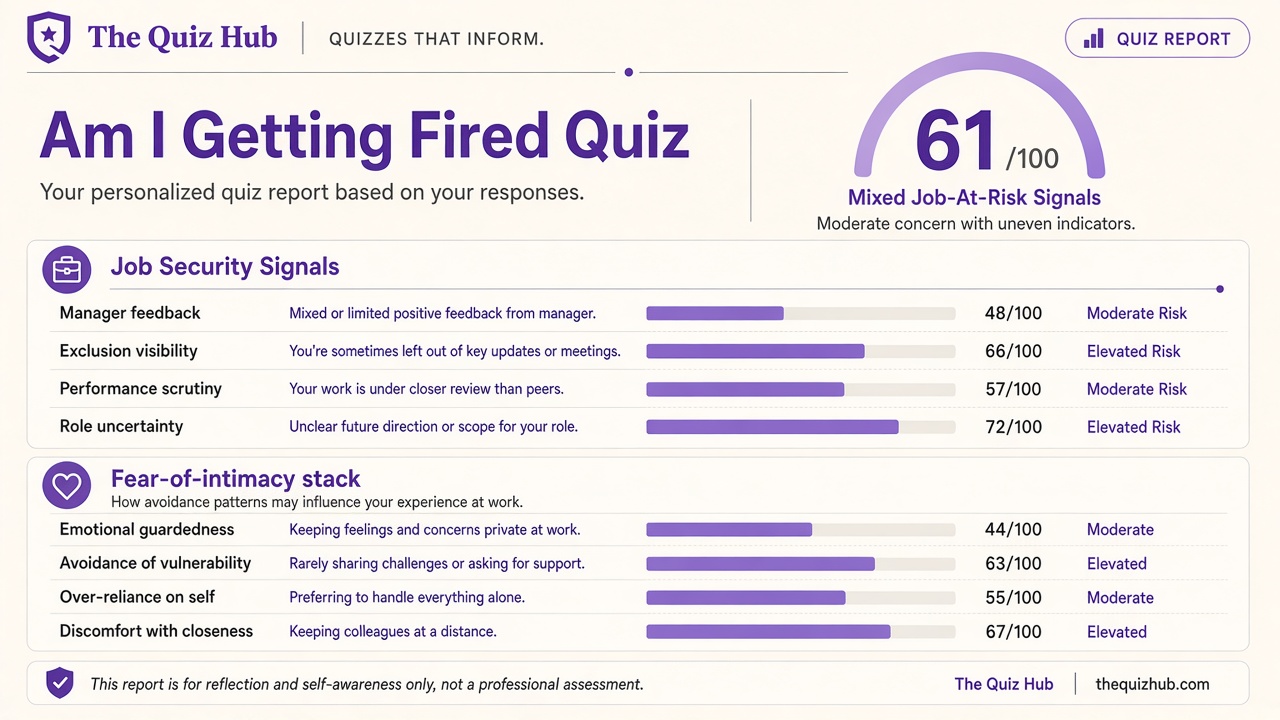
What your getting fired report looks like
After all 22 items, you get a job-at-risk signal index from 0 to 100, a band label, four domain bars for manager feedback, exclusion visibility, performance scrutiny, and role uncertainty, plus a fear-of-intimacy stack chart with vulnerability, trust, disclosure, and closeness anxiety layers.
What this quiz can and cannot tell you
Can tell you
- How often job-at-risk pattern signals showed up in this self-report screener
- A job-at-risk signal index and four domain bars for feedback, exclusion, scrutiny, and uncertainty
- A fear-of-intimacy stack showing which closeness-guarding layer feels strongest alongside work stress
- A starting point for HR conversations, career planning, or therapy about job anxiety
Cannot tell you
- Whether HR has already decided to terminate you without their official communication
- Whether your manager is toxic, fair, or building a lawful paper trail without full context
- Whether you should quit, sue, or stay without legal or career advice tailored to your situation
- What severance, PIP outcomes, or timeline you will face without company-specific facts
Job insecurity cues, manager feedback, and the intimacy stack
People search am I getting fired when a manager goes cold, meetings shrink, or restructuring emails multiply. Organizational researchers Johnny Hellgren and Magnus Sverke reviewed job insecurity literature in 2002, showing that perceived threat to continued employment predicts stress, sleep loss, and withdrawal even before any layoff announcement. Wayne Cascio studied workforce reductions in the 1990s, documenting how survivors and targets alike scan leadership behavior for clues about who is safe. Those research threads inform everyday language about vague warnings, documentation trails, and visibility shifts that feel like pre-firing signals.
The Quiz Hub built this am I getting fired quiz as an original self-report screener inspired by job insecurity themes plus FOIS-style intimacy avoidance layers from Descutner and Thelen (1991), not a reproduction of any published HR instrument. Readers often compare it to sibling tools on this site. Our is my boss toxic quiz screens disrespect and retaliation patterns under harsh leadership. The am I burnt out quiz measures exhaustion, cynicism, and efficacy loss inspired by Maslach burnout inventory themes. The am I a workaholic quiz screens overwork habits rather than termination-risk cues.
| The Quiz Hub test | What it adds |
|---|---|
| Is my boss toxic quiz | Disrespect, micromanagement, favoritism, and retaliation fear domains, not termination-risk cues alone |
| Am I burnt out quiz | Exhaustion and cynicism screener, not manager warning or meeting exclusion items |
| Am I a workaholic quiz | Overwork and boundary blur habits, not layoff rumor scanning or PIP documentation |
| Am I lazy quiz | Procrastination and motivation deferral domains, not role uncertainty signals |
| Fear of intimacy quiz | General intimacy avoidance across vulnerability and trust, not job-at-risk domains |
| This getting fired quiz | Job-at-risk signal index plus fear-of-intimacy stack for feedback, exclusion, scrutiny, and uncertainty |
Sample item types include frequency ratings such as whether you get left off meeting invites you usually attend, or whether performance targets shift mid-quarter without discussion. High manager feedback signals with high trust hesitation on the stack often land in Mixed Job-At-Risk Signals bands when you want clarity but fear asking directly. Strong exclusion visibility with lower role uncertainty can split domain scores when one team change feels personal but company-wide cuts are not rumored yet. Read how we review quizzes in our editorial policy or browse more tools on our personality psychology hub.
Am I getting fired quiz FAQ
What are signs you might be getting fired?
Common workplace pattern signals include vague manager warnings, written documentation, meeting exclusion, reassigned projects, shifting performance targets, and layoff rumors tied to your department. One bad week does not prove termination is coming. This am I getting fired quiz measures how often those pattern signals show up in your self-report, plus a fear-of-intimacy stack chart showing how job stress may shape closeness habits at home. It is not legal advice or proof of HR plans.
What does this am I getting fired quiz measure?
Twenty-two original frequency items ask how often you notice manager feedback red flags, exclusion and visibility cues, performance scrutiny spikes, and role uncertainty signals when you think about job security. Each item also maps to a fear-of-intimacy stack layer: vulnerability pull-back, trust hesitation, self-disclosure limits, and closeness anxiety. You receive a job-at-risk signal index from 0 to 100 and a band from Lower through Higher Job-At-Risk Signals.
What is the fear-of-intimacy stack on this quiz?
The fear-of-intimacy stack is a second results chart inspired by FOIS-style intimacy avoidance themes from Descutner and Thelen (1991), adapted to job insecurity framing. Each of the 22 items maps to one of four stack layers showing how workplace stress may connect to adult closeness habits: hiding vulnerability, testing trust, limiting disclosure, or panicking when bonds deepen. The stack index summarizes those layers alongside the job-at-risk signal index.
How is this different from the is my boss toxic quiz?
The is my boss toxic quiz screens disrespect, micromanagement, favoritism, and retaliation fear under harsh leadership. This am I getting fired quiz focuses on termination-risk pattern signals: vague warnings, meeting exclusion, scrutiny spikes, and restructuring rumors. Both include a parallel fear-of-intimacy stack, but the primary domains target job security cues rather than toxic leadership behavior alone.
Can this quiz tell me if I will be fired?
No. The job-at-risk signal index describes self-reported pattern signals on this abbreviated screener. Busy seasons, new managers, and company reorgs can raise scores without a termination plan. Only HR, leadership, or employment attorneys can confirm personnel decisions through proper channels. Online quizzes cannot predict firing dates, confirm PIP outcomes, or replace your judgment about whether to stay or leave.
What should I do if I get a higher job-at-risk band?
Save written feedback, ask your manager for concrete success criteria, update your resume, and talk with HR, a career coach, or an employment attorney if documentation or PIP language appears. If anxiety or hopelessness feels overwhelming, call or text 988 (US) or your local crisis line.
Who reviewed this content?
Dr. James Whitfield, PhD, reviewed the test framing and result explanations. See our editorial policy for review standards.
Reviewed by
