What this am I dumb test measures
This am I dumb test screens six self-talk domains tied to the fear of being seen as unintelligent. Each domain uses original agree-disagree statements. Higher scores mean kinder inner language on these items, not higher IQ. Words like dumb describe shame habits, not ability.
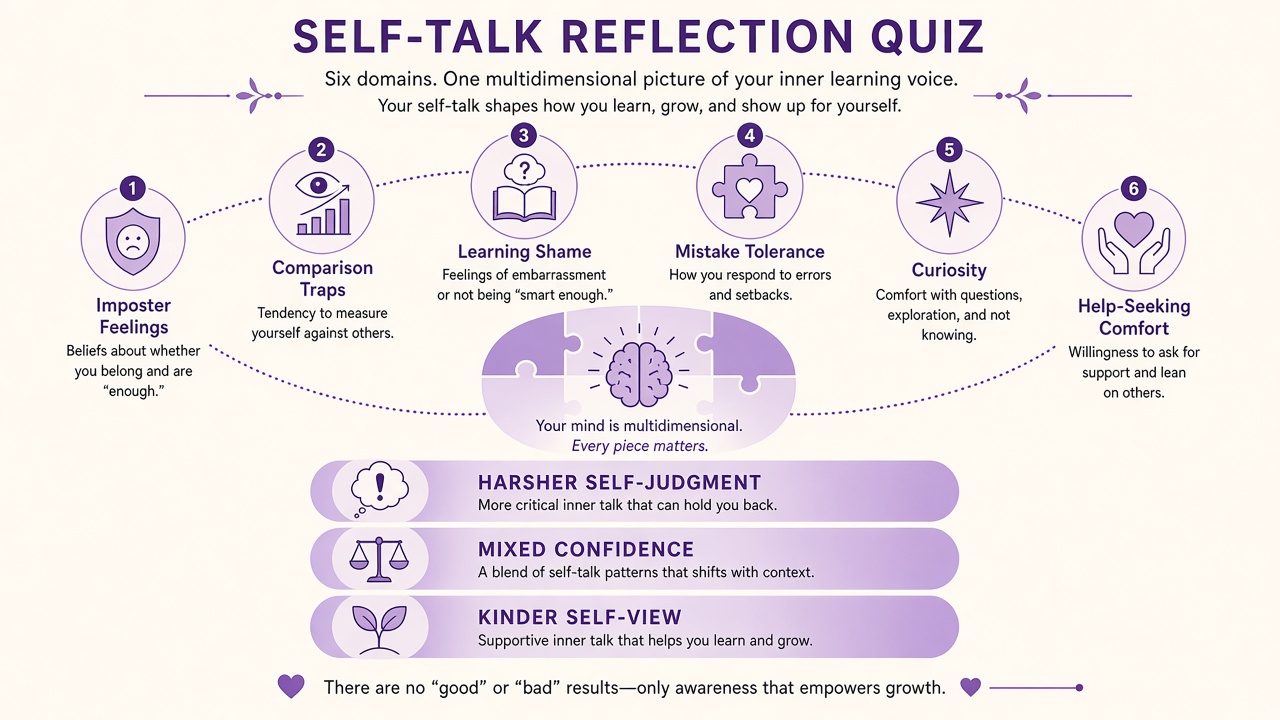
Imposter feelings
Feeling like a fraud despite praise, wins, or visible competence.
Comparison traps
Measuring your worth against curated wins or highlight reels from peers.
Learning shame
Treating not-knowing as a character flaw instead of a normal learning stage.
Mistake tolerance
Recovering from errors without name-calling or global self-attack.
Curiosity
Staying interested in hard topics when progress is slow or invisible.
Help-seeking comfort
Asking questions or requesting support before shame snowballs.
How it works
Three steps from first statement to your self-talk band. Click Start Test to open the interactive quiz in a full-screen modal.
Answer 24 statements
Rate how much you agree with each item on a five-point scale from strongly disagree to strongly agree. There is no timer and no auto-advance between items.
Items map to six domains
Your answers accumulate scores across imposter feelings, comparison, learning shame, mistake tolerance, curiosity, and help-seeking. Some items are reverse-coded so that agreeing with harsh self-labels lowers your score.
View index and domain chart
Results show a self-talk reflection index from 0 to 100, a band label, six domain bars ranked lowest to highest, and suggested next steps.
Take the am I dumb test
Rate 24 statements about how you talk to yourself when learning, comparing, or making mistakes. Your answers produce a self-talk reflection index and one of three bands with a six-domain breakdown chart.
Opens in a focused modal. No account required. Results stay on screen.
What your result means
Your self-talk reflection index is the sum of scored items normalized to 0 through 100. Higher percentages mean more agreement with kinder self-talk items and less agreement with harsh or shame-driven items. The band label groups that score into plain-language stages for reflection today.
| Self-talk band | Percentage range | Typical reading |
|---|---|---|
| Harsher Self-Judgment | 0 to 35% | More imposter spirals, comparison shame, or attack after errors on these items |
| Mixed Confidence | 36 to 65% | Blend of kind and harsh self-talk; domain chart shows where friction sits |
| Kinder Self-View | 66 to 100% | Steadier inner language when learning or asking for help; one domain may still lag |
Six domains of self-talk about intelligence
The diagram below shows how domain scores feed an overall self-talk reflection index. Strong curiosity with weak help-seeking comfort, for example, can still land you in a Mixed Confidence band until asking for support feels safer.
What this test can and cannot tell you
Can tell you
- How your self-talk habits cluster across six shame and curiosity domains
- A band label and percentage for reflection today
- Which domain bar scores lowest and may deserve attention first
- A starting point before therapy, study groups, or confidence work
Cannot tell you
- Whether you are dumb, stupid, or lacking intelligence
- Your IQ score, GPA, or learning disability status
- Whether you should drop classes, jobs, or hobbies
- How others objectively judge your ability
Self-talk, intelligence myths, and online reflection quizzes
Psychologist Carol Dweck's research on mindset shows that calling ability fixed ("I am dumb") predicts giving up sooner than treating skill as developable. The American Psychological Association notes that intelligence includes many aptitudes measured with validated tools, not single insults typed into search bars. This am I dumb test borrows that framing with twenty-four original statements about inner language when you learn, compare, or err.
It is not an IQ test, not a learning disability screener, and not comparable to WAIS or WISC scores. For puzzle warm-up with explicit limits, take our live IQ test. For emotional skill context that overlaps with shame after conflict, take our live EQ test. For confidence under observation, take our live confidence test. For mental engagement habits, take our live brain test.
Sample item: agreeing that you treat errors as data raises your mistake tolerance domain score. Agreeing that needing help proves you are not smart enough lowers your help-seeking score on a reverse-coded item. Social media comparison and sleep loss often spike harsh self-talk temporarily. Read how we review quizzes in our editorial policy.
Am I dumb test FAQ
Does this am I dumb test measure my IQ?
No. This quiz measures self-talk habits such as imposter feelings, comparison traps, learning shame, mistake tolerance, curiosity, and help-seeking comfort. It produces a self-talk reflection index from 0 to 100 with Harsher Self-Judgment, Mixed Confidence, or Kinder Self-View bands. It does not report IQ, academic ability, or any clinical diagnosis.
Why avoid calling myself dumb or stupid?
Labels like dumb or stupid flatten multidimensional intelligence into a single insult. Psychologists treat cognitive ability as many skills that develop at different speeds. This test reframes the search phrase into a self-talk snapshot so you can notice inner language without treating the label as fact.
How long does the am I dumb test take?
Most people finish in about six minutes. There are twenty-four agree-disagree statements on a five-point scale. You can pause and return in the same browser session.
What do the three self-talk bands mean?
Harsher Self-Judgment (0 to 35%) suggests sharper self-criticism on these items. Mixed Confidence (36 to 65%) shows a blend of kind and harsh self-talk across domains. Kinder Self-View (66 to 100%) suggests steadier inner language when learning, comparing, or asking for help today.
Should I take the IQ test instead?
Use both for different goals. This am I dumb test maps self-talk, not puzzle ability. Our IQ test offers recreational logic practice with an explicit not-a-real-IQ-score limit. Pair them when you want reflection on inner language plus a warm-up on patterns, not a verdict on worth.
Who reviewed this content?
Dr. James Whitfield, PhD, reviewed the test framing and result explanations. See our editorial policy for review standards.
Reviewed by