What this double jointed quiz measures
This am I double jointed quiz estimates how often hypermobile or bendy joint habits show up in how you report using your body. Twenty original frequency items group into four domains inspired by rheumatologist Peter Beighton on joint hypermobility screening and clinician Roger Grahame on benign versus syndromic hypermobility: joint bending tricks, flexibility range, show-off performance, and body awareness strain. Each item also maps to a fear-of-intimacy stack layer so you can see whether vulnerability pull-back, trust hesitation, self-disclosure limits, or closeness anxiety pairs with tricks you hide or post online. Your hypermobility trait index averages these patterns into a 0 to 100 score where higher numbers mean more double-jointed-style habits on this screener.
Joint bending tricks
Thumb to wrist, hyperextended elbows or knees, flat finger bends, and joints that bend farther after popping.
Flexibility range
Floor palm touches, splits, backbends, leg-behind-head stretches, and deep range without long training.
Show-off performance
Party demonstrations, being called double jointed, posted clips, and dare-winning flexibility contests.
Body awareness strain
Pain after over-bending, subluxation slips, frequent cracking, injury warnings, and connective-tissue curiosity.
How it works
Three steps from first question to your hypermobility report with fear-of-intimacy stack. Click Start Quiz to open the interactive quiz in a full-screen modal.
Answer 20 frequency items
Rate how often each bendy habit showed up in your life, from Never to Almost always. You click Next after each answer; nothing auto-advances.
Items map to hypermobility domains and intimacy stack
Your answers accumulate percentages for joint bending tricks, flexibility range, show-off performance, and body awareness strain, plus four fear-of-intimacy stack layers.
View band and dual charts
Results show Lower, Mixed, or Higher Hypermobility Signals with domain bars and a fear-of-intimacy stack chart. Higher index means more bendy habits on this screener.
Take the am I double jointed quiz
Rate 20 statements about thumb bends, splits, party tricks, and joint strain. Your answers produce a hypermobility trait index from 0 to 100, a fear-of-intimacy stack index, four domain scores, and a band label for group-chat reflection or honest body talks.
Opens in a focused modal. No account required. Results stay on screen.
What your hypermobility result means
Your hypermobility trait index is the normalized total across all 20 items on a 0 to 100 scale, with reverse scoring on stiffness and avoidance items so higher scores mean more bendy habits overall. The fear-of-intimacy stack index uses the same answers mapped to vulnerability, trust, disclosure, and closeness anxiety layers where higher stack scores mean more avoidance patterns. Domain bars show endorsement rates so you can see whether joint bending tricks, flexibility range, show-off performance, or body awareness strain drives your result most.
| Band | Index range | Typical reading |
|---|---|---|
| Lower Hypermobility Signals | 0 to 35 | Fewer bendy tricks on this screener; one impressive stretch can still spike a few items |
| Mixed Hypermobility Signals | 36 to 65 | Blend of average joints and party tricks; domain and stack charts show where flexibility feels strongest |
| Higher Hypermobility Signals | 66 to 100 | Frequent thumb bends, splits, posted clips, or joint slips that can read as double jointed on this screener |
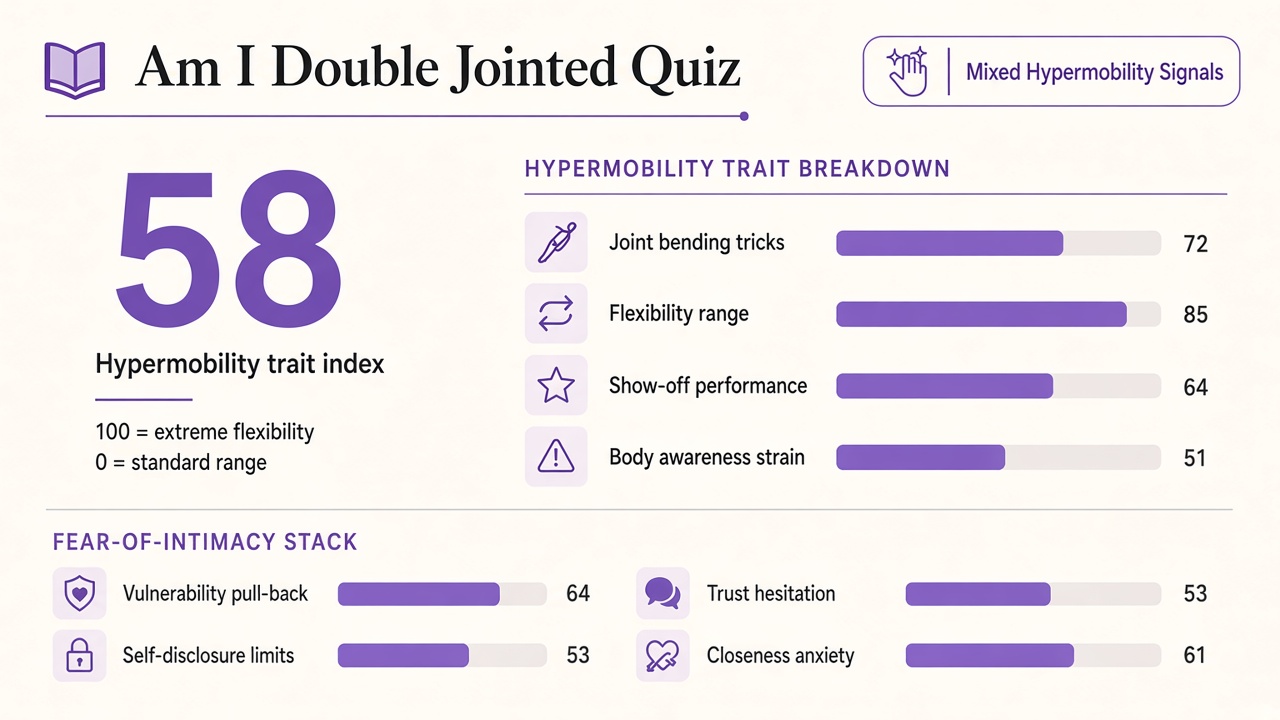
What your double jointed report looks like
After all 20 items, you get a hypermobility trait index from 0 to 100, a band label, four hypermobility domain bars, and a fear-of-intimacy stack chart with vulnerability pull-back, trust hesitation, self-disclosure limits, and closeness anxiety layers. Percentages reflect how you report joint habits, not a clinical Beighton score.
What this quiz can and cannot tell you
Can tell you
- How often bendy tricks, deep stretches, party demos, or joint strain showed up in your self-report
- A hypermobility trait index and fear-of-intimacy stack index with domain bars
- Which hypermobility domain or intimacy stack layer feels strongest in your current habits
- A starting point for noticing which joints need protection or whether clinical screening would help
Cannot tell you
- Whether you have hypermobile Ehlers-Danlos syndrome or any connective-tissue disorder
- Your formal Beighton score without a trained examiner
- Whether every trick is safe without physical therapy or sports medicine input
- What a rheumatologist would find without a full clinical workup
Party tricks, Beighton screening, and the fear-of-intimacy stack
Rheumatologist Peter Beighton popularized a nine-point joint hypermobility screen still used in clinics today. Clinician Roger Grahame distinguished benign joint hypermobility from syndromic forms where fatigue, bruising, and stretchy skin cluster with loose joints. TikTok and sleepover culture turned thumb-to-wrist bends into a casual identity marker long before anyone mentions Brighton criteria or genetic testing.
The Quiz Hub built this am I double jointed quiz as an original self-report screener inspired by those hypermobility themes plus FOIS-style intimacy avoidance layers from Descutner and Thelen (1991), not a reproduction of the Beighton score or any single published scale. Readers often compare it to sibling tools on this site. Our am I ambidextrous quiz screens hand dexterity and cross-lateral motor habits rather than joint range. The am I athletic quiz measures sports confidence and training habits rather than party tricks. The am I a hypochondriac quiz screens body symptom checking rather than flexibility demonstrations.
| The Quiz Hub test | What it adds |
|---|---|
| Am I ambidextrous quiz | Hand dexterity bias and cross-lateral habits, not thumb bends or splits |
| Am I athletic quiz | Sports confidence and training habits, not hyperextended joint tricks |
| Am I a hypochondriac quiz | Health anxiety and body checking, not flexibility party tricks |
| Am I lazy quiz | Task procrastination and motivation waiting, not joint range |
| Fear of intimacy quiz | General intimacy avoidance across vulnerability and trust, not bendy habit framing |
| This double jointed quiz | Hypermobility trait index plus fear-of-intimacy stack for joint tricks, flexibility range, show-off performance, and body strain |
Sample item types include frequency ratings such as whether you hyperextended your elbows past a straight line when locking your arms, or whether you demonstrated a bendy trick at a party or group chat video. High show-off performance with high self-disclosure limits on the stack often lands in Mixed or Higher Hypermobility Signals bands. One friend calling you rubber-boned can raise performance items without confirming syndromic hypermobility. Read how we review quizzes in our editorial policy or browse more tools on our fun and novelty hub.
Am I double jointed quiz FAQ
What does the am I double jointed quiz measure?
Twenty original frequency items ask how often joint bending tricks, deep flexibility range, show-off performance, and body awareness strain patterns show up in how you report using your body. Each item also maps to a fear-of-intimacy stack layer: vulnerability pull-back, trust hesitation, self-disclosure limits, and closeness anxiety. You receive a hypermobility trait index from 0 to 100 where higher scores mean more bendy or double-jointed-style habits on this screener, plus a parallel stack index.
Does a higher hypermobility trait index mean I have hypermobile Ehlers-Danlos syndrome?
No. On this screener, a higher index means you endorsed more thumb-to-wrist bends, splits, party demonstrations, or joint slip items. Clinical hypermobility syndromes require a Beighton score, family history review, and connective-tissue signs assessed by a licensed clinician. This quiz cannot diagnose Ehlers-Danlos syndrome or any other medical condition.
What is the fear-of-intimacy stack on this quiz?
The fear-of-intimacy stack is a second results chart inspired by FOIS-style intimacy avoidance themes from Descutner and Thelen (1991), adapted to hypermobility framing. Each of the 20 items maps to one of four stack layers showing how closeness guarding may pair with bendy tricks you hide, post, or downplay: hiding vulnerability, testing trust, limiting disclosure, or worrying about being too close. Higher stack scores mean more avoidance patterns on these items.
How is this different from the am I ambidextrous quiz?
The am I ambidextrous quiz uses frequency items about off-hand fluency, hand switching, and cross-lateral motor habits with a hand dexterity bias index. This am I double jointed quiz focuses on joint range, party tricks, flexibility stretches, and strain awareness with a parallel fear-of-intimacy stack chart in one report.
How is this different from the am I athletic quiz?
The am I athletic quiz uses frequency items about sports confidence, training habits, and physical activity enjoyment with an athletic habit index. This double jointed quiz focuses on hyperextended joints, splits, posted flexibility clips, and subluxation curiosity rather than gym or team-sport habits.
Can this quiz tell me my Beighton score?
No. The hypermobility trait index describes self-reported bendy habits on this abbreviated screener. A clinical Beighton score uses nine specific joint tests performed by a trained examiner. Only a licensed clinician can assign a formal Beighton or Brighton criteria assessment.
Who reviewed this content?
Dr. James Whitfield, PhD, reviewed the test framing and result explanations. See our editorial policy for review standards.
Reviewed by