
What this ambidextrous quiz measures
This am I ambidextrous quiz estimates how often mixed-hand and cross-dominant patterns show up in how you report using your hands for everyday tasks. Twenty original frequency items group into four domains drawn from handedness research and motor habit self-report: non-dominant fluency, hand switching, bilateral coordination, and cross-lateral habits. Each item also maps to a fear-of-intimacy stack layer so you can see whether vulnerability pull-back, trust hesitation, self-disclosure limits, or closeness anxiety pairs with guarded motor risk-taking. Your hand dexterity bias index averages these patterns into a 0 to 100 score where higher numbers mean more ambidextrous-style habits on this screener.
Non-dominant fluency
Off-hand door handles, brushing teeth, opening jars, and catching objects with whichever hand is closer.
Hand switching
Alternating mid-chore, practicing hobbies with the off hand, and passing tools between hands without reset pauses.
Bilateral coordination
Equal two-handed typing, chopping, steering, and catch-or-drum hobbies without a weak-side freeze.
Cross-lateral habits
Writing with one hand and throwing with the other, flexible mouse or scissors side, and self-describing as mixed-handed.
How it works
Three steps from first question to your hand dexterity report with fear-of-intimacy stack. Click Start Quiz to open the interactive quiz in a full-screen modal.
Answer 20 frequency items
Rate how often each hand habit shows up in everyday tasks, from Never to Almost always. You click Next after each answer; nothing auto-advances.
Items map to dexterity domains and intimacy stack
Your answers accumulate percentages for non-dominant fluency, hand switching, bilateral coordination, and cross-lateral habits, plus four fear-of-intimacy stack layers.
View band and dual charts
Results show Lower, Mixed, or Higher Ambidextrous Pull with domain bars and a fear-of-intimacy stack chart. Higher index means more mixed-hand habits on this screener.
Take the am I ambidextrous quiz
Rate 20 statements about everyday hand habits and mixed-handed comfort. Your answers produce a hand dexterity bias index from 0 to 100, a fear-of-intimacy stack index, four domain scores, and a band label for reflection or occupational therapy conversation.
Opens in a focused modal. No account required. Results stay on screen.
What your hand dexterity result means
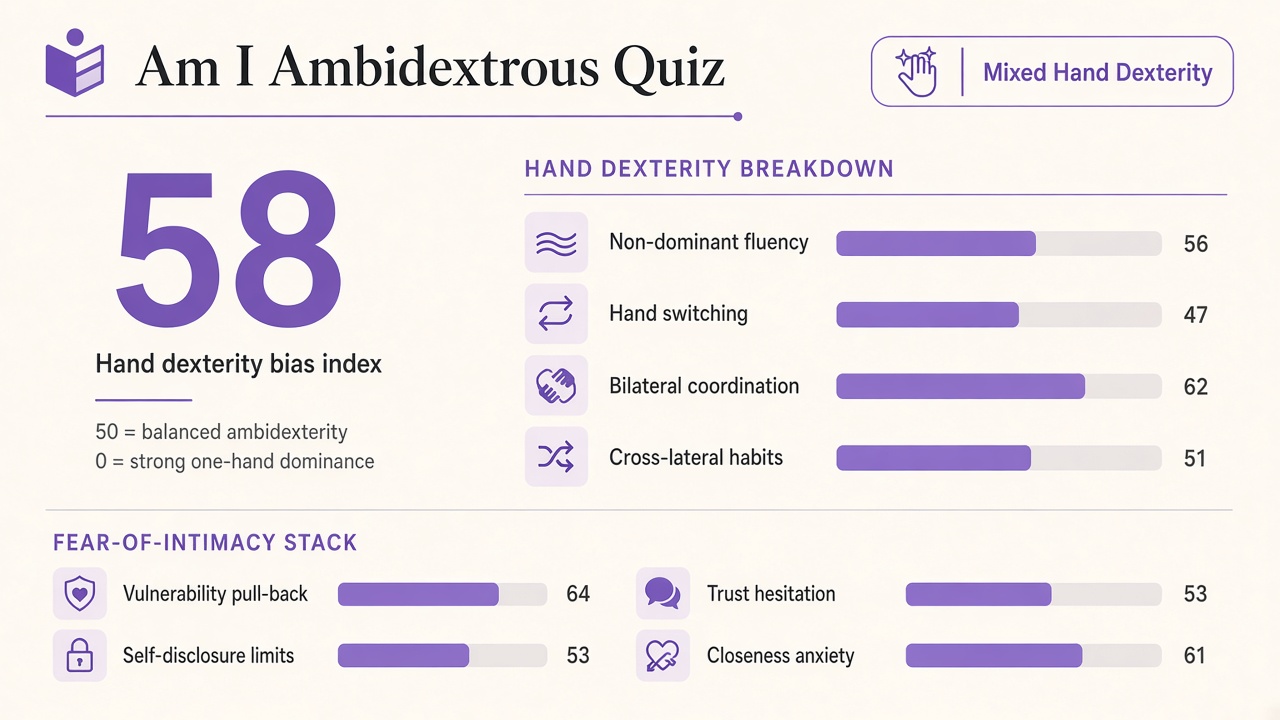
Your hand dexterity bias index is the normalized total across all 20 items on a 0 to 100 scale, with reverse scoring on dominant-only items so higher scores mean more mixed-hand or cross-dominant habits overall. The fear-of-intimacy stack index uses the same answers mapped to vulnerability, trust, disclosure, and closeness anxiety layers where higher stack scores mean more avoidance patterns. Domain bars show endorsement rates so you can see whether non-dominant fluency, hand switching, bilateral coordination, or cross-lateral habits drives your result most.
| Band | Index range | Typical reading |
|---|---|---|
| Lower Ambidextrous Pull | 0 to 35 | Stronger single-hand dominance; injury or new hobbies can still spike mixed-hand scores temporarily |
| Mixed Hand Dexterity | 36 to 65 | Blend of dominant-hand habits and cross-dominant comfort; domain and stack charts show where guarded risk-taking shows up |
| Higher Ambidextrous Pull | 66 to 100 | Frequent off-hand fluency, hand switching, bilateral balance, or cross-lateral habits on this screener |
What your ambidextrous report looks like
After all 20 items, you get a hand dexterity bias index from 0 to 100, a band label, four dexterity domain bars, and a fear-of-intimacy stack chart with vulnerability pull-back, trust hesitation, self-disclosure limits, and closeness anxiety layers. Percentages reflect how you report using your hands, not a clinical verdict on brain lateralization.
What this quiz can and cannot tell you
Can tell you
- How often non-dominant fluency, hand switching, bilateral coordination, and cross-lateral habits showed up in your self-report
- A hand dexterity bias index and fear-of-intimacy stack index with domain bars
- Which dexterity domain or intimacy stack layer feels strongest in your current motor habits
- A starting point for occupational therapy conversation about off-hand training or injury recovery
Cannot tell you
- Whether you are clinically ambidextrous or which hemisphere dominates motor control
- Whether you will excel at sports, music, or surgery without structured practice and coaching
- Whether injury, tremor, or neurological conditions explain your score
- What specific motor training you need without a licensed clinician's evaluation
Handedness research, cross-dominance, and the fear-of-intimacy stack
Neuroscientist Richard J. Oldfield published the Edinburgh Handedness Inventory in 1971 in Neuropsychologia to quantify hand preference across writing, throwing, and tool use. Neurologists Norman Geschwind and Albert Galaburda (1985) linked handedness to brain lateralization patterns, though most adults remain strongly right- or left-dominant for precision tasks. Cross-dominance, where you write with one hand and bat with the other, is common and does not automatically mean full ambidexterity on timed pegboard or tapping tests.
The Quiz Hub built this am I ambidextrous quiz as an original self-report screener inspired by everyday motor habit research plus FOIS-style intimacy avoidance layers from Descutner and Thelen (1991), not a reproduction of the Edinburgh inventory. Readers often compare it to sibling tools on this site. Our am I athletic quiz screens sports confidence and training habits rather than handedness frequency. The 2 types of people quiz maps planner-versus-spontaneous lifestyle types with match percentages. The am I an NPC quiz uses background-character meme framing with a parallel fear-of-intimacy stack rather than hand dexterity items.
| The Quiz Hub test | What it adds |
|---|---|
| Am I athletic quiz | Sports confidence and training habits, not off-hand fluency or cross-lateral habits |
| 2 types of people quiz | Planner versus spontaneous type matches, not hand dexterity frequency items |
| Am I an NPC quiz | Background blend and scripted dialogue with intimacy stack, not motor habits |
| Fear of intimacy quiz | General intimacy avoidance across vulnerability and trust, not hand habit framing |
| Brainrot quiz | Scenario-based viral meme archetypes, not how-often dexterity screeners |
| This ambidextrous quiz | Hand dexterity bias index plus fear-of-intimacy stack for non-dominant fluency, hand switching, bilateral coordination, and cross-lateral habits |
Sample item types include frequency ratings such as whether you switch hands mid-task when the first hand gets tired, or whether you use different hands for different jobs without it feeling weird. High hand switching with high trust hesitation on the stack often lands in Mixed Hand Dexterity bands. Strong cross-lateral sports habits with dominant-only writing can split domain scores. Read how we review quizzes in our editorial policy or browse more tools on our fun and novelty hub.
Am I ambidextrous quiz FAQ
What does the am I ambidextrous quiz measure?
Twenty original frequency items ask how often non-dominant fluency, hand switching, bilateral coordination, and cross-lateral habit patterns show up in how you report using your hands for everyday tasks. Each item also maps to a fear-of-intimacy stack layer: vulnerability pull-back, trust hesitation, self-disclosure limits, and closeness anxiety. You receive a hand dexterity bias index from 0 to 100 where higher scores mean more mixed-hand or ambidextrous-style habits on this screener, plus a parallel stack index.
Does a higher hand dexterity bias index mean I am clinically ambidextrous?
No. On this screener, a higher index means you endorsed more off-hand tasks, mid-task switching, two-handed balance, or cross-dominance items. True clinical ambidexterity requires timed motor tests and tools such as the Edinburgh Handedness Inventory (Oldfield, 1971). This quiz cannot certify brain lateralization or replace occupational therapy assessment.
What is the fear-of-intimacy stack on this quiz?
The fear-of-intimacy stack is a second results chart inspired by FOIS-style intimacy avoidance themes from Descutner and Thelen (1991), adapted to hand-habit framing. Each of the 20 items maps to one of four stack layers showing how guarded risk-taking may pair with motor habits: hiding vulnerability, testing trust, limiting disclosure, or worrying about closeness. Higher stack scores mean more avoidance patterns on these items.
How is this different from the am I athletic quiz?
The am I athletic quiz uses frequency items about sports confidence, training habits, and physical activity enjoyment with an athletic habit index. This am I ambidextrous quiz focuses on everyday hand dexterity, off-hand fluency, and cross-lateral habits with a parallel fear-of-intimacy stack chart in one report.
How is this different from the 2 types of people quiz?
The 2 types of people quiz maps agree-disagree items to The Planner and The Spontaneous lifestyle types with match percentages. This ambidextrous quiz uses how-often frequency items about hand habits and mixed-handed comfort, not planner-versus-spontaneous structure.
Can this quiz tell me if I am left-handed or right-handed?
No. The hand dexterity bias index describes self-reported motor habits on this abbreviated entertainment screener. Injury, fatigue, and task type all shape how hands feel day to day. Only structured handedness inventories or clinical motor tests can classify dominance with precision.
Who reviewed this content?
Dr. James Whitfield, PhD, reviewed the test framing and result explanations. See our editorial policy for review standards.
Reviewed by
