What this am I delusional quiz measures
This am I delusional quiz estimates how often delusion-like thinking patterns showed up for you in the past two weeks. Twenty-two original frequency items group into four domains drawn from psychosis research themes: persecutory suspicion, grandiose certainty, referential meaning, and reality testing strain. Your delusional thinking index averages these patterns into a 0 to 100 score with plain-language bands. A parallel fear-of-intimacy stack shows how suspicion or unverified beliefs may guard closeness. It reflects your self-report, not a clinician's evaluation.
Persecutory suspicion
Feeling watched, targeted, or harmed on purpose, and assuming hostile talk about you.
Grandiose certainty
Believing you have special insight, destiny, or rules that do not apply like they do to others.
Referential meaning
Reading personal messages into media, coincidences, numbers, or strangers gestures.
Reality testing strain
Holding unverified beliefs, avoiding reality checks, and feeling frustrated when others disagree.
How it works
Three steps from first question to your delusional thinking report. Click Start Quiz to open the interactive quiz in a full-screen modal.
Answer 22 frequency items
Rate how often each unusual belief pattern showed up in the past two weeks, from Never to Very often. You click Next after each answer; nothing auto-advances.
Items map to four belief domains
Your answers accumulate percentages for persecutory suspicion, grandiose certainty, referential meaning, and reality testing strain, plus a fear-of-intimacy stack index.
View band and domain bars
Results show Lower, Mixed, or Higher Delusion-Like Thinking with belief domain bars and intimacy stack layers. Higher bands include crisis resources.
Take the am I delusional quiz
Rate 22 statements about unusual belief patterns from the past two weeks. Your answers produce a delusional thinking index from 0 to 100, four belief domain scores, a fear-of-intimacy stack chart, and a band label for reflection or clinical conversation.
Opens in a focused modal. No account required. Results stay on screen.
What your result means
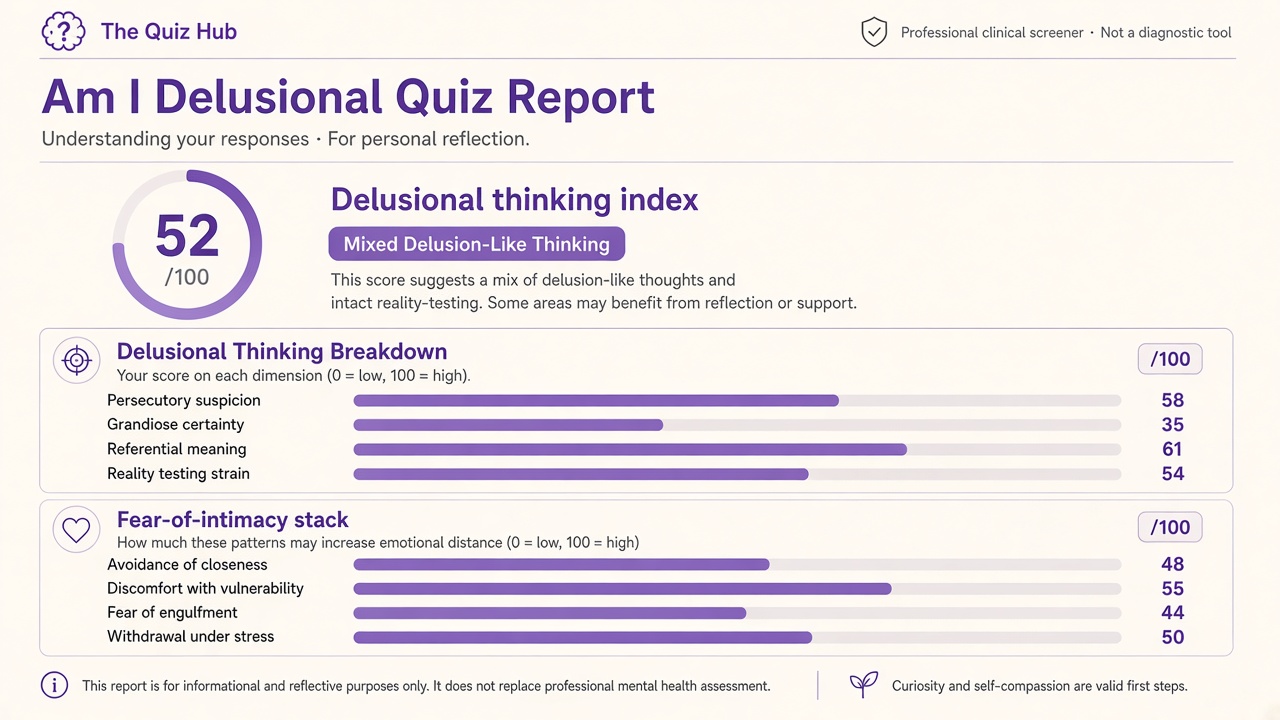
Your delusional thinking index is the normalized total across all 22 items on a 0 to 100 scale, with reverse scoring on protective items so higher scores mean more delusion-like thinking signals overall. Domain bars show endorsement rates so you can see whether persecutory suspicion, grandiose certainty, referential meaning, or reality testing strain drives your result most. The fear-of-intimacy stack chart shows how closeness guarding layers alongside unusual beliefs.
| Band | Index range | Typical reading |
|---|---|---|
| Lower Delusion-Like Thinking | 0 to 35 | Fewer unusual belief patterns on this screener; stress may still create temporary suspicion |
| Mixed Delusion-Like Thinking | 36 to 65 | Blend of ordinary worry and interpretation; worth tracking if persistent |
| Higher Delusion-Like Thinking | 66 to 100 | Frequent persecution, referential, or reality-testing signals; professional evaluation may help |
What your am I delusional report looks like
After all 22 items, you get a delusional thinking index from 0 to 100, a band label, four belief domain bars, and a fear-of-intimacy stack chart with vulnerability pull-back, trust hesitation, self-disclosure limits, and closeness anxiety layers. Percentages reflect how you interpret events and closeness, not a clinical verdict about psychosis.
What this quiz can and cannot tell you
Can tell you
- How often delusion-like thinking patterns showed up for you in the past two weeks
- A delusional thinking index and four domain bars for persecution, grandiosity, referential meaning, and reality testing strain
- A fear-of-intimacy stack chart showing how closeness guarding layers with unusual beliefs
- A starting point for clinical conversation or retaking after sleep repair, support, or treatment
Cannot tell you
- Whether you are delusional, psychotic, or mentally ill as a person
- Whether you have schizophrenia, delusional disorder, bipolar disorder, or any clinical diagnosis
- Whether your beliefs are true or false in the real world
- What treatment you need without a licensed clinician's evaluation
Delusional thinking, stress, and when to seek help
Psychiatrist Aaron Beck and colleagues described in Schizophrenia Bulletin (2009) how persecutory and referential interpretations can intensify under sleep loss, social isolation, and substance use before they become fixed clinical delusions. The Peters Delusions Inventory (Peters, Joseph, and Garety, 1999) showed that mild unusual beliefs are common in the general population, which is why frequency and impact matter more than a single yes-or-no label. In everyday language, am I delusional searches often map to those patterns: feeling targeted, reading signs into random events, or holding beliefs loved ones cannot verify.
The Quiz Hub built this am I delusional quiz as an original self-report screener inspired by psychosis spectrum research themes, not a reproduction of the Peters Delusions Inventory or any published clinical instrument. Readers often compare it to sibling tools on this site. Our am I insane quiz screens broader distress and functioning rather than specific belief domains. The am I crazy test maps general psychological distress without persecution or referential item banks. The signs you need to go to a mental hospital quiz focuses on safety and acute care thresholds rather than belief theme frequency.
| The Quiz Hub test | What it adds |
|---|---|
| Am I insane quiz | Broader distress and functioning screen without persecution or referential domain bars |
| Am I crazy test | General psychological distress frequency, not delusion-like belief themes |
| Do I have trust issues quiz | Betrayal imprint and trust hesitation after harm, not grandiose or referential beliefs |
| Am I anxious or normal quiz | Anxiety symptom frequency, not fixed unusual belief conviction |
| Fear of intimacy quiz | FOIS-inspired intimacy avoidance only, without delusion-like thinking domain bars |
| This am I delusional quiz | Four-domain delusional thinking index plus fear-of-intimacy stack for unusual belief frequency |
Sample item types include frequency ratings such as whether you believed random media contained messages meant for you, or whether you held beliefs others could not verify. High persecutory suspicion with high reality testing strain often lands in Mixed or Higher Delusion-Like Thinking. Sleep debt, cannabis, stimulants, grief, and social media rabbit holes can spike scores temporarily without meaning you have a lifelong psychotic disorder. Read how we review quizzes in our editorial policy or browse more tools on our mental health and clinical hub.
Am I delusional quiz FAQ
What is delusional thinking in everyday language?
Delusional thinking usually means holding fixed beliefs that others cannot verify, such as feeling targeted, reading personal messages into random events, or feeling specially destined. Clinicians distinguish delusions from ordinary worry using duration, conviction, and impact on functioning. This am I delusional quiz measures how often those belief patterns showed up for you in the past two weeks. It is not proof that you have a psychotic disorder.
What does this am I delusional quiz measure?
Twenty-two original frequency items ask how often you notice persecutory suspicion, grandiose certainty, referential meaning, and reality testing strain. Scores map to four delusion-like thinking domains plus a parallel fear-of-intimacy stack with vulnerability pull-back, trust hesitation, self-disclosure limits, and closeness anxiety layers. You receive a delusional thinking index from 0 to 100 and a band from Lower through Higher Delusion-Like Thinking.
What is the fear-of-intimacy stack on this quiz?
The fear-of-intimacy stack is a second results chart inspired by FOIS-style intimacy avoidance themes, adapted to unusual belief framing. Each of the 22 items also maps to one of four stack layers. The stack index summarizes how often suspicion or unverified beliefs shape closeness guarding alongside delusion-like thinking items.
How is this different from the am I insane quiz?
The am I insane quiz screens broader distress, functioning, and mood disruption rather than specific belief themes. This am I delusional quiz focuses on persecution, grandiosity, referential meaning, and reality testing strain frequency. Both include honest limits and crisis links on higher bands. Neither is a diagnosis.
Can this quiz diagnose schizophrenia or delusional disorder?
No. The delusional thinking index describes self-reported pattern frequency on this abbreviated screener. Only a licensed clinician can evaluate psychosis spectrum conditions through structured interviews, collateral history, and medical workup. Online quizzes cannot confirm or deny a diagnosis.
Who reviewed this content?
Dr. Elena Vasquez, PhD, reviewed the test framing and result explanations. See our editorial policy for review standards.
Reviewed by