What this am I broken quiz measures
This am I broken quiz estimates how often broken-self beliefs showed up for you in the past two weeks. Twenty-two original frequency items group into four woundedness domains drawn from shame and self-worth research: defectiveness shame, hopeless repair, relational unworthiness, and fragile functioning. Your emotional woundedness index averages these patterns into a 0 to 100 score with plain-language bands. A parallel fear-of-intimacy stack shows how shame or hurt may guard closeness. It reflects your self-report, not a clinician's evaluation.
Defectiveness shame
Believing something is fundamentally wrong with you, hiding a damaged self, and fearing exposure if people saw the real you.
Hopeless repair
Doubting healing is possible, feeling stuck in old pain, and giving up on ever feeling whole again.
Relational unworthiness
Feeling too damaged for love, pulling away to avoid burdening others, and editing your story before disclosure.
Fragile functioning
Fearing one more setback will shatter you, doubting you can cope, and treating help as proof you are broken.
How it works
Three steps from first question to your woundedness report. Click Start Quiz to open the interactive quiz in a full-screen modal.
Answer 22 frequency items
Rate how often each broken-self belief showed up in the past two weeks, from Never to Very often. You click Next after each answer; nothing auto-advances.
Items map to four woundedness domains
Your answers accumulate percentages for defectiveness shame, hopeless repair, relational unworthiness, and fragile functioning, plus a fear-of-intimacy stack index.
View band and domain bars
Results show Lower, Mixed, or Higher Emotional Woundedness with woundedness domain bars and intimacy stack layers. Higher bands include crisis resources.
Take the am I broken quiz
Rate 22 statements about broken-self beliefs from the past two weeks. Your answers produce an emotional woundedness index from 0 to 100, four woundedness domain scores, a fear-of-intimacy stack chart, and a band label for reflection or therapy conversation.
Opens in a focused modal. No account required. Results stay on screen.
What your result means
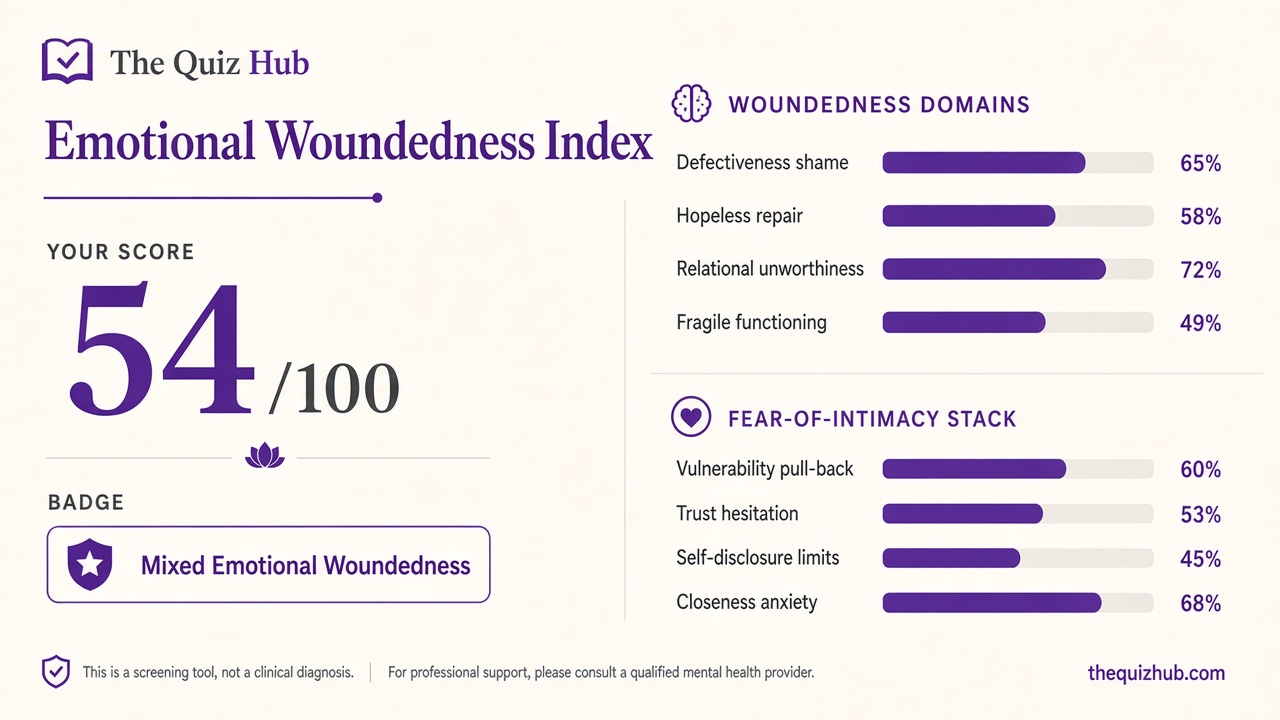
Your emotional woundedness index is the normalized total across all 22 items on a 0 to 100 scale, with reverse scoring on protective items so higher scores mean more broken-self belief signals overall. Domain bars show endorsement rates so you can see whether defectiveness shame, hopeless repair, unworthiness, or fragile functioning drives your result most. The fear-of-intimacy stack chart shows how closeness guarding layers alongside woundedness beliefs.
| Band | Index range | Typical reading |
|---|---|---|
| Lower Emotional Woundedness | 0 to 35 | Fewer broken-self beliefs on this screener; ordinary self-doubt may still appear |
| Mixed Emotional Woundedness | 36 to 65 | Blend of hurt and healing progress; worth tracking if persistent |
| Higher Emotional Woundedness | 66 to 100 | Frequent defect shame, hopelessness, or unworthiness; professional support may help |
What your am I broken report looks like
After all 22 items, you get an emotional woundedness index from 0 to 100, a band label, four woundedness domain bars, and a fear-of-intimacy stack chart with vulnerability pull-back, trust hesitation, self-disclosure limits, and closeness anxiety layers. Percentages reflect how you handle shame and hurt, not a clinical verdict about your worth.
What this quiz can and cannot tell you
Can tell you
- How often broken-self beliefs showed up for you in the past two weeks
- An emotional woundedness index and four domain bars for shame, hopelessness, unworthiness, and fragility
- A fear-of-intimacy stack chart showing how closeness guarding layers with woundedness beliefs
- A starting point for therapy conversation or retaking after support and healing progress
Cannot tell you
- Whether you are broken, damaged, or irreparably flawed as a person
- Whether you have depression, complex trauma, or any clinical diagnosis
- How fast you should heal or whether therapy will work for you
- What treatment you need without a licensed clinician's evaluation
Broken-self beliefs, shame, and worth
Clinical psychologist Paul Gilbert described in The Compassionate Mind (2010) how shame can fuse identity with defect: people conclude they are bad rather than that they did something bad. Trauma researchers Judith Herman and Bessel van der Kolk wrote that lasting hurt can leave adults feeling permanently damaged even when their present life looks stable from the outside. In everyday language, am I broken searches often map to those patterns: a core belief that healing stopped, love is undeserved, and one more setback will prove you cannot hold yourself together.
The Quiz Hub built this am I broken quiz as an original self-report screener inspired by shame and self-criticism themes from the Other as Shamer Scale (Goss et al., 1994) and trauma-related identity research, not a reproduction of any published clinical instrument. Readers often compare it to sibling tools on this site. Our emotional trauma test screens memory intrusion, body alarm, and shutdown tied to past overwhelming events. The am I emotionally numb quiz maps flat affect and dissociative numbing rather than defect identity beliefs. The depression test measures low mood and anhedonia frequency without broken-self framing.
| The Quiz Hub test | What it adds |
|---|---|
| Emotional trauma test | Trauma imprint domains across memory, body, shutdown, and shame after harm |
| Am I emotionally numb quiz | Flat affect, anhedonia, and dissociative numbing, not defect identity beliefs |
| Depression test | PHQ-style mood and anhedonia items, not hopeless repair or unlovable-self identity |
| Fear of intimacy quiz | FOIS-inspired intimacy avoidance only, without woundedness domain bars |
| Do I have trust issues quiz | Betrayal imprint and trust hesitation frequency, not core defect beliefs |
| This am I broken quiz | Four-domain woundedness index plus fear-of-intimacy stack for broken-self belief frequency |
Sample item types include frequency ratings such as whether you believed something is fundamentally wrong with you, or whether you felt too damaged to deserve steady love. High defectiveness shame with high hopeless repair often lands in Mixed or Higher Emotional Woundedness. Rejection, anniversaries of loss, and conflict can spike scores temporarily without meaning you are broken forever. Read how we review quizzes in our editorial policy or browse more tools on our mental health and clinical hub.
Am I broken quiz FAQ
What does feeling broken mean emotionally?
Feeling broken often describes a belief that something is fundamentally wrong with you, that healing is impossible, or that you are too damaged for love and steady support. Psychologists sometimes link this to shame, trauma imprint, or depressive cognition, though the word broken is not a clinical diagnosis. This am I broken quiz measures how often those beliefs showed up for you in the past two weeks. It is not proof that you are damaged as a person.
What does this am I broken quiz measure?
Twenty-two original frequency items ask how often you notice defectiveness shame, hopeless repair beliefs, relational unworthiness, or fragile functioning. Scores map to four woundedness domains plus a parallel fear-of-intimacy stack with vulnerability pull-back, trust hesitation, self-disclosure limits, and closeness anxiety layers. You receive an emotional woundedness index from 0 to 100 and a band from Lower through Higher Emotional Woundedness.
What is the fear-of-intimacy stack on this quiz?
The fear-of-intimacy stack is a second results chart inspired by FOIS-style intimacy avoidance themes, adapted to broken-self framing. Each of the 22 items also maps to one of four stack layers. The stack index summarizes how often shame or hurt shapes closeness guarding alongside woundedness beliefs.
How is this different from the emotional trauma test?
The emotional trauma test screens memory intrusion, body alarm, emotional shutdown, and shame tied to past overwhelming events. This am I broken quiz focuses on identity-level broken-self beliefs: feeling fundamentally flawed, doubting repair, fearing you are unlovable, and feeling one setback from collapse. Both include a fear-of-intimacy stack. Neither is a diagnosis.
Can this quiz diagnose depression or a personality disorder?
No. The emotional woundedness index describes self-reported pattern frequency on this abbreviated screener. Only a licensed clinician can evaluate depression, complex trauma, borderline traits, or related conditions through structured interviews. Online tests cannot confirm or deny a diagnosis.
Who reviewed this content?
Dr. Elena Vasquez, PhD, reviewed the test framing and result explanations. See our editorial policy for review standards.
Reviewed by