What this asking too much quiz measures
This am I asking for too much quiz estimates how often doubt patterns make fair relationship needs feel excessive. Twenty original frequency items group into four domains drawn from assertiveness and equity research: reasonable needs, communication style, reciprocity sense, and guilt about asking. Your needs-clarity index averages these patterns into a 0 to 100 score with plain-language bands. It reflects your self-report about need doubt, not your partner's hidden intentions.
Reasonable needs
Second-guessing fair expectations for time, support, and reliability versus trusting they are normal.
Communication style
Hinting instead of asking plainly, stacking apologies, and shrinking requests until they disappear.
Reciprocity sense
Mental tallies, feeling one-sided, and believing you must earn care before you can receive it.
Guilt about asking
Shame after requests, fear of being a burden, and backpedaling when a partner looks tired.
How it works
Three steps from first question to your needs-clarity report. Click Start Quiz to open the interactive quiz in a full-screen modal.
Answer 20 frequency items
Rate how often each need-doubt pattern shows up when you think about what you want from your partner, from Never to Almost always. You click Next after each answer; nothing auto-advances.
Items map to four need domains
Your answers accumulate percentages for reasonable needs, communication style, reciprocity sense, and guilt about asking, plus an overall needs-clarity index.
View band and domain bars
Results show Clearer Reasonable Needs, Mixed Needs Doubt, or Higher Needs Doubt with domain bars and reflection prompts. Higher bands include crisis resources.
Take the am I asking for too much quiz
Rate 20 statements about whether your relationship needs feel fair or excessive. Your answers produce a needs-clarity index from 0 to 100, four domain scores, and a band label for reflection or therapy conversation.
Opens in a focused modal. No account required. Results stay on screen.
What your result means
Your needs-clarity index is the normalized total across all 20 items on a 0 to 100 scale, with reverse scoring on reasonable-needs clarity items so higher scores mean more need doubt overall. Domain bars show endorsement rates so you can see whether guilt about asking, reciprocity tally, indirect communication, or mislabeled needs drives your result most.
| Band | Index range | Typical reading |
|---|---|---|
| Clearer Reasonable Needs | 0 to 35 | Fewer patterns that blur fair expectations; normal second-guessing during conflict may still appear |
| Mixed Needs Doubt | 36 to 65 | Blend of fair expectations and habits that make you question whether you ask too much |
| Higher Needs Doubt | 66 to 100 | Frequent guilt, tallying, or indirect asking; professional support may help |
What your asking too much report looks like
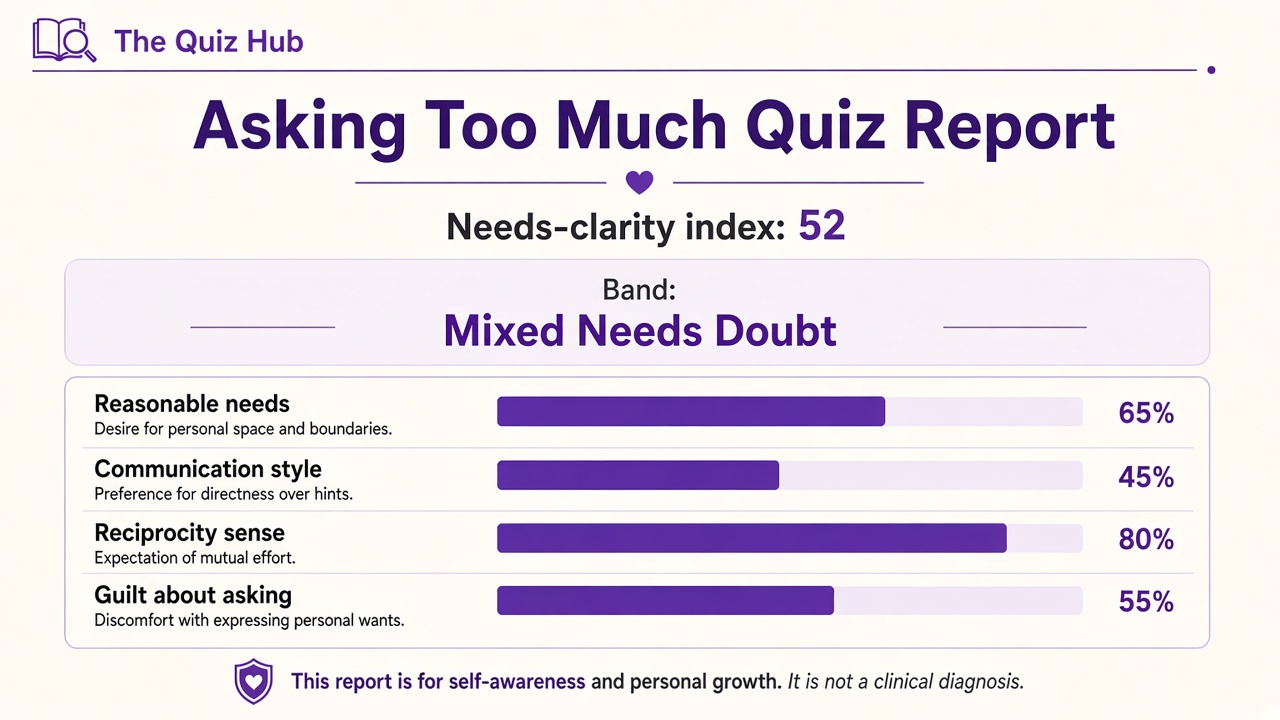
After all 20 items, you get a needs-clarity index from 0 to 100, a band label, and four domain bars for reasonable needs, communication style, reciprocity sense, and guilt about asking. Percentages reflect how you judge your own relationship needs, not a clinical verdict about fairness.
What this quiz can and cannot tell you
Can tell you
- How often need-doubt patterns showed up for you in close relationships
- A needs-clarity index and four domain bars for reasonable needs, communication, reciprocity, and guilt
- Which domain pattern feels strongest in your current self-talk about asking
- A starting point for therapy conversation or retaking after couples work
Cannot tell you
- Whether you actually ask for too much or your partner is unfair without your own judgment
- Whether you have codependency, anxiety, or any clinical diagnosis
- Whether your relationship can improve without honest dialogue and mutual effort
- What treatment you need without a licensed clinician's evaluation
Fair needs, guilt, and reciprocity in close bonds
Psychologists Robert Alberti and Michael Emmons published foundational work on assertiveness in the 1970s and 2008 edition of Your Perfect Right, distinguishing fair requests from aggression or passivity. Elaine Hatfield and Susan Sprecher studied equity and reciprocity in close relationships, showing how people track give-and-take and sometimes misread balance when they feel vulnerable. Harriet Lerner's work on the dance of anger also notes how many partners shrink legitimate needs to avoid being labeled demanding. Need doubt in everyday language often maps to those patterns: apologizing before you ask, tallying favors, and treating basic reliability as selfish.
The Quiz Hub built this am I asking for too much quiz as an original self-report screener inspired by those themes, not a reproduction of any single published instrument. Readers often compare it to sibling tools on this site. Our people pleaser quiz screens approval seeking and guilt about boundaries across many relationships. The fear of intimacy quiz maps vulnerability pull-back and trust hesitation, not need fairness. The codependency level test measures caretaking overload and self-worth through usefulness rather than reciprocity tally alone.
| The Quiz Hub test | What it adds |
|---|---|
| People pleaser quiz | Approval seeking and conflict avoidance across relationships, not partner-specific need doubt |
| Fear of intimacy quiz | Vulnerability avoidance and self-disclosure limits, not guilt about fair requests |
| Relationship anxiety quiz | Reassurance seeking and jealousy scan worry, not reciprocity tally habits |
| Codependency level test | Caretaking overload and boundary blur, not whether normal needs feel excessive |
| Compatibility test | Values and lifestyle fit bars, not communication style when voicing needs |
| This asking too much quiz | Four-domain needs-clarity index for reasonable needs, asking style, reciprocity sense, and guilt |
Sample item types include frequency ratings such as whether you stack apologies before a small request, or whether you keep a mental tally of who did what last before you allow yourself to ask. High guilt about asking with high reciprocity distortion often lands in Mixed or Higher Needs Doubt. Past criticism, uneven partners, and family messages about not being needy can spike scores temporarily. Read how we review quizzes in our editorial policy or browse more tools on our relationships and dating hub.
Am I asking for too much quiz FAQ
How do I know if I am asking for too much in my relationship?
Fair needs usually include respect, reliability, emotional support, and shared effort. Signs of need doubt rather than excess include guilt after small requests, shrinking what you say until it disappears, or tallying who gave what before you speak up. This am I asking for too much quiz measures how often those doubt patterns show up. It cannot prove your partner is unfair or that you are wrong to ask.
What does this asking too much quiz measure?
Twenty original frequency items ask how often you mislabel normal needs, ask indirectly, distort reciprocity, or feel guilty after voicing wants in close relationships. Scores map to four domains inspired by assertiveness and equity research (Alberti and Emmons, 2008; Hatfield and Sprecher, 1983). You receive a needs-clarity index from 0 to 100 and a band from Clearer Reasonable Needs through Higher Needs Doubt.
How is this different from the people pleaser quiz?
The people pleaser quiz screens approval seeking, conflict avoidance, and guilt about boundaries across many relationships. This asking too much quiz focuses on whether your relationship needs feel fair: hinting instead of asking, counting favors, and treating basic support as selfish. It uses a partner-needs frequency frame rather than broad people-pleasing items.
Can this quiz prove my partner is taking advantage of me?
No. The needs-clarity index describes self-reported doubt patterns on this abbreviated screener. Only you and your partner, ideally with a licensed clinician, can judge whether expectations are mutual. Online quizzes cannot confirm exploitation, abuse, or partner intent.
What should I do if I get a higher needs doubt band?
Consider scheduling an evaluation with a licensed therapist who treats couples communication or boundaries. Bring your result summary and describe which domain feels hardest. If you feel unsafe or in crisis, call or text 988 (US) or your local crisis line.
Who reviewed this content?
Dr. Priya Sharma, PhD, reviewed the test framing and result explanations. See our editorial policy for review standards.
Reviewed by