What this am I a socialist quiz measures
This am I a socialist quiz estimates how much your self-report aligns with socialist and social democratic themes in everyday political life. Twenty-two original agree-disagree items group into four domains drawn from thinkers like Karl Marx, Rosa Luxemburg, Eugene Debs, and contemporary democratic socialists: economic equality, public services solidarity, labor collective power, and market skepticism. Each item also maps to a fear-of-intimacy stack layer so you can see whether vulnerability pull-back, trust hesitation, self-disclosure limits, or closeness anxiety rides alongside collective economic values. Your socialist leanings index averages these patterns into a 0 to 100 score where higher numbers mean stronger endorsement.
Economic equality
Concern about wealth gaps, progressive taxation, inherited privilege, and dignity beyond income.
Public services solidarity
Preference for publicly funded healthcare, education, housing, and shared community goods.
Labor collective power
Support for unions, worker ownership, strikes, living wages, and cooperatives over distant boards.
Market skepticism
Skepticism that profit motives, corporations, or shareholders alone meet social needs.
How it works
Three steps from first question to your socialist leanings report with fear-of-intimacy stack. Click Start Quiz to open the interactive quiz in a full-screen modal.
Answer 22 agree-disagree items
Rate each statement from Strongly disagree to Strongly agree. You click Next after each answer; nothing auto-advances.
Items map to socialist domains and intimacy stack
Your answers accumulate percentages for economic equality, public services, labor power, and market skepticism, plus four fear-of-intimacy stack layers.
View band, domain bars, and stack chart
Results show Lower, Mixed, or Higher Socialist Leanings with domain bars, stack layers, and reflection prompts.
Take the am I a socialist quiz
Rate 22 statements about wealth gaps, public services, unions, and corporate power. Your answers produce a socialist leanings index from 0 to 100, four domain scores, a fear-of-intimacy stack chart, and a band label for reflection.
Opens in a focused modal. No account required. Results stay on screen.
What your socialist leanings result means
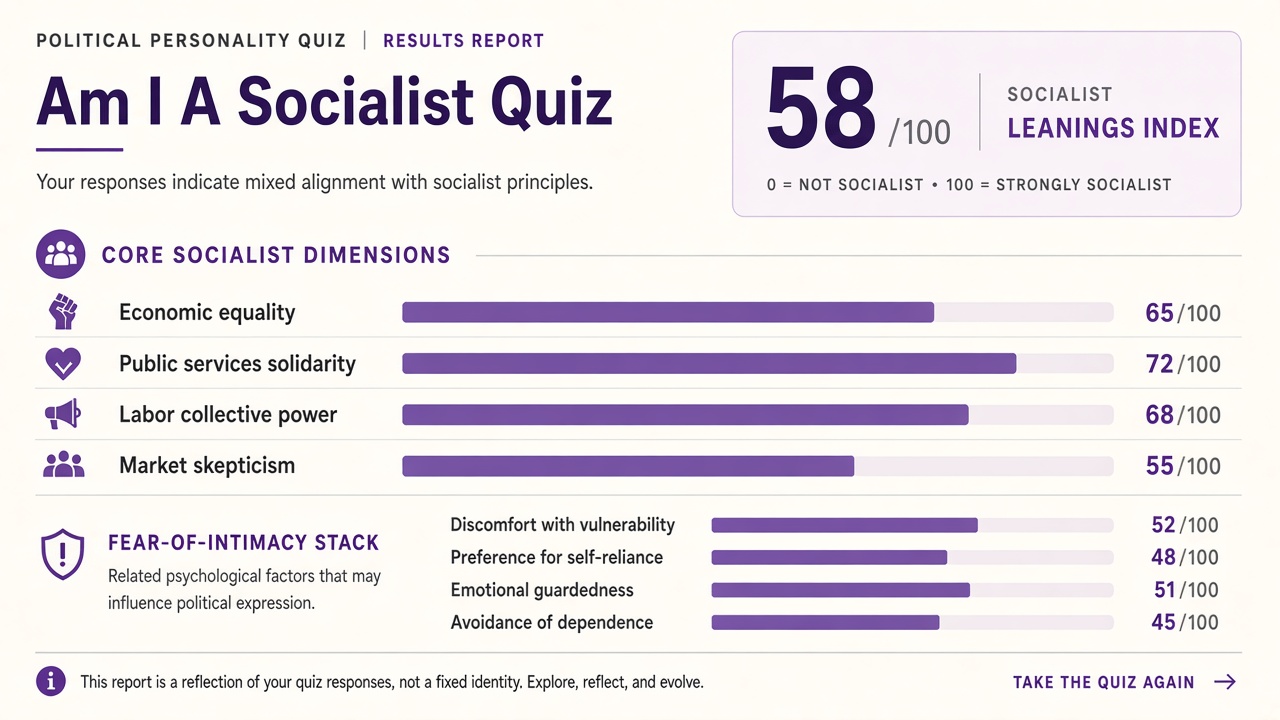
Your socialist leanings index is the normalized total across all 22 items on a 0 to 100 scale. Higher scores mean more frequent endorsement of economic equality, public services solidarity, labor collective power, and market skepticism items on this screener. Domain bars show endorsement rates so you can see whether redistribution, public funding, union themes, or corporate skepticism drives your result most. The fear-of-intimacy stack chart shows parallel layers for vulnerability pull-back, trust hesitation, self-disclosure limits, and closeness anxiety when political conviction or caution shapes closeness habits.
| Band | Index range | Typical reading |
|---|---|---|
| Lower Socialist Leanings | 0 to 35 | Fewer socialist-leaning signals; market trust or moderate welfare views can still score here |
| Mixed Socialist Leanings | 36 to 65 | Blend of market trust and collective policy instincts; domain and stack charts show where you lean most |
| Higher Socialist Leanings | 66 to 100 | Frequent redistributive, labor, or public services signals; read primary sources if you want labels |
What your socialist leanings report looks like
After all 22 items, you get a socialist leanings index from 0 to 100, a band label, four domain bars for economic equality, public services solidarity, labor collective power, and market skepticism, plus a fear-of-intimacy stack chart with vulnerability, trust, disclosure, and closeness anxiety layers.
What this quiz can and cannot tell you
Can tell you
- How often socialist-leaning political patterns showed up in this self-report screener
- A socialist leanings index and four domain bars for equality, public services, labor, and markets
- A fear-of-intimacy stack showing which closeness-guarding layer feels strongest
- A starting point for reading labor history or comparing with sibling tests
Cannot tell you
- Whether you must call yourself a socialist or join any activist group
- Whether your views are morally right, illegal, or safe to act on without context
- Whether friends, family, or voters would agree with your self-view
- Whether you are radicalized or need intervention without professional context
Socialist history, labor power, and political self-reflection
People search am I a socialist when they worry about rent hikes, cheer union wins, or wonder why healthcare costs bankrupt families while insurers post record profits. Karl Marx argued in 1848 that class struggle shapes history, a frame that still shapes debates about wages and ownership. Rosa Luxemburg warned that reform without worker power could stall real change. Eugene Debs ran for U.S. president five times from prison cells and jail terms tied to labor speech, showing how socialist ideas once reached mainstream ballots.
The Quiz Hub built this am I a socialist quiz as an original self-report screener inspired by those themes plus FOIS-style intimacy avoidance layers from Descutner and Thelen (1991), not a reproduction of any single published political typology. Readers often compare it to sibling tools on this site. Our am I an anarchist quiz maps horizontal organizing and anti-state themes rather than redistributive economics. The am I cynical quiz screens motive skepticism and jaded worldview habits without public services or labor power domains. The fear of intimacy quiz measures general vulnerability pull-back across closeness, not economic policy views.
| The Quiz Hub test | What it adds |
|---|---|
| Am I an anarchist quiz | Anti-authoritarianism, mutual aid, direct action, and voluntary association without socialist redistribution domains |
| Moral alignment test | Lawful versus chaotic ethics in a nine-alignment fiction frame without socialist domain bars or intimacy stack |
| Am I cynical quiz | Motive skepticism, trust erosion, pessimistic expectations, and ideal disillusionment without public services framing |
| Mach IV test | Machiavellian cynical views, tactical style, and moral flexibility facets without labor solidarity themes |
| Fear of intimacy quiz | General intimacy avoidance across vulnerability and trust, not economic equality domains |
| This am I a socialist quiz | Socialist leanings index plus fear-of-intimacy stack for economic equality, public services, labor power, and market skepticism |
Sample item types include agree-disagree ratings such as whether healthcare should be funded publicly so cost never blocks treatment, or whether unions protect workers more than individual negotiation with bosses. High economic equality with high trust hesitation on the stack often lands in Mixed or Higher Socialist Leanings bands. Owning a small business while backing Medicare expansion can still score in Mixed bands when public services and labor domains run high. Read how we review quizzes in our editorial policy or browse more tools on our personality psychology hub.
Am I a socialist quiz FAQ
What does socialist mean on this quiz?
Socialist here means your self-reported answers lean toward economic equality, public services solidarity, labor collective power, or market skepticism more than toward pure market trust or minimal redistribution. It does not mean you reject all private business, vote for any single party, or identify with every labor slogan. This am I a socialist quiz maps those patterns to a socialist leanings index from 0 to 100 for reflection, not a political membership card.
What does this am I a socialist quiz measure?
Twenty-two original agree-disagree items ask how much you align with wealth redistribution, publicly funded essentials, union and worker ownership themes, and skepticism of corporate power. Each item also feeds a parallel fear-of-intimacy stack with vulnerability pull-back, trust hesitation, self-disclosure limits, and closeness anxiety layers. You receive a socialist leanings index from 0 to 100 and a band from Lower through Higher Socialist Leanings.
What is the fear-of-intimacy stack on this quiz?
The fear-of-intimacy stack is a second results chart inspired by FOIS-style intimacy avoidance themes from Descutner and Thelen (1991), adapted to political self-report framing. Each of the 22 items also maps to one of four stack layers showing how conviction or caution may connect to adult closeness habits. The stack index summarizes those layers alongside the socialist leanings index.
How is this different from the am I an anarchist quiz?
The am I an anarchist quiz maps anti-authoritarianism, mutual aid, direct action, and voluntary association themes from horizontal organizing philosophy. This am I a socialist quiz focuses on redistributive economics, public services, labor power, and market skepticism drawn from socialist and social democratic traditions rather than stateless association.
Can this quiz tell me which party to join?
No. The socialist leanings index describes self-reported pattern signals on this abbreviated screener. It cannot assign party membership, predict voting behavior, or screen for radicalization. Centrist voters, libertarians, social democrats, and democratic socialists can all land in Mixed bands depending on how they read each item.
Who reviewed this content?
Dr. James Whitfield, PhD, reviewed the test framing and result explanations. See our editorial policy for review standards.
Reviewed by