What this baby energy quiz measures
This am I a baby quiz estimates how often comfort dependency, tantrum reactions, responsibility dodge, and needy reassurance patterns show up in how you report handling stress and daily life. Twenty original frequency items group into four domains inspired by psychologist Lindsay Gibson on emotional immaturity habits and developmental psychologist Jean Piaget on adult regression under stress: comfort dependency, tantrum reactions, responsibility dodge, and needy reassurance. Each item also maps to a fear-of-intimacy stack layer so you can see whether vulnerability pull-back, trust hesitation, self-disclosure limits, or closeness anxiety pairs with pouting or reassurance fishing. Your baby energy immaturity index averages these patterns into a 0 to 100 score where higher numbers mean more baby-energy habits on this screener.
Comfort dependency
Snacks, blankets, cozy corners, easy options, and wanting others to handle logistics so you can nest.
Tantrum reactions
Pouting, storming off, passive-aggressive jokes, and shutdowns instead of naming what hurt.
Responsibility dodge
Waiting for reminders, playing dumb, hoping others fix shared problems, and choosing fun over obligations.
Needy reassurance
Extra texts for warmth, are-we-okay checks, compliment fishing, and needing validation before deciding.
How it works
Three steps from first question to your baby energy report with fear-of-intimacy stack. Click Start Quiz to open the interactive quiz in a full-screen modal.
Answer 20 frequency items
Rate how often each baby-energy pattern shows up in your daily life, from Never to Almost always. You click Next after each answer; nothing auto-advances.
Items map to baby domains and intimacy stack
Your answers accumulate percentages for comfort dependency, tantrum reactions, responsibility dodge, and needy reassurance, plus four fear-of-intimacy stack layers.
View band and dual charts
Results show Lower, Mixed, or Higher Baby Energy with domain bars and a fear-of-intimacy stack chart. Higher index means more baby-energy habits on this screener.
Take the am I a baby quiz
Rate 20 statements about cozy avoidance, pouting, chore delays, and reassurance fishing. Your answers produce a baby energy immaturity index from 0 to 100, a fear-of-intimacy stack index, four domain scores, and a band label for group-chat reflection or honest habit talks.
Opens in a focused modal. No account required. Results stay on screen.
What your baby energy result means
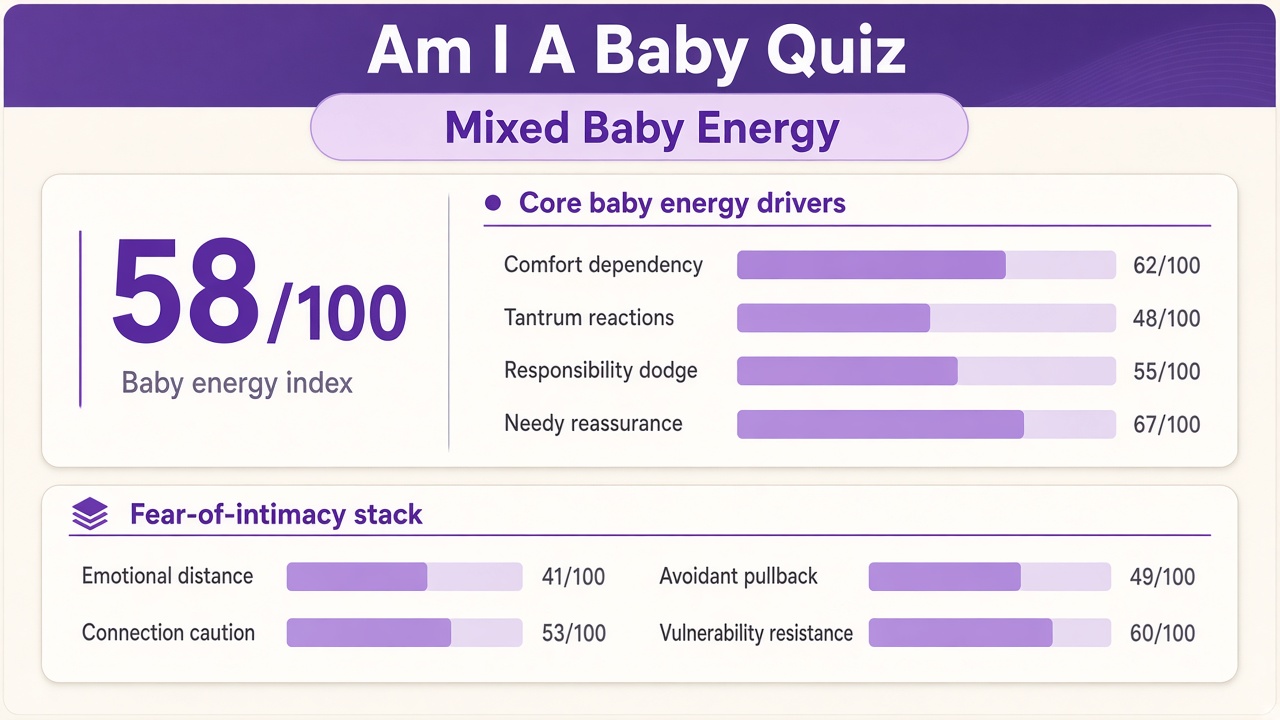
Your baby energy immaturity index is the normalized total across all 20 items on a 0 to 100 scale, with reverse scoring on grounded items so higher scores mean more baby-energy habits overall. The fear-of-intimacy stack index uses the same answers mapped to vulnerability, trust, disclosure, and closeness anxiety layers where higher stack scores mean more avoidance patterns. Domain bars show endorsement rates so you can see whether comfort dependency, tantrum reactions, responsibility dodge, or needy reassurance drives your result most.
| Band | Index range | Typical reading |
|---|---|---|
| Lower Baby Energy | 0 to 35 | Fewer cozy avoidance, pouting shutdowns, or reassurance fishing habits; asking for help when overwhelmed is still healthy |
| Mixed Baby Energy | 36 to 65 | Blend of grounded moments and habits that miss the room; domain and stack charts show where stress pairs with nesting or pouting |
| Higher Baby Energy | 66 to 100 | Frequent comfort nesting, tantrum reactions, chore dodge, or reassurance fishing that others may read as baby energy on this screener |
What your baby energy report looks like
After all 20 items, you get a baby energy immaturity index from 0 to 100, a band label, four baby-energy domain bars, and a fear-of-intimacy stack chart with vulnerability pull-back, trust hesitation, self-disclosure limits, and closeness anxiety layers. Percentages reflect how you report daily habits, not a permanent label.
What this quiz can and cannot tell you
Can tell you
- How often comfort dependency, tantrum reactions, responsibility dodge, and needy reassurance patterns showed up in your self-report
- A baby energy immaturity index and fear-of-intimacy stack index with domain bars
- Which baby-energy domain or intimacy stack layer feels strongest in your current habits
- A starting point for group-chat jokes, habit reflection, or therapy conversation about pacing and direct communication
Cannot tell you
- Whether every partner finds you babyish without their side of the story
- Whether you are immature forever, unlovable, or a bad roommate
- Whether playful softness or asking for comfort is wrong when your people enjoy it
- What specific changes others want without honest conversation and trusted guidance
Baby energy, adult stress, and the fear-of-intimacy stack
Psychologist Lindsay Gibson wrote in Adult Children of Emotionally Immature Parents (2015) that adults under stress sometimes revert to comfort-seeking, blame shifting, or reassurance fishing that looks childish from the outside even when the person feels overwhelmed inside. Developmental psychologist Jean Piaget noted that regression under pressure is a common coping pattern, not proof someone lacks capacity forever. TikTok baby-energy memes turned those habits into playful labels, yet the same patterns feel different in close friendships than in shared apartments or dating.
The Quiz Hub built this am I a baby quiz as an original self-report screener inspired by those stress-regression themes plus FOIS-style intimacy avoidance layers from Descutner and Thelen (1991), not a reproduction of any single published baby-energy scale. Readers often compare it to sibling tools on this site. Our am I immature quiz screens broader emotional regulation and empathy gaps rather than meme-friendly baby habits. The mental age test maps playful age-energy vibes rather than four baby-energy domains. The am I a drama queen quiz covers conflict escalation and spotlight pull rather than cozy nesting.
| The Quiz Hub test | What it adds |
|---|---|
| Am I immature quiz | Emotional regulation and empathy gaps across 22 items, not baby-energy meme framing |
| Mental age test | Playful age-energy band, not comfort dependency or tantrum reaction domains |
| Am I a drama queen quiz | Conflict escalation and narrative broadcast, not chore dodge or reassurance fishing |
| Am I lazy quiz | Procrastination and low initiation habits, not pouting or are-we-okay checks |
| Fear of intimacy quiz | General intimacy avoidance across vulnerability and trust, not baby-energy habit framing |
| This baby quiz | Baby energy immaturity index plus fear-of-intimacy stack for comfort nesting, tantrum reactions, responsibility dodge, and needy reassurance |
Sample item types include frequency ratings such as whether you delay leaving a cozy couch because the day ahead feels too heavy, or whether you ask are-we-okay after a normal quiet hour. High comfort dependency with high closeness anxiety on the stack often lands in Mixed or Higher Baby Energy bands. Playful softness that lands well with close friends but chore dodge at home can split domain scores. Read how we review quizzes in our editorial policy or browse more tools on our fun and novelty hub.
Am I a baby quiz FAQ
What does the am I a baby quiz measure?
Twenty original frequency items ask how often comfort dependency, tantrum reactions, responsibility dodge, and needy reassurance patterns show up in how you report handling stress and daily life. Each item also maps to a fear-of-intimacy stack layer: vulnerability pull-back, trust hesitation, self-disclosure limits, and closeness anxiety. You receive a baby energy immaturity index from 0 to 100 where higher scores mean more baby-energy habits on this screener, plus a parallel stack index.
Does a higher baby energy index mean I am immature forever?
No. On this screener, a higher index means you endorsed more cozy avoidance, pouting shutdowns, chore delays, or reassurance fishing items. Many playful, tired, or stressed adults score high without intending harm. Burnout and closeness anxiety are not the same as being a bad person. This quiz cannot prove how every partner or roommate experiences you or replace honest feedback from people who know you.
What is the fear-of-intimacy stack on this quiz?
The fear-of-intimacy stack is a second results chart inspired by FOIS-style intimacy avoidance themes from Descutner and Thelen (1991), adapted to baby-energy habit framing. Each of the 20 items maps to one of four stack layers showing how closeness guarding may pair with pouting, chore dodge, or reassurance seeking: hiding vulnerability, testing trust, limiting disclosure, or worrying about being too close. Higher stack scores mean more avoidance patterns on these items.
How is this different from the am I immature quiz?
The am I immature quiz uses 22 frequency items about emotional regulation gaps, responsibility avoidance, empathy deficits, and impulse comfort seeking from Lindsay Gibson and Young-Eisendrath inspired themes. This am I a baby quiz focuses on meme-friendly baby-energy habits like cozy nesting, tantrum reactions, chore dodge, and reassurance fishing with a parallel fear-of-intimacy stack chart in one report.
How is this different from the mental age test?
The mental age test maps playful age-energy vibes across curiosity, responsibility, humor, and routine habits with a single age-energy band. This baby quiz focuses on baby-energy immaturity habits with four domain bars and a fear-of-intimacy stack rather than a fictional mental age number.
Can this quiz tell me if my partner thinks I act like a baby?
No. The baby energy index describes self-reported patterns on this abbreviated screener. Mood, context, and relationship history all shape how habits land. Only people in your life can tell you how your presence feels, ideally through honest conversation.
Who reviewed this content?
Dr. James Whitfield, PhD, reviewed the test framing and result explanations. See our editorial policy for review standards.
Reviewed by