Hot and Cold Behavior in Dating: What It Means and What to Do
Last updated:
Educational only: This article explains hot and cold behavior in dating and attachment-informed boundaries. It is not therapy or crisis care. If you are in danger, monitored, or cannot leave safely, call or text 988 (U.S.), contact Samaritans at 116 123 (UK), or use local emergency services. Coercive control needs advocacy beyond dating tips.
Hot and cold behavior in dating means interest and warmth swing toward you, then pull back without a clear, mutual plan. You may get enthusiastic texts and dates, then silence, canceled plans, or emotional distance that leaves you scanning your phone for clues. Occasional busyness happens in every courtship; a repeating warmth-distance loop is different. It often pairs with attachment stress, fear of intimacy, or intermittent reward that makes relief feel like chemistry. This guide names common patterns, links them to research-backed habits, and separates mixed signals from harm that needs safety planning.
Tips at a glance
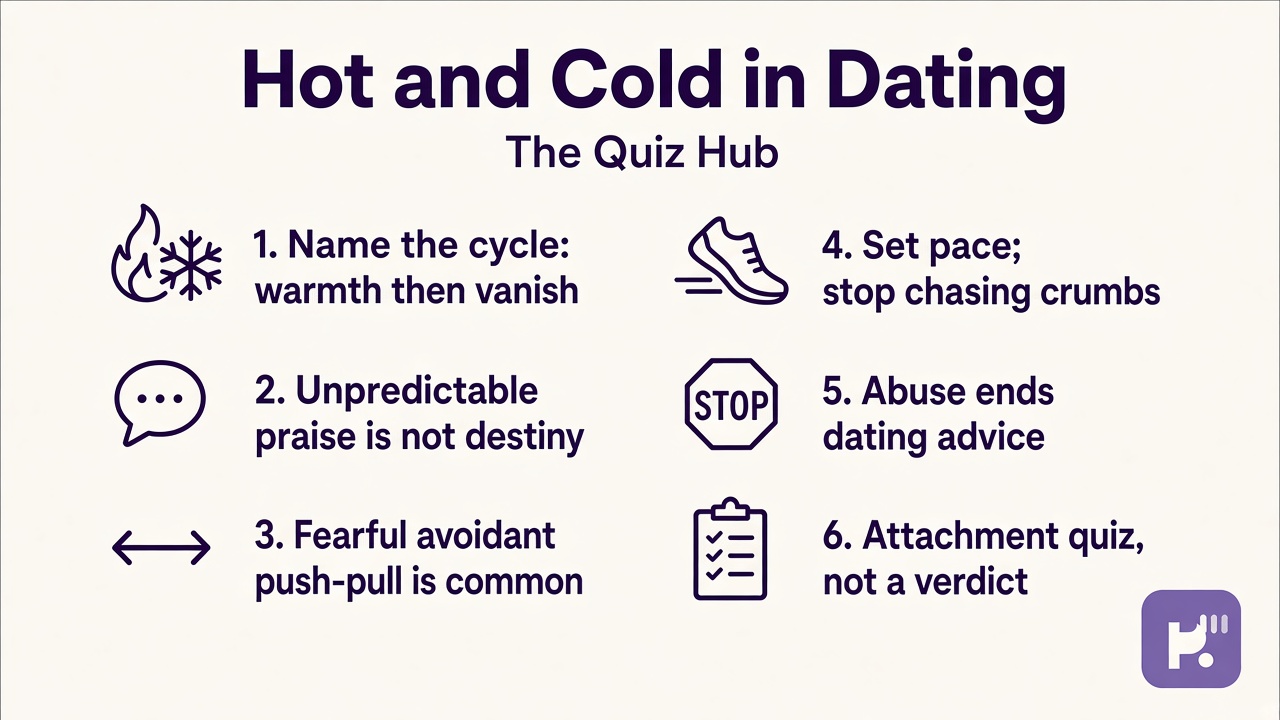
Key takeaways
- Hot and cold cycles repeat; one-off busyness does not.
- Intensity after distance can mimic love while your body stays on alert.
- Fearful avoidant push-pull and dismissive withdrawal are common attachment flavors.
- Track behavior for weeks; words during warm phases are not enough alone.
- Chasing crumbs trains the loop; boundaries protect self-respect.
- Abuse, coercion, or threats override attachment framing.
Hot and cold behavior patterns at a glance
Mixed signals show up in texting cadence, plan follow-through, emotional availability, and talk about the future. A partner might say you are special, then vanish when you ask for steadier contact. They may initiate intimacy, then treat routine check-ins as pressure. Labeling the cycle on paper (dates, tone, promises) helps you see whether you are dating a person or managing a schedule of hope and disappointment. For how unpredictable reward fuels craving, read our frustration attraction patterns guide.
| Phase | What you might see | What it can mean (not proof) | Healthy response |
|---|---|---|---|
| Hot | Frequent contact, future talk, affection, fast replies | Genuine interest, love-bombing, or relief after distance | Enjoy without abandoning boundaries; note consistency over time |
| Cooling | Slower replies, vague "busy" messages, shorter calls | Stress, avoidant deactivation, or testing your chase response | Ask once for clarity; avoid double-text spirals |
| Cold | Canceled dates, silence, minimization of your concern | Withdrawal, loss of interest, or punishment pattern | State impact; decide whether to pause investment |
| Reheat | Apology without change, grand gestures, jealousy spikes | Repair attempt or intermittent reinforcement hook | Require specific behavior change; watch for repeat cycles |
One table row is not a diagnosis. New jobs, grief, health flares, or family crises can cool responsiveness temporarily. The question is whether your partner returns with honesty, shares a plan, and respects your pacing when you name the pattern.
Why hot and cold behavior shows up
Adult attachment research maps how people handle closeness and rejection fears. An anxiously attached dater may chase when distance appears; an avoidant partner may deactivate after intimacy by focusing on work or solo plans. Fearful avoidant patterns blend longing and dread, which can look like dramatic swings rather than steady ambivalence. Triggers such as exclusivity talks, meeting friends, or conflict can spike withdrawal even when care exists. Our fearful avoidant triggers article lists common spark points and pacing ideas that respect safety.
Operant learning studies show that variable rewards can increase persistent responding. Applied to romance, praise that arrives unpredictably can feel more addictive than steady kindness. That mechanism explains why cold spells followed by affection hit hard. It does not mean you should tolerate disrespect. It means your nervous system may need time to trust calmer partners after you leave the loop.
Stress, options, and honesty gaps
Sometimes hot and cold behavior reflects divided attention: dating multiple people without disclosure, ambivalence about commitment, or keeping a backup plan. Other times the person lacks skill naming limits and uses distance instead of direct conversation. You deserve clarity about exclusivity, expectations, and repair after hurt. If answers stay vague across multiple talks, treat vagueness as information.
| Possible driver | Clues | What to ask or observe |
|---|---|---|
| Attachment avoidance | Distance after intimacy; discomfort with routine bonding | Whether they return after pauses and honor time-bound space requests |
| Fearful push-pull | Intense closeness then sudden retreat; distrust despite longing | Whether triggers map to conflict, labels, or vulnerability |
| Intermittent reward | Grand re-entry after silence; praise only when you pull back | Whether warmth rises when you stop initiating |
| Life overload | Explains delays with specifics; offers make-up plans | Whether reliability returns when stress eases |
| Low mutual investment | Convenience dating; avoids defining relationship | Whether effort is reciprocal over a month of tracking |
If you are on the receiving end of hot and cold behavior
Start with behavior tracking, not mind reading. For two to three weeks, note who initiates contact, how plans are kept, and how you feel after interactions. Share one specific observation using impact language: "When replies drop for days after we are affectionate, I feel confused and shut out. I need a rhythm we both agree on." Ask for concrete changes: reply windows that are realistic, scheduled dates, and clarity about exclusivity if that matters to you.
Reduce chase habits that feed the loop. Double texting, social media surveillance, and preemptive apologies for normal needs can train the other person that distance regains control. Self-soothe before sending another message. Invest in friendships, work, and rest so one person's temperature does not set your entire mood. If you notice abandonment panic, an abandonment issues quiz can prompt therapy topics; it cannot label your partner.
Boundaries that protect dignity
- Match effort gradually; do not reward cold spells with extra pursuit.
- Name one boundary at a time (for example, no last-minute cancelations without reschedule).
- Pause dating when contempt, mockery, or stonewalling punish your requests.
- Keep support outside the relationship so isolation does not shrink your judgment.
- Revisit decisions after a full warm-cold cycle, not only during hot phases.
If you recognize hot and cold behavior in yourself
Self-awareness is the first repair step. Notice body signals before you vanish: tight chest, urge to scroll, fantasy of freedom. Replace ghosting with time-bound pauses: "I am overwhelmed and need until Thursday to respond thoughtfully." Return at the stated time. Practice small consistency: one daily check-in, one follow-through on plans, one honest limit instead of fading.
Therapy helps when fear of engulfment or betrayal drives swings. Couples work can map pursuer- distancer cycles when both people want the relationship. Attachment language explains habits; it does not excuse cruelty. Partners should not serve as unpaid therapists for harm.
When hot and cold behavior crosses into harm
Intermittent kindness after insults, control of your phone or money, or pressure for sex when you said no are abuse patterns, not attachment puzzles. Love-bombing followed by withdrawal can trap survivors in hope loops. If you fear escalation, contact local domestic violence resources before confronting a partner. Our love-bombing screener highlights warning signs to discuss with an advocate; it does not replace safety plans.
When professional help makes sense
Individual therapy helps when hot and cold cycles replay across relationships or pair with depression, trauma flashbacks, or substance use. Couples therapy fits when both partners want repair and can tolerate structured conflict. If only one person does the emotional labor, assess whether the relationship is mutual. Clinical screeners on our Mental Health & Clinical hub flag symptoms worth bringing to a licensed provider; they do not diagnose or choose your partner for you.
Related quizzes on The Quiz Hub
Use screeners to prepare for therapy conversations, not to justify staying or leaving alone.
- Attachment style test: explores secure, anxious, avoidant, and mixed themes in close relationships. Helpful for literacy about hot and cold habits; not a clinical attachment disorder assessment.
- Relationship anxiety quiz: flags worry about rejection and over-monitoring behaviors that can amplify mixed signals.
- Fear of intimacy quiz: useful if you or a partner withdraws after closeness milestones.
- Browse the Relationships & Dating category and the Mental Health & Clinical hub for additional screeners with stated limits.
Frequently asked questions
What does hot and cold behavior mean in dating?
Hot and cold behavior is a pattern where affection, contact, and future talk swing between warmth and sudden distance without clear explanation. Warm phases may include frequent texts, dates, and intimacy; cold phases may include slow replies, canceled plans, or vague excuses. Occasional busyness differs from a repeating cycle that keeps you guessing. Context matters: stress can mute responsiveness, but a steady on-off rhythm often signals attachment stress or mixed commitment.
Why do people act hot and cold when dating?
Common drivers include fear of intimacy, past betrayal, overwhelmed schedules, or attachment habits that treat closeness as risky. Fearful avoidant patterns can produce push-pull conflict when someone wants connection and fears it at the same time. Intermittent reinforcement can also intensify craving when praise arrives unpredictably. None of these explanations excuse insults, control, or ghosting used as punishment. They help you decide whether to invest in repair or protect your peace.
Is hot and cold behavior a sign of love?
Love includes respect, reliability, and repair after conflict. Hot and cold cycles can feel like passion because relief after distance is intense, but intensity is not the same as safety. Steady partners may feel quieter at first while your nervous system recalibrates. If kindness only appears after you chase or apologize for normal needs, review the pattern with a therapist rather than treating anxiety as proof of chemistry.
Should I confront a hot and cold partner?
A calm, specific conversation can help when both people want clarity: name the pattern, share impact, and ask for a concrete rhythm (reply windows, date planning, exclusivity talk). Avoid ultimatums that mimic childhood engulfment, but do state boundaries on chasing and disrespect. If the person deflects, mocks your needs, or punishes you with silence, the issue is behavior and safety, not your wording. Couples therapy helps when both partners opt in.
When should I walk away from hot and cold dating?
Consider stepping back when cycles repeat after honest talks, when you shrink your needs to keep access, or when you feel worse about yourself over time. Coercive control, threats, monitoring, or violence end the dating puzzle and require safety planning. Our frustration attraction guide explains intermittent reward; it does not replace advocacy when you are unsafe. Trust actions across weeks, not promises after cold spells.
Can quizzes explain hot and cold patterns?
Attachment screeners such as our attachment style test highlight tendencies toward anxiety, avoidance, or mixed fearful patterns to discuss with a clinician. They do not diagnose disorders, predict compatibility, or prove someone manipulates you. Pair quiz results with behavior tracking and professional care when trauma, depression, or abuse is present. Browse the mental health and clinical hub for related YMYL screeners with stated limits.
Sources
- Bartholomew, K., & Horowitz, L. M. (1991). Attachment styles among young adults: A test of a four-category model. Journal of Personality and Social Psychology, 61(2), 226-244.
- Brennan, K. A., Clark, C. L., & Shaver, P. R. (1998). Self-report measurement of adult attachment: An integrative overview. In J. A. Simpson & W. S. Rholes (Eds.), Attachment theory and close relationships (pp. 46-76). Guilford Press.
- Ferster, C. B., & Skinner, B. F. (1957). Schedules of reinforcement. Appleton-Century-Crofts.
- American Psychological Association. (2023). Attachment and adult relationships overview.
- National Domestic Violence Hotline. (2024). Recognize relationship abuse.