Frustration Attraction: Why Intermittent Reward Hooks You
Last updated:
Educational only: This article explains frustration attraction and intermittent reward in dating. It is not therapy or crisis care. If you are in danger, monitored, or cannot leave safely, call or text 988 (U.S.), contact Samaritans at 116 123 (UK), or use local emergency services and domestic violence hotlines. Coercive control needs advocacy, not romance tips.
Frustration attraction is the pull toward someone whose approval arrives on an unpredictable schedule, so relief feels intense when contact finally comes. Classic learning studies show that intermittent reinforcement can make behavior persist longer than steady reward. Applied to romance, hot-and-cold attention can mimic soulmate chemistry while your nervous system stays on alert. This article separates research on partial rewards from pop psychology, links patterns to attachment habits, and names when the conversation must shift to safety rather than seduction games.
Tips at a glance
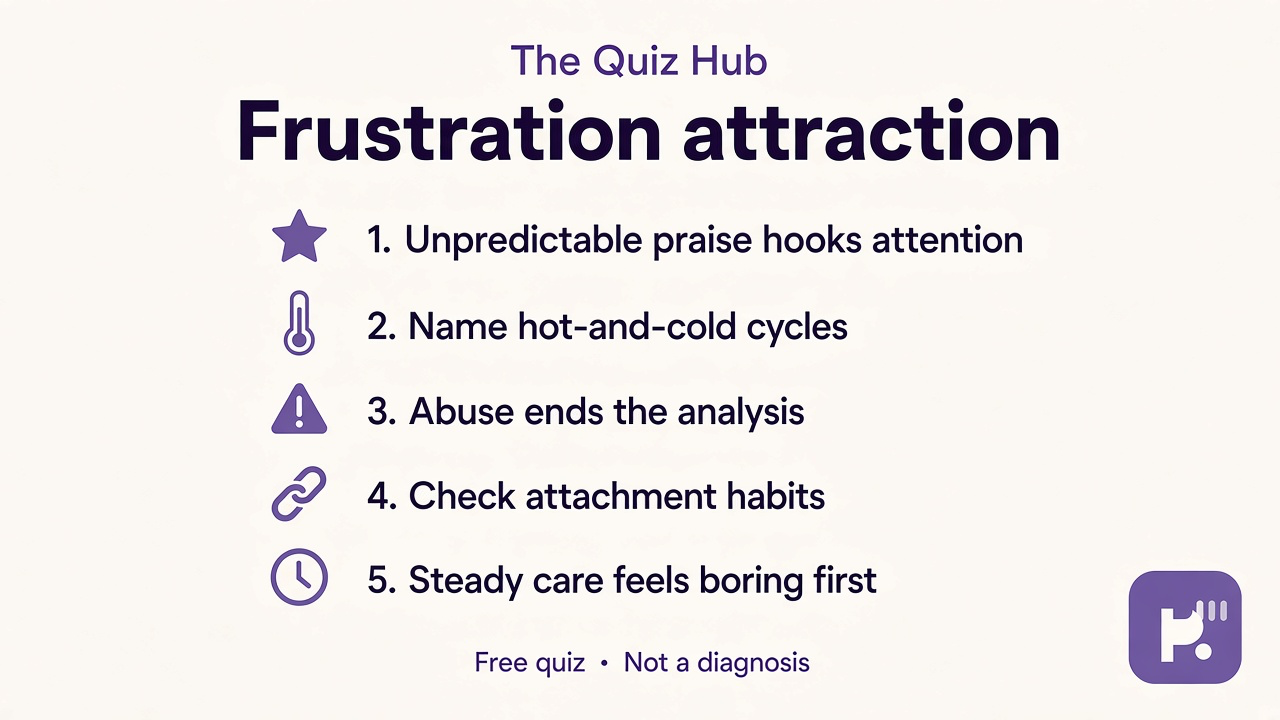
Key takeaways
- Unpredictable praise can increase craving; it is not proof the match is special.
- Intermittent reinforcement shows up in texting gaps, make-up cycles, and vague commitment talk.
- Anxious and avoidant pairings often amplify chase-withdraw loops.
- Steady partners may feel boring at first while your brain recalibrates.
- Manipulation, coercion, or violence override attachment framing.
- Screeners in the attachment style test support reflection, not fate.
Intermittent reinforcement at a glance
Psychologists studying operant conditioning found that rewards delivered on variable schedules can produce high, persistent responding. Slot machines exploit the same mechanism: you never know which pull pays off. Dating is not a casino, yet ambiguous interest can hook attention because each kind message resets hope. The table maps common romantic behaviors to what your nervous system may learn over time.
| Partner behavior | Possible reinforcement effect | Healthier counter-move |
|---|---|---|
| Long silence, then affectionate flood | Relief spikes dopamine; pursuit feels rewarded | Ask for steady contact rhythm; note if requests are dismissed |
| Future talk without plans | Hope stays alive without accountability | Request concrete dates and follow-through metrics |
| Jealousy after you set boundaries | Anxiety pulls you back toward them | Hold boundary; watch for respect versus punishment |
| Apology gifts without behavior change | Short-term soothe, long-term repeat harm | Require repair steps and time-bound change |
| Social media breadcrumbs | Micro-rewards keep you checking | Mute feeds; judge actions in real life |
| Breakup threats then reunion sex | Trauma bond intensity mistaken for passion | Seek therapy; consider safety planning if threats escalate |
Not every spaced text is manipulation. Busy schedules and poor communication skills exist. The pattern matters: does interest return reliably when you stop chasing, or only when you threaten to leave? Does kindness include respect on ordinary Tuesdays, not just after fights?
Why uncertainty can feel like chemistry
Early-stage dating includes natural ambiguity. Frustration attraction intensifies when ambiguity becomes the main fuel. Your brain may interpret delayed replies as a puzzle to solve, recruiting the same focus you would use on a challenging project. Stress hormones can pair with reunion moments, creating a memory that this person is exciting when they are often absent.
Compare that with secure bonding, where excitement grows alongside trust. Secure partners disagree, repair, and show up. If your body only lights up during reconciliation, track whether you are addicted to relief from fear rather than enjoying shared daily life. Journaling contact times for two weeks reveals schedules your feelings might obscure.
Attachment patterns that feed the loop
Adults with higher attachment anxiety often scan for signs of rejection. A partner who is sometimes warm and sometimes distant confirms the fear that love is fragile, which can increase clingy bids or protest behavior. Dismissive or fearful avoidant partners may offer closeness then retreat when intimacy deepens, triggering pursuit. Read about fear of abandonment signs and healing if silence feels unbearable, and explore fearful avoidant triggers when you both want closeness and fear it.
Changing the loop takes two willing people or your decision to stop auditioning for inconsistent love. Individual therapy can separate old family templates from current partner behavior. Couples therapy helps only when both people attend and abuse is absent. The attachment style test offers language for habits; it does not predict compatibility or excuse harm.
Questions to ask yourself
- Do I feel calmer or more anxious after most interactions?
- Would I advise a friend to accept this contact pattern?
- Does interest rise when I pull back, suggesting reward tied to my chase?
- Are kind moments paired with insults, surveillance, or control?
- Have I neglected sleep, work, or friendships to monitor their signals?
When frustration attraction masks manipulation
Intermittent kindness is a known feature of coercive relationships. Love bombing followed by withdrawal can trap partners who blame themselves for the cold phase. Guilt trips, gaslighting, and isolation are not attachment puzzles; they are control tactics. Our article on emotional manipulation signs lists behaviors that require boundaries and professional support, not more patience.
If weapons, threats, or monitoring appear, prioritize safety plans from domestic violence organizations. Attachment theory does not ask you to earn basic respect. Frustration attraction language should never normalize staying when you are afraid in your own home.
Breaking the loop without blaming your heart
Quitting an intermittent reward schedule feels like withdrawal. Your mind may invent reasons the person will change tomorrow. Support groups, therapy, and structured no-contact periods reduce relapse into checking their profiles. Replace the slot-machine loop with activities that deliver reliable small wins: exercise, creative projects, volunteer shifts, and friendships that answer texts.
When you date again, expect a adjustment period. Steady interest can feel flat because your baseline calibrated to chaos. Give secure connections time. Discuss pacing openly: how often you text, how conflicts get repaired, and what commitment means to each of you. Skills beat suspense as a foundation for long-term intimacy.
Research context without overselling certainty
Animal learning studies by Skinner and colleagues demonstrated variable-ratio schedules decades ago; human romance is more complex than lever presses. Modern relationship science also examines rejection sensitivity, rejection-induced arousal, and how social media notifications shape attention. No single study proves your crush is a deliberate manipulator. Use science to question your own suffering, not to diagnose strangers from a meme.
Therapists trained in cognitive behavioral therapy or emotionally focused therapy can map your negative cycle and practice distress tolerance when urges to text spike. Trauma-informed care matters if past abuse primed you to confuse intensity with care. Progress is measured in fewer panic hours between messages and more choices aligned with self-respect.
Related reading and screeners
- Fear of abandonment: signs and healing paths when silence feels catastrophic.
- Fearful avoidant triggers: when you want closeness and fear it at the same time.
- Emotional manipulation signs: when kindness is used as control.
- Attachment style test: self-report habits with stated non-diagnostic limits.
Frequently asked questions
What is frustration attraction in relationships?
Frustration attraction describes wanting someone more when their attention or approval is unpredictable. Behavioral research on intermittent reinforcement shows that partial, variable rewards can increase persistence and craving compared with steady kindness. In dating, hot-and-cold texting or last-minute plans can feel like chemistry when it is partly a nervous system response to uncertainty, not proof of destiny.
Is frustration attraction the same as love?
Love includes care, respect, reliability, and repair after conflict. Frustration attraction centers on craving relief from doubt. You may think about the person constantly while feeling anxious between contacts. Secure bonds can include passion, but they also include emotional safety and consistent follow-through. If kindness only arrives after you chase, examine the pattern with a therapist rather than romanticizing the chase.
How does intermittent reinforcement show up in dating?
Signs include praise after silence, affection following arguments without real repair, promises of future commitment that never land, and jealousy spikes that pull you back in. Social media views or brief messages can function as small rewards that reset hope. The loop trains you to work harder for crumbs of closeness. Naming the schedule of reward helps you choose whether to stay.
Can attachment style explain frustration attraction?
Anxious attachment often pairs with partners who are inconsistent, which revives old fears of abandonment. Avoidant partners may offer closeness then withdraw, which intensifies pursuit. Fearful avoidant patterns add push-pull conflict. Attachment language explains habits; it does not excuse insults, control, or violence. Screeners clarify tendencies to discuss in therapy, not labels to weaponize in fights.
When does frustration attraction cross into manipulation or abuse?
Coercive control, threats, isolation, financial sabotage, or physical harm end the attachment analysis and require safety planning. Intermittent kindness after harm is a common trap in abusive cycles. Our emotional manipulation signs article lists coercive tactics. If you are unsafe, contact local domestic violence services or emergency numbers; attachment tips are not enough.
How can I break frustration attraction patterns?
Track contact rhythms on paper, set boundaries on chasing, and invest in relationships where interest is steady even if excitement feels lower at first. Therapy helps separate loneliness from compatibility. No-contact or limited contact may be needed when obsession blocks judgment. Attachment quizzes support reflection; they do not replace clinical care when trauma or abuse is present.
Sources
- Skinner, B. F. (1953). Science and human behavior. Macmillan.
- Hazan, C., & Shaver, P. (1987). Romantic love conceptualized as an attachment process. Journal of Personality and Social Psychology, 52(3), 511-524.
- Downey, G., & Feldman, S. I. (1996). Implications of rejection sensitivity for intimate relationships. Journal of Personality and Social Psychology, 70(6), 1327-1343.
- American Psychological Association. (2023). Healthy relationships overview.
- National Domestic Violence Hotline. (2024). Safety planning resources.