What this relationship OCD quiz measures
This relationship OCD quiz estimates how often ROCD-style doubt and checking cycles showed up over the past two weeks. Twenty-two original frequency items group into four domains drawn from relationship OCD research: reassurance loops, partner doubt, comparison, and moral scrupulosity. Your ROCD pattern index averages these cycles into a 0 to 100 score with plain-language bands. It reflects your self-report, not proof that you should leave your partner.
Reassurance loops
Repeated reassurance seeking, mental checking, and short-lived relief that returns doubt quickly.
Partner doubt
Sudden "wrong person" spikes, numbness interpreted as doom, and breakup urges without concrete cause.
Comparison
Ranking your partner against exes, ideals, or social media fantasies as proof you chose wrong.
Moral scrupulosity
Guilt about intrusive thoughts, brief attraction elsewhere, and avoidance of triggers you fear mean betrayal.
How it works
Three steps from first question to your ROCD pattern report. Click Start Quiz to open the interactive quiz in a full-screen modal.
Answer 22 frequency items
Rate how often each doubt or checking pattern showed up in the past two weeks, from Never to Very often. You click Next after each answer; nothing auto-advances.
Items map to four ROCD domains
Your answers accumulate percentages for reassurance loops, partner doubt, comparison, and moral scrupulosity, plus an overall ROCD pattern index.
View band and domain bars
Results show Lower, Mixed, or Higher ROCD Pattern Signals with domain bars and reflection prompts. Higher bands include crisis resources.
Take the relationship OCD quiz
Rate 22 statements about relationship doubt and checking loops over the past two weeks. Your answers produce a ROCD pattern index from 0 to 100, four domain scores, and a band label for reflection or therapy conversation.
Opens in a focused modal. No account required. Results stay on screen.
What your result means
Your ROCD pattern index is the normalized total across all 22 items on a 0 to 100 scale, with reverse scoring on secure-response items so higher scores mean more doubt and checking overall. Domain bars show raw endorsement rates so you can see whether reassurance loops, partner doubt, comparison, or moral scrupulosity drives your result most.
| Band | Index range | Typical reading |
|---|---|---|
| Lower ROCD Pattern Signals | 0 to 35 | Fewer checking loops on this screener; normal doubt during conflict may still appear |
| Mixed ROCD Pattern Signals | 36 to 65 | Blend of secure moments and more frequent doubt or checking; worth tracking if persistent |
| Higher ROCD Pattern Signals | 66 to 100 | Frequent reassurance loops, partner doubt, or comparison; professional support may help |
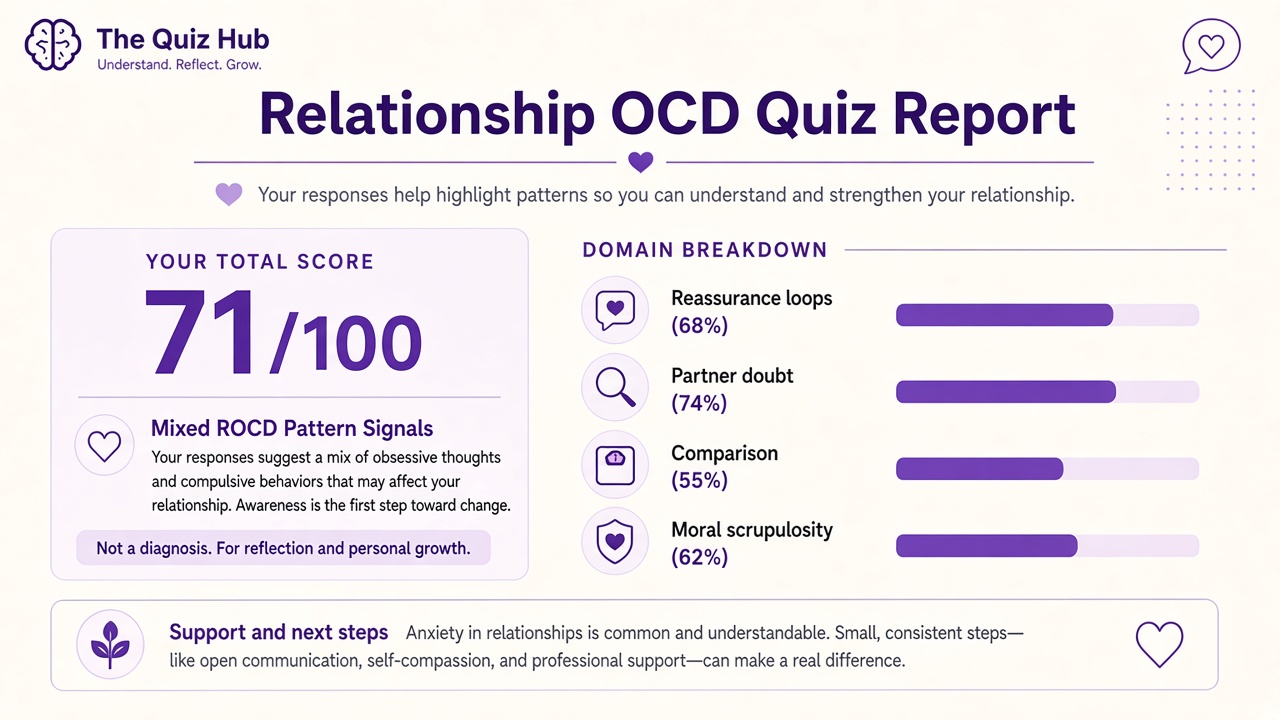
What your relationship OCD report looks like
After all 22 items, you get a ROCD pattern index from 0 to 100, a band label, and four domain bars for reassurance loops, partner doubt, comparison, and moral scrupulosity. Percentages reflect how you experience doubt and checking cycles, not a clinical verdict about OCD or your relationship.
What this quiz can and cannot tell you
Can tell you
- How often ROCD-style doubt and checking loops showed up for you in the past two weeks
- A ROCD pattern index and four domain bars for reassurance, partner doubt, comparison, and moral checking
- Which domain pattern feels strongest in your current bond
- A starting point for therapy conversation or retaking after a calmer month
Cannot tell you
- Whether you have OCD, ROCD, or any clinical diagnosis
- Whether your partner is wrong for you or you should break up
- Whether your relationship is healthy or doomed without honest dialogue
- What treatment you need without a licensed clinician's evaluation
ROCD research, reassurance loops, and relationship doubt
Clinical researchers Guy Doron, Danny Derby, and Jonathan S. Abramowitz published work on relationship-centered obsessive themes in 2012, distinguishing ROCD from generic jealousy or attachment anxiety alone. ROCD often involves two symptom clusters: partner-focused doubt (sudden "wrong person" spikes, comparison to alternatives) and relationship-focused doubt (whether love feels "right enough"). Reassurance seeking and mental checking temporarily reduce distress but tend to return doubt within hours, which is why online lists that treat ROCD as simple jealousy miss the loop structure.
The Quiz Hub built this relationship OCD quiz as an original self-report screener inspired by ROCD themes, not a reproduction of any published clinical instrument. Readers often compare it to sibling tools on this site. Our relationship anxiety quiz screens ECR-inspired worry: reassurance seeking, jealousy scanning, catastrophizing, and self-worth strain. The anxiety test screens generalized worry and tension across life domains, not relationship-specific checking loops. The bird test relationship measures partner bid responsiveness to small shares, not your internal doubt cycles.
| The Quiz Hub test | What it adds |
|---|---|
| Relationship anxiety quiz | ECR-inspired worry index for reassurance, jealousy scan, catastrophizing, and self-worth |
| Anxiety test | Generalized worry across life domains, not ROCD-style partner doubt loops |
| Anxiety or intuition quiz | Body alarm versus gut clarity when uncertainty hits, not mental checking cycles |
| Bird test relationship | Partner responsiveness to everyday bids, not your internal ROCD-style doubt |
| Attachment style test | Anxiety and avoidance dimensions across closeness, not two-week ROCD frequency |
| This relationship OCD quiz | Four-domain ROCD pattern index for reassurance loops, partner doubt, comparison, and moral scrupulosity |
Sample item types include frequency ratings such as whether you mentally replayed moments to check if you felt enough love, or whether you accepted occasional stray thoughts without treating them as moral proof. High reassurance loops with high partner doubt often lands in Mixed or Higher ROCD Pattern Signals. Sleep loss, new relationship stages, and past betrayal can spike scores temporarily. Read how we review quizzes in our editorial policy, browse more screeners on our mental health and clinical hub, or explore dating tools on our relationships and dating hub.
Relationship OCD quiz FAQ
What is relationship OCD (ROCD)?
Relationship obsessive-compulsive disorder (ROCD) refers to obsessive doubt and checking cycles centered on a romantic bond: repeated reassurance seeking, sudden "wrong person" spikes, comparison to exes or ideals, and guilt about intrusive thoughts. Researchers Guy Doron and colleagues described ROCD themes in 2012 as distinct from generic jealousy. This relationship OCD quiz measures how often those patterns showed up for you in the past two weeks. It is not an OCD diagnosis.
What does this relationship OCD quiz measure?
Twenty-two original frequency items ask how often you experienced reassurance loops, partner doubt spikes, comparison scanning, and moral scrupulosity about intrusive thoughts over the past two weeks. Scores map to four domains inspired by ROCD literature (Doron et al., 2012). You receive a ROCD pattern index from 0 to 100 and a band from Lower through Higher ROCD Pattern Signals.
How is this different from the relationship anxiety quiz?
The relationship anxiety quiz focuses on ECR-inspired worry: reassurance seeking, jealousy scanning, future catastrophizing, and self-worth strain. This relationship OCD quiz targets ROCD-style loops: mental checking, sudden partner doubt without cause, comparison to alternatives, and moral guilt about unwanted thoughts. Both use two-week frequency scales but map different pattern clusters.
Can this quiz diagnose OCD or ROCD?
No. The ROCD pattern index describes self-reported doubt and checking cycles on this abbreviated screener. Only a licensed clinician can evaluate OCD, ROCD, or related conditions through structured interviews. Online quizzes cannot confirm or deny a diagnosis.
What should I do if I get a higher ROCD pattern band?
Consider scheduling an evaluation with a licensed therapist who treats OCD or relationship-focused anxiety. ERP-informed CBT is a common treatment direction for ROCD themes. Bring your result summary and describe which domain feels hardest. If you feel unsafe or in crisis, call or text 988 (US) or your local crisis line.
Who reviewed this content?
Dr. Elena Vasquez, PhD, reviewed the test framing and result explanations. See our editorial policy for review standards.
Reviewed by