What this mother-in-law toxic quiz measures
This is my mother-in-law toxic quiz estimates how often toxic in-law pattern signals show up with your partner's mother and how they may connect to closeness habits in your marriage. Twenty original frequency items group into four in-law domains inspired by family systems theorist Murray Bowen (1978) on triangulation and psychologist Andrea Bonior (2018) on toxic relationship red flags: boundary interference, disrespect and criticism, emotional manipulation, and marriage undermining. Each item also maps to a fear-of-intimacy stack layer so you can see whether vulnerability pull-back, trust hesitation, self-disclosure limits, or closeness anxiety feels strongest. Your toxic in-law index averages these patterns into a 0 to 100 score with plain-language bands.
Boundary interference
Overstepping visit limits, sharing private details, treating your home like hers, and ignoring agreed household decisions.
Disrespect and criticism
Backhanded compliments, unfavorable comparisons, dismissive tones, and criticism of your culture or choices.
Emotional manipulation
Warmth withdrawal after limits, martyr guilt, dramatic labels, and passive aggression about holidays.
Marriage undermining
Recruiting your partner against boundaries, undoing joint decisions, loyalty tests, and rewriting conflict stories.
How it works
Three steps from first question to your toxic in-law report with fear-of-intimacy stack. Click Start Quiz to open the interactive quiz in a full-screen modal.
Answer 20 frequency items
Rate how often each in-law pattern and closeness habit shows up when you think about your mother-in-law, from Never to Almost always. You click Next after each answer; nothing auto-advances.
Items map to in-law domains and intimacy stack
Your answers accumulate percentages for boundary interference, disrespect, manipulation, and marriage-undermining domains, plus four fear-of-intimacy stack layers.
View band and dual charts
Results show Lower, Mixed, or Higher Toxic In-Law Concern with in-law domain bars and a fear-of-intimacy stack chart. Higher bands include crisis resources.
Take the is my mother-in-law toxic quiz
Rate 20 statements about your mother-in-law and how she treats you and your marriage. Your answers produce a toxic in-law index from 0 to 100, a fear-of-intimacy stack index, four domain scores, and a band label for reflection or therapy conversation.
Opens in a focused modal. No account required. Results stay on screen.
What your result means
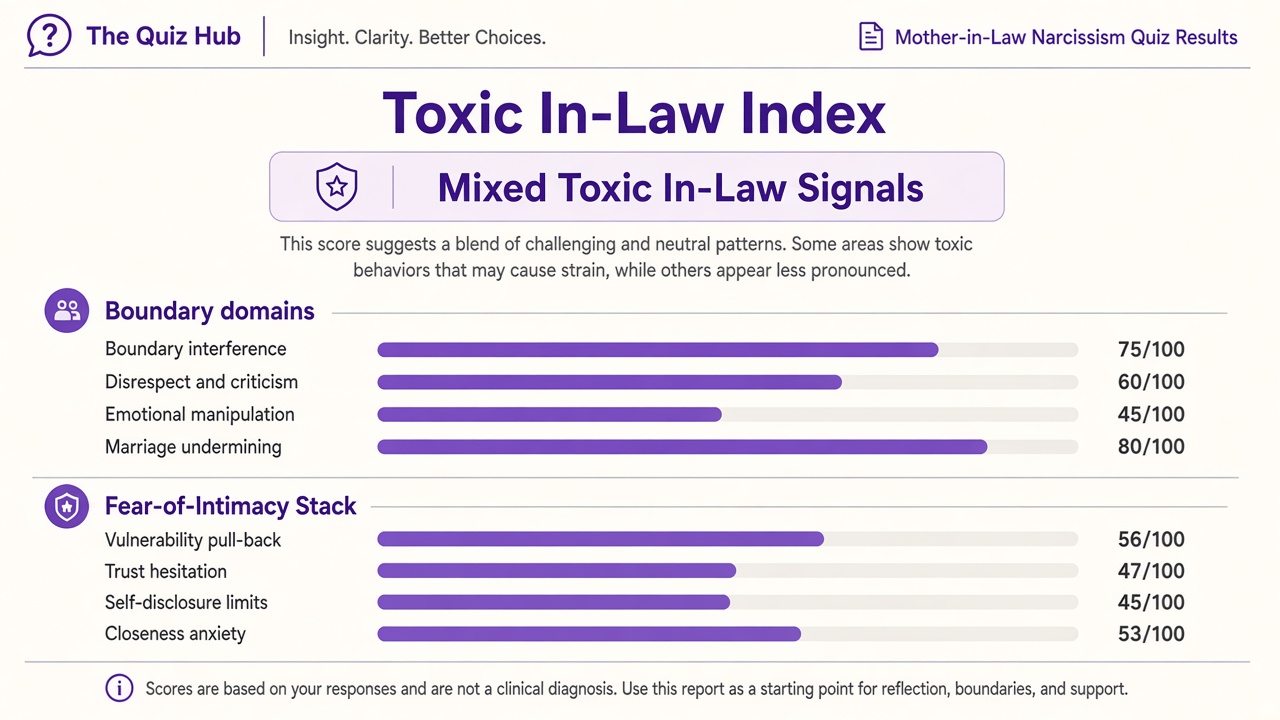
Your toxic in-law index is the normalized total across all 20 items on a 0 to 100 scale, with reverse scoring on protective items so higher scores mean more concern overall. The fear-of-intimacy stack index uses the same answers mapped to vulnerability, trust, disclosure, and closeness anxiety layers. Domain bars show endorsement rates so you can see whether boundary interference, criticism, manipulation, or marriage undermining drives your result most.
| Band | Index range | Typical reading |
|---|---|---|
| Lower Toxic In-Law Concern | 0 to 35 | Fewer toxic mother-in-law pattern signals on this screener; normal friction or stress may still appear |
| Mixed Toxic In-Law Signals | 36 to 65 | Blend of warm in-law moments and strain; worth tracking if persistent across seasons |
| Higher Toxic In-Law Concern | 66 to 100 | Frequent boundary violations, criticism, guilt tactics, or marriage undermining; professional support may help |
What your mother-in-law toxic report looks like
After all 20 items, you get a toxic in-law index from 0 to 100, a band label, four in-law domain bars, and a fear-of-intimacy stack chart with vulnerability pull-back, trust hesitation, self-disclosure limits, and closeness anxiety layers. Percentages reflect how you experience your mother-in-law and closeness habits in marriage, not a clinical verdict about her character.
What this quiz can and cannot tell you
Can tell you
- How often toxic in-law pattern signals showed up for you with your mother-in-law
- A toxic in-law index and fear-of-intimacy stack index with domain bars
- Which in-law domain or intimacy stack layer feels strongest in your current experience
- A starting point for couples therapy conversation about in-law boundaries and closeness patterns
Cannot tell you
- Whether your mother-in-law has a personality disorder or any clinical diagnosis
- Whether your marriage can heal without honest dialogue and mutual effort with your partner
- Whether you should cut contact without your own judgment and professional support
- What treatment you need without a licensed clinician's evaluation
Toxic in-law dynamics, marriage strain, and the fear-of-intimacy stack
Family systems theorist Murray Bowen (1978) wrote about triangulation, where a third person gets pulled into a two-person bond and destabilizes boundaries. Psychologist Andrea Bonior (2018) describes toxic relationship patterns as recurring disrespect, guilt pressure, and one-sided emotional labor that drain the healthier partner over time. Mother-in-laws with strong toxic pattern signals may criticize you in public while recruiting your partner privately, a split that can raise fear-of-intimacy stack scores when you stop sharing openly with your spouse.
The Quiz Hub built this is my mother-in-law toxic quiz as an original self-report screener inspired by those themes, not a reproduction of any single published instrument. Readers often compare it to sibling tools on this site. Our is my mother-in-law a narcissist quiz screens admiration seeking and status competition with a narcissism trait lens. The is my friend toxic quiz maps emotional drain and guilt pressure in friendships with 20 items. The fear of intimacy quiz maps vulnerability avoidance in romantic bonds without an in-law toxicity lens.
| The Quiz Hub test | What it adds |
|---|---|
| Is my mother-in-law a narcissist quiz | In-law narcissism pattern index: triangulation, admiration, empathy gaps, conditional approval |
| Is my friend toxic quiz | Toxic friendship index: emotional drain, disrespect, unreliability, guilt pressure |
| Are your parents toxic quiz | Parental toxicity index from childhood: criticism, control, emotional neglect, boundary violations |
| Fear of intimacy quiz | FOIS-inspired avoidance index without in-law toxicity domains |
| Codependency level test | Caretaking overload and boundary blur rather than in-law interference frequency |
| This mother-in-law toxic quiz | Toxic in-law index plus parallel fear-of-intimacy stack layers |
Sample item types include frequency ratings such as whether your mother-in-law oversteps visit limits without asking, or whether she recruits your partner to take her side against household boundaries. High boundary interference with high marriage-undermining scores often lands in Mixed or Higher Toxic In-Law Concern. Wedding planning, new babies, and holiday stress can spike scores temporarily. Read how we review quizzes in our editorial policy or browse more tools on our relationships and dating hub.
Is my mother-in-law toxic quiz FAQ
What makes a mother-in-law toxic?
In family therapy and self-help language, toxic mother-in-law patterns often describe recurring behaviors such as boundary interference, public criticism, guilt-based manipulation, and undermining your marriage. Clinical personality disorders require a formal evaluation and are not the same as a difficult in-law during stress. This is my mother-in-law toxic quiz measures how often those pattern signals show up with your mother-in-law and how they may shape your fear-of-intimacy stack in marriage. It is not proof your mother-in-law is irredeemably toxic.
What does this mother-in-law toxic quiz measure?
Twenty original frequency items ask how often you notice boundary interference, disrespect and criticism, emotional manipulation, and marriage undermining when you think about your mother-in-law and your partner. Each item also maps to a fear-of-intimacy stack layer: vulnerability pull-back, trust hesitation, self-disclosure limits, and closeness anxiety. You receive a toxic in-law index from 0 to 100 and a band from Lower through Higher Toxic In-Law Concern.
What is the fear-of-intimacy stack on this quiz?
The fear-of-intimacy stack is a second results chart inspired by FOIS-style intimacy avoidance themes, adapted to in-law and marriage dynamics. Each of the 20 items maps to one of four stack layers showing how in-law pattern signals may connect to closeness habits: hiding vulnerability from your partner, testing trust, limiting disclosure, or panicking when bonds deepen under family pressure. The stack index summarizes those layers alongside the toxic in-law index.
How is this different from the is my mother-in-law a narcissist quiz?
The is my mother-in-law a narcissist quiz screens triangulation, admiration seeking, empathy gaps, and conditional approval with a narcissism trait lens in 20 items. This is my mother-in-law toxic quiz focuses on boundary violations, criticism, guilt tactics, and marriage undermining with a broader toxic in-law pattern frame plus the same parallel fear-of-intimacy stack. It uses a marriage and extended-family frequency scale rather than a narcissism-specific domain index.
Can this quiz diagnose my mother-in-law or label her toxic clinically?
No. The toxic in-law index describes self-reported pattern signals on this abbreviated screener. Cultural norms about family roles, wedding stress, and imperfect in-law relationships can raise scores without any personality disorder. Only a licensed clinician can evaluate personality or relational pathology through structured interviews. Online quizzes cannot confirm or deny a diagnosis or tell you whether to cut contact.
What should I do if I get a higher toxic in-law band?
Consider speaking with a licensed couples or family therapist who understands in-law triangulation and boundary work. Align with your partner on limits before confronting patterns if retaliation is a concern. If you feel unsafe or in crisis, call or text 988 (US) or your local crisis line.
Who reviewed this content?
Dr. Elena Vasquez, PhD, reviewed the test framing and result explanations. See our editorial policy for review standards.
Reviewed by