What this is my child a narcissist quiz measures
This is my child a narcissist quiz estimates how often narcissistic trait signals show up in your child's behavior through parent-report frequency items. Twenty original items group into four domains drawn from child narcissism research: grandiosity and entitlement, empathy deficits, rivalry and attention, and manipulation and control. Each item also maps to a family intimacy strain stack layer adapted from fear-of-intimacy themes. Your child narcissistic traits index averages these signals into a 0 to 100 score with plain-language bands. It reflects behaviors you notice, not a clinical verdict about your child's personality.
Grandiosity and entitlement
Double standards, praise demands, bragging that puts others down, and outrage when not treated as special.
Empathy deficits
Dismissing others' hurt, little remorse, self-centered conversations, and blaming adults or peers.
Rivalry and attention
Sabotaging sibling wins, interrupting, jealousy over praise, and creating drama to stay central.
Manipulation and control
Charm or guilt to escape consequences, tantrums after limits, lying, and pitting family members against each other.
How it works
Three steps from first question to your child narcissistic traits report. Click Start Quiz to open the interactive quiz in a full-screen modal.
Answer 20 frequency items
Rate how often each trait signal shows up when you think about your child's behavior, from Never to Almost always. You click Next after each answer; nothing auto-advances.
Items map to trait domains and intimacy stack
Your answers accumulate percentages for four trait domains plus four family intimacy strain stack layers, plus an overall child narcissistic traits index.
View band and dual charts
Results show Lower, Mixed, or Higher Trait Signals with trait domain bars and a family intimacy strain stack chart. Higher bands include crisis resources.
Take the is my child a narcissist quiz
Rate 20 statements about narcissistic trait signals you notice in your child. Your answers produce a child narcissistic traits index from 0 to 100, four trait domain scores, a family intimacy strain stack, and a band label for reflection or therapy conversation.
Opens in a focused modal. No account required. Results stay on screen.
What your result means
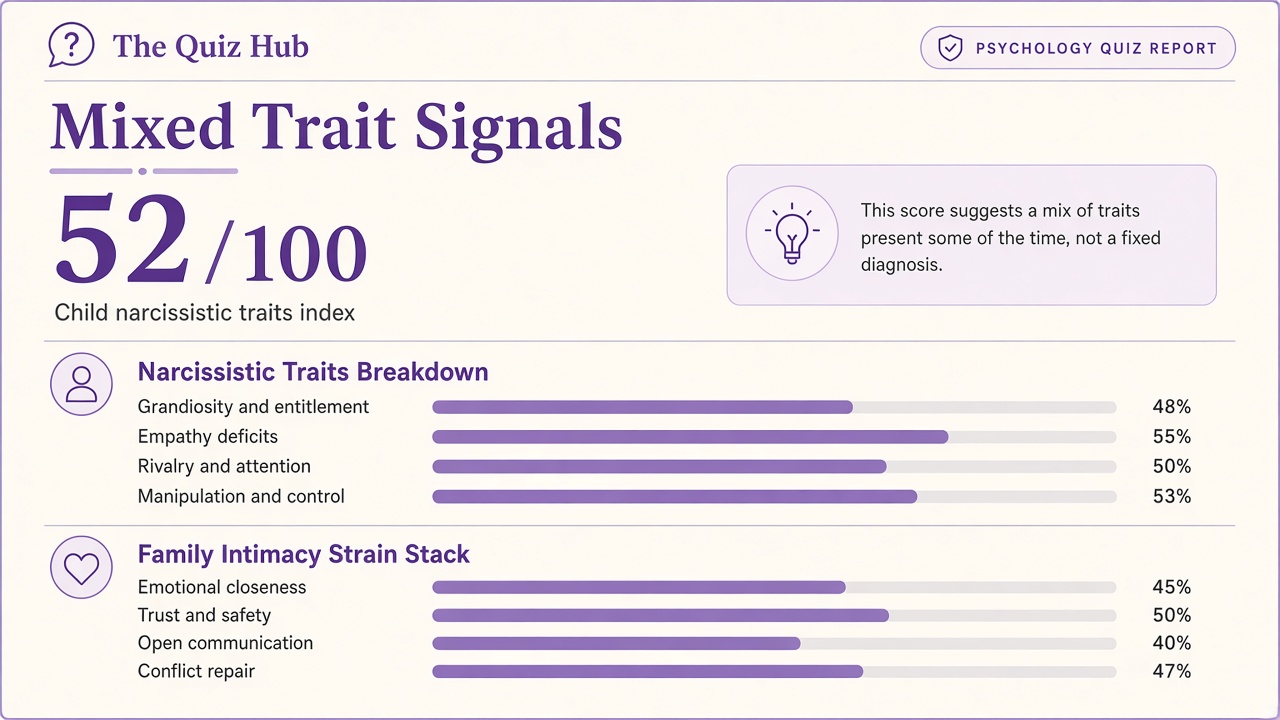
Your child narcissistic traits index is the normalized total across all 20 parent-report items on a 0 to 100 scale, with reverse scoring on healthy-behavior items so higher scores mean more trait signals overall. Trait domain bars show endorsement rates so you can see whether grandiosity, empathy gaps, rivalry, or manipulation drives your result most. The family intimacy strain stack chart shows how those behaviors may limit honest closeness at home.
| Band | Index range | Typical reading |
|---|---|---|
| Lower Trait Signals | 0 to 35 | Fewer narcissistic trait signals on this screener; age-typical self-focus may still appear |
| Mixed Trait Signals | 36 to 65 | Blend of caring moments and trait signals; worth tracking if persistent |
| Higher Trait Signals | 66 to 100 | Frequent grandiosity, empathy gaps, rivalry, or manipulation; pediatric professional support may help |
What your child narcissistic traits report looks like
After all 20 items, you get a child narcissistic traits index from 0 to 100, a band label, four trait domain bars, and a family intimacy strain stack chart with its own index. Percentages reflect trait signals you notice in your child, not a clinical verdict that they have narcissistic personality disorder.
What this quiz can and cannot tell you
Can tell you
- How often narcissistic trait signals showed up in your parent-report answers
- A child narcissistic traits index and four trait domain bars
- A family intimacy strain stack showing how behavior may limit closeness at home
- A starting point for pediatric psychology or family therapy conversation
Cannot tell you
- Whether your child has narcissistic personality disorder or any clinical diagnosis
- Whether behavior is caused by ADHD, autism, trauma, or temperament without evaluation
- What your child will be like as an adult based on this screener alone
- What treatment you need without a licensed clinician's evaluation
Child narcissism research, parenting limits, and when to seek help
Psychologists Eddie Brummelman and Sander Thomaes published research on narcissistic traits in children, measuring grandiosity, entitlement, and low empathy through parent and teacher reports rather than clinical NPD labels. The American Psychiatric Association's DSM-5-TR lists narcissistic personality disorder criteria for adults, but clinicians generally do not apply that diagnosis to young children because personality is still developing. Parent coaching, consistent limits, and family therapy can address entitlement spikes without pathologizing normal developmental self-focus.
The Quiz Hub built this is my child a narcissist quiz as an original parent-report screener inspired by child narcissism research and fear-of-intimacy stack themes, not a reproduction of any published child NPI instrument. Readers often compare it to sibling tools on this site. Our are your parents toxic quiz screens caregiver behavior toward you. The is my mom a narcissist quiz measures maternal narcissism pattern signals from the adult child's perspective. The fear of intimacy quiz measures your own intimacy avoidance in adult relationships.
| The Quiz Hub test | What it adds |
|---|---|
| Are your parents toxic quiz | Both-parent toxicity index across criticism, guilt, boundaries, and emotional safety |
| Is my mom a narcissist quiz | Maternal narcissism pattern index from the adult child's perspective |
| Is my dad a narcissist quiz | Paternal pattern index plus fear-of-intimacy stack from adult child report |
| Am I dealing with a narcissist quiz | Partner narcissistic pattern index on gaslighting, entitlement, and control tactics |
| Fear of intimacy quiz | Intimacy avoidance index on vulnerability, trust, disclosure, and closeness desire |
| This is my child a narcissist quiz | Parent-report child trait index plus family intimacy strain stack for grandiosity, empathy, rivalry, and control |
Sample item types include frequency ratings such as whether your child expects praise for chores they already agreed to do, or whether they punish you with cold silence when you say no. High grandiosity with high manipulation often lands in Mixed or Higher Trait Signals. School stress, friend drama, sleep loss, and inconsistent consequences can spike scores temporarily. Read how we review quizzes in our editorial policy or browse more tools on our relationships and dating hub.
Is my child a narcissist quiz FAQ
What are narcissistic traits in children?
Developmental psychologists such as Eddie Brummelman and Sander Thomaes study narcissistic traits in children as patterns of grandiosity, entitlement, low empathy, and rivalry for admiration. These traits differ from normal childhood self-focus and do not equal narcissistic personality disorder, which clinicians do not diagnose in young children. This is my child a narcissist quiz measures how often you notice those trait signals in your child through parent-report frequency items. It is not proof your child has narcissistic personality disorder.
What does this child narcissist quiz measure?
Twenty original frequency items ask how often you notice grandiosity and entitlement, empathy deficits, rivalry for attention, and manipulation tactics when you think about your child. Each item also maps to a family intimacy strain stack layer inspired by FOIS-style intimacy themes: vulnerability shutdown, trust strain, honesty barriers, and family closeness tension. You receive a child narcissistic traits index from 0 to 100 and a band from Lower through Higher Trait Signals.
What is the family intimacy strain stack on this quiz?
The family intimacy strain stack is a second results chart adapted from fear-of-intimacy research to parent-child dynamics. Each of the 20 items maps to one of four stack layers showing how your child's behavior may limit honest closeness at home: shutting down tender talks, straining trust, blocking honest disclosure, or creating tension when family warmth focuses elsewhere. The stack index summarizes those layers alongside the child narcissistic traits index.
How is this different from the are your parents toxic quiz?
The are your parents toxic quiz screens caregiver behavior toward you across criticism, guilt, boundaries, and emotional safety. This is my child a narcissist quiz is parent-report about your child's narcissistic trait signals: grandiosity, empathy gaps, rivalry, and manipulation, plus a parallel family intimacy strain stack. It uses a child trait frequency frame rather than screening your own parents.
Can this quiz diagnose my child with narcissistic personality disorder?
No. The child narcissistic traits index describes parent-reported pattern signals on this abbreviated screener. Strong-willed temperament, ADHD, autism-related rigidity, trauma, or inconsistent limits can raise scores without narcissistic personality disorder. NPD requires formal clinical evaluation and is not diagnosed in young children under current standards. Online quizzes cannot confirm or deny a diagnosis or label your child a narcissist.
What should I do if I get a higher trait signals band?
Consider scheduling an evaluation with a licensed pediatric psychologist or family therapist. Bring your domain chart and describe which behaviors feel hardest. If you are under 18 and feel unsafe at home, contact Childhelp at 1-800-422-4453. If you feel unsafe or in crisis, call or text 988 (US) or your local crisis line.
Who reviewed this content?
Dr. Elena Vasquez, PhD, reviewed the test framing and result explanations. See our editorial policy for review standards.
Reviewed by