What this bondage test measures
This bondage quiz screens seven reflection domains tied to consensual restraint. Four items cover being tied or restrained. Four items cover tying or restraining a partner. Three items cover rope versus cuffs curiosity. Three items cover immobilization comfort. Three items cover sensory deprivation combined with restraint. Four items cover safety and education interest. Three items cover negotiation before any tie begins.
Receiver and rigger pull
Whether you gravitate toward surrendering movement or applying rope, cuffs, and holds after limits are set.
Equipment curiosity
Interest in rope aesthetics, cuff practicality, or comparing both restraint styles with a willing partner.
Intensity comfort
Light wrist ties versus fuller immobilization, plus blindfolds or reduced senses while restrained.
Safety and negotiation
Circulation checks, emergency shears, safewords, and never leaving someone bound alone.
How it works
Three steps from first statement to your restraint band. Click Start Test to open the interactive bondage quiz in a full-screen modal.
Answer 24 statements
Rate how much you agree with each item on a five-point scale from strongly disagree to strongly agree. There is no timer and no auto-advance between items.
Items map to seven domains
Your answers produce domain percentages, a restraint affinity index, receiver and rigger indices, switch flexibility, safety priority, and circulation or negotiation signals.
View band and role lean
Results show Bondage-Curious, Mixed Restraint Interests, or Strong Bondage Affinity. Strong affinity adds receiver-leaning, rigger-leaning, or restraint switch lean.
Take the bondage test
Rate 24 statements about being tied, tying a partner, rope and cuff curiosity, immobilization, sensory deprivation with restraint, safety education, and negotiation. Your answers produce a restraint affinity index, role indices, domain bars, and safety signals with plain-language next steps.
Opens in a focused modal. No account required. Results stay on screen.
What your result means
Your restraint affinity index averages five experience domains: being tied, tying, equipment curiosity, immobilization, and sensory deprivation with restraint. Safety and negotiation domains inform signals but do not inflate affinity. Receiver and rigger indices compare pull toward bottom and top restraint roles. Role lean appears only when affinity reaches the strong band.
| Restraint band | Affinity range | Typical reading |
|---|---|---|
| Bondage-Curious | 0 to 39% | Early or cautious curiosity; pair with safety education before practice |
| Mixed Restraint Interests | 40 to 54% | Moderate, uneven interest across restraint themes worth exploring slowly |
| Strong Bondage Affinity | 55 to 100% | Strong pull toward restraint themes; role lean names receiver, rigger, or switch pattern |
Seven bondage preference domains
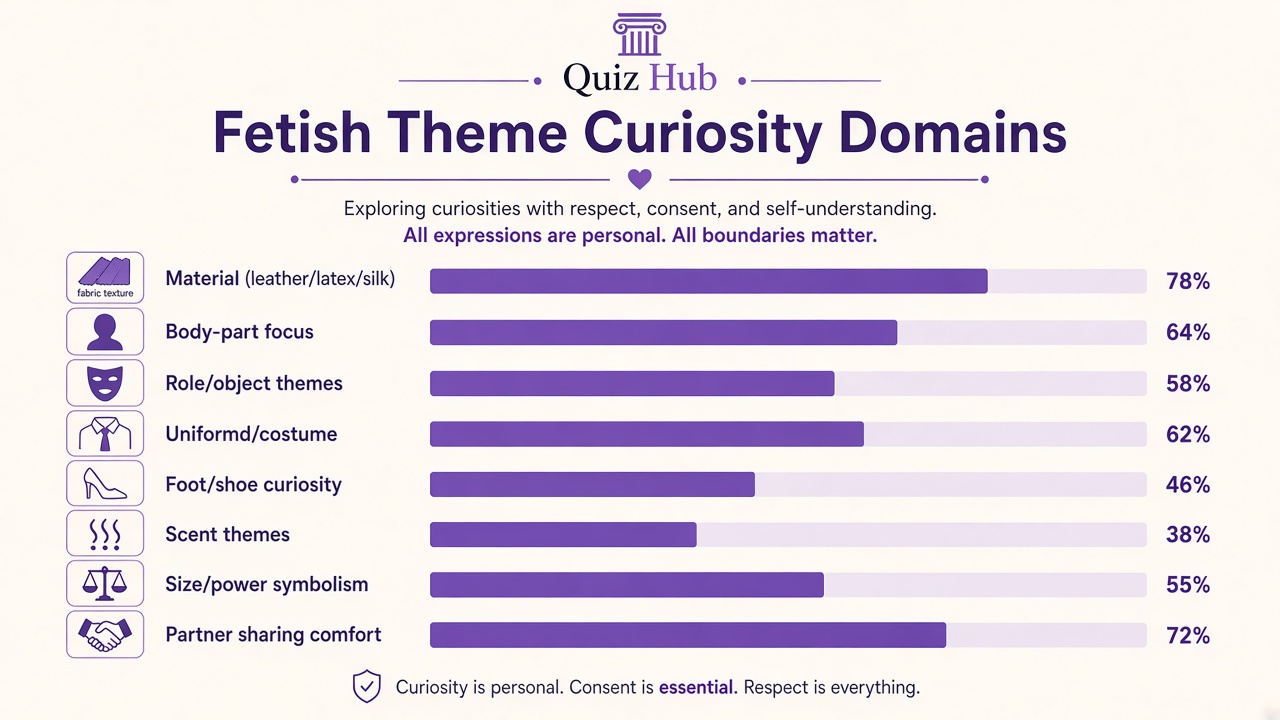
The diagram below shows how domain scores appear in your results. High safety education with moderate immobilization scores, for example, is a common pattern worth discussing with partners before escalating tie complexity.
What this bondage quiz can and cannot tell you
Can tell you
- Whether restraint themes lean curious, mixed, or strong on this screener
- Receiver versus rigger pull and switch flexibility within bondage specifically
- Seven domain scores for rope, cuffs, immobilization, sensory play, safety, and negotiation
- Circulation safety and negotiation priority signals for reflection before practice
Cannot tell you
- Whether you are ready to restrain a partner without formal education or supervision
- What any partner wants, owes, or should accept without explicit negotiation
- Official clinical scores or certification as a rigger or rope bottom
- Permission to skip safewords, circulation checks, or aftercare
Restraint curiosity, safety, and how this bondage quiz fits
Bondage sits on a wide spectrum inside consensual kink. Some adults feel drawn to decorative rope, padded cuffs, or the psychology of surrendering movement. Others prefer to rig scenes, study knot safety, or guide a partner through restrained sensory play. Many land in the middle with mixed interests that shift by partner and mood. Community educators emphasize circulation monitoring, nerve awareness, quick-release tools, and explicit negotiation before any tie touches skin. The Quiz Hub built this bondage test as a narrow lens on restraint preference with safety copy woven through every band.
The Kink Academy and similar consent-forward educators teach that rope is a skill, not a vibe. That framing shaped our items: receiver questions mention safewords, rigger questions mention check-ins, and safety items score as positively as curiosity items. This trade-off favors readable self-reflection while naming limits honestly. Pair results with our BDSM test for a nine-domain kink map, our how kinky are you quiz for broader openness bands, or our dominant or submissive test when power exchange also interests you.
| The Quiz Hub test | What it adds |
|---|---|
| BDSM test | Nine-domain kink profile with role tendency, not restraint-specific indices |
| How kinky are you quiz | General kink openness across novelty, power, sensation, and communication |
| Dominant or submissive test | D/s power exchange lean, not rope versus cuff equipment curiosity |
| This bondage test | Receiver and rigger indices, immobilization comfort, sensory deprivation with restraint, and safety signals |
Sample item: agreeing that you want circulation checks before trying cuffs raises your safety education domain. Agreeing that rope aesthetics interest you raises rope versus cuffs curiosity. Browse more quizzes on our kink and BDSM hub. Read how we review adult content in our editorial policy.
Bondage test FAQ
What does this bondage test measure?
This bondage quiz measures self-reported interest in consensual restraint play across seven domains: being tied, tying a partner, rope versus cuffs curiosity, immobilization comfort, sensory deprivation with restraint, safety education, and negotiation before restraint. Results show a restraint affinity index, receiver and rigger indices, safety priority, three bands, and a role lean when affinity is strong. It describes preference patterns, not a mandate to try bondage.
Is rope bondage safe to try after a quiz result?
No online bondage quiz replaces hands-on education. Circulation checks, nerve safety, emergency shears, safewords, and never leaving a bound person unattended are non-negotiable. High affinity scores mean you may want to learn from workshops or vetted instructors before restraining anyone or being restrained.
What is the difference between receiver and rigger lean?
Receiver lean suggests stronger pull toward being tied, held still, or experiencing restrained sensory play. Rigger lean suggests stronger pull toward applying rope, cuffs, or physical holds. Restraint Switch means both indices score high or close together. Role lean appears when your restraint affinity index reaches the strong band.
How is this different from a BDSM test or dominant submissive quiz?
This page focuses on bondage and restraint themes only. Our BDSM test maps nine broader kink domains. Our dominant or submissive test maps power exchange across eight D/s domains. Pair them when you want a wider map than rope and cuffs alone.
Can I enjoy bondage without full immobilization?
Yes. Many adults prefer light wrist restraint or decorative rope over full-body immobilization. Domain bars show where your comfort sits today. Mixed Restraint Interests is a common band when some themes appeal and others do not.
Who reviewed this content?
Dr. Morgan Chen, PhD, reviewed the test framing and result explanations. See our editorial policy for review standards.
Reviewed by