What this am I a masochist quiz measures
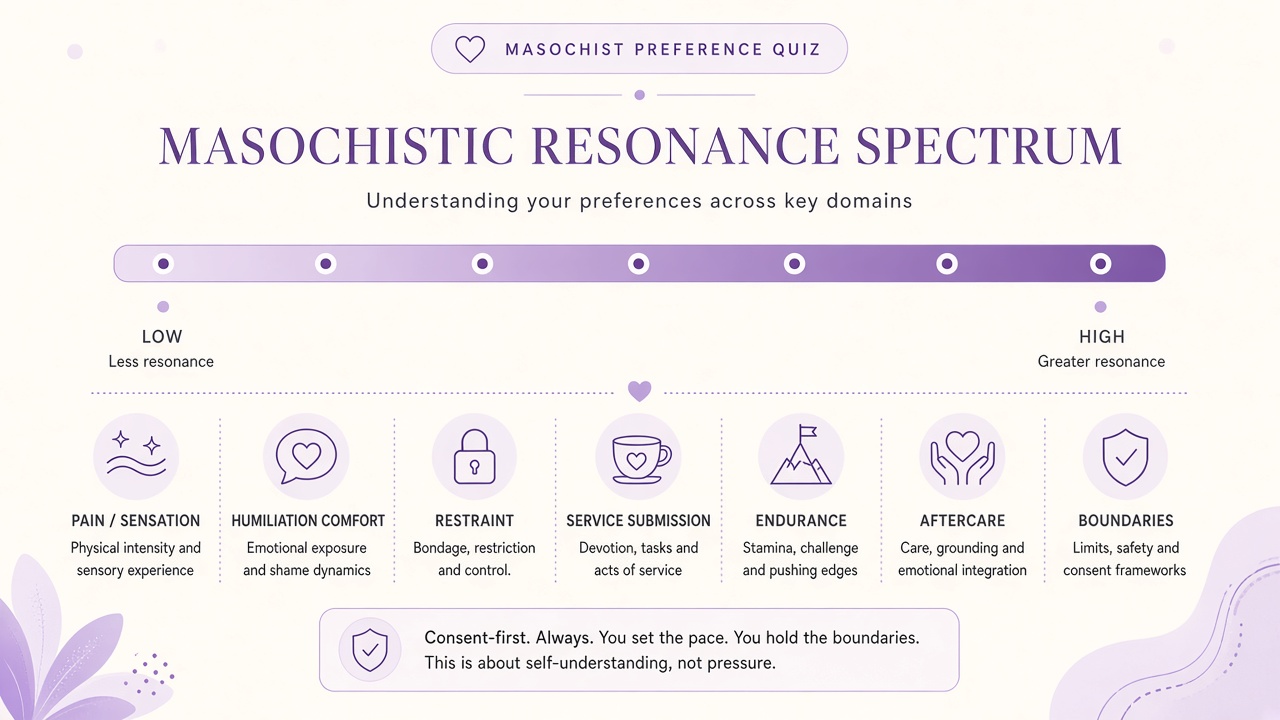
This masochist test screens seven domains researchers and community educators associate with consensual masochistic receiving preference. Every item assumes adults, negotiated limits, and the right to stop. Results describe lean on a spectrum, not a mandate for how any partner should treat you. Masochism in kink is not self-harm.
Pain / sensation enjoyment
Appeal of stronger consensual physical sensation, impact, and lingering intensity within agreed limits.
Humiliation / degradation comfort
Comfort with consensual verbal humiliation or status play when tone and safewords are negotiated.
Restraint receiving
Interest in being bound or limited in movement by a trusted partner after clear negotiation.
Service submission overlap
Meaning found in yielding or serving through challenging sensation you opted into freely.
Endurance / play intensity
Appeal of longer or more demanding scenes with pacing and check-ins built into the plan.
Aftercare needs
Importance of reassurance, warmth, and explicit post-scene care after intense receiving play.
Boundary communication
Priority on limits, safewords, renegotiation, and stopping when sensation starts to feel wrong.
How it works
Three steps from first statement to masochistic resonance index plus domain bars. Click Start Test to open the interactive quiz in a full-screen modal with session autosave.
Answer 24 statements
Rate agreement on a five-point scale. Each prompt begins with a consensual adult context reminder. There is no timer and no auto-advance.
Items map to seven domains
Your answers accumulate percentages for sensation, humiliation comfort, restraint, service overlap, endurance, aftercare, and boundary communication.
View index and band
Results show masochistic resonance index, boundary communication index, domain chart, signal flags, and one of three bands with consent-first next steps.
Take the masochist test
Rate 24 consent-first statements about receiving sensation, humiliation comfort, restraint, service overlap, endurance, aftercare, and boundary habits. Your answers produce a masochistic resonance index plus a band label.
Opens in a focused modal. Adults only. Results stay on screen.
What your result means
Your masochistic resonance index (0 to 100) is the average of six receiving-oriented domain scores, excluding boundary communication which scores separately. Higher percentages mean more frequent agreement with masochistic-theme items on this snapshot. Band assignment uses the resonance index only. No band ranks one preference as morally superior.
| Band | Score range | Plain-language reading |
|---|---|---|
| Low Masochistic Resonance | 0 to 35% | Limited pull toward receiving intense sensation or related themes on this screener |
| Moderate Sensation-Receiving Interest | 36 to 65% | Mixed interest worth exploring slowly with negotiation and aftercare |
| Strong Masochistic Lean | 66 to 100% | Stronger pull toward receiving intensity in consensual play, still not permission to coerce |
Masochistic domains and the preference spectrum
The diagram below shows how seven domains feed your masochistic resonance index alongside boundary communication scores. High pain enjoyment with low humiliation comfort, for example, is a common mixed pattern that can still land in Moderate Sensation-Receiving Interest when your overall index sits between bands.
What this test can and cannot tell you
Can tell you
- How your answers lean toward masochistic receiving themes today
- Which of seven domain bars scored highest on this snapshot
- Whether boundary communication scored alongside intensity interest
- When to explore our BDSM test or dominant or submissive test for sibling maps
Cannot tell you
- Whether masochism means self-harm or tolerating abuse outside negotiated play
- What any specific partner wants or owes you sexually
- Whether you must accept intensity a partner has not negotiated with you
- A fixed label that will never change as you gain experience
Masochism, consent, and receiving-side kink
Community educators and researchers emphasize that masochism in BDSM describes consensual enjoyment of receiving sensation or psychological intensity, not self-injury or tolerating harm you did not choose. The National Coalition for Sexual Freedom promotes consent policies that treat safewords, negotiation, and aftercare as baseline requirements. The Quiz Hub built this am I a masochist quiz to mirror that framing: every item references agreed boundaries, and boundary communication is its own scored domain.
Popular searches mix masochist test intent with broader BDSM curiosity or dominant versus submissive language. This page stays focused on receiving-side masochistic preference across seven themes. Our BDSM test maps wider kink interests. Our dominant or submissive test separates power-exchange lean from sensation receiving. Our sadist test explores the giving-side mirror. Pair them when you want more than one lens.
| Framework | What it means for masochistic play |
|---|---|
| SSC | Safe, Sane, Consensual: receiving intensity stays within negotiated physical and emotional limits |
| RACK | Risk-Aware Consensual Kink: partners acknowledge risks before intense receiving play |
| Enthusiastic consent | Yes means yes actively given; silence or pressure never counts as agreement to intensity |
| Aftercare | Post-scene comfort and emotional check-in are part of the activity, especially after heavy sensation |
| The Quiz Hub test | What it adds |
|---|---|
| BDSM test | Broader nine-domain kink map beyond masochistic receiving lean alone |
| Dominant or submissive test | Power exchange lean separate from sensation receiving preference |
| Sadist test | Giving-side sensation preference mirror to this receiving-side screener |
| This masochist test | Masochistic resonance index, boundary communication index, and seven domain bars |
Sample item: agreeing that you discuss safewords before intense receiving play raises your boundary communication score without automatically pushing masochistic resonance higher. Agreeing that consensual impact from a trusted partner feels exciting raises pain and sensation enjoyment. If aftercare items score highest, expect strong aftercare needs signals even in moderate bands. Browse more adult quizzes on our kink and BDSM hub or read how we review them in our editorial policy.
Masochist test FAQ
What does this masochist test measure?
This am I a masochist quiz measures self-reported pull toward receiving intense sensation and related masochistic themes in consensual adult play. Seven domains cover pain and sensation enjoyment, humiliation and degradation comfort, restraint receiving, service submission overlap, endurance and play intensity, aftercare needs, and boundary communication. Results show a masochistic resonance index, domain bars, and one of three bands. It describes preference patterns, not self-harm or tolerating mistreatment.
Is masochism the same as self-harm?
No. In kink communities, masochism means consensual enjoyment of receiving physical or psychological intensity between adults who negotiate limits, safewords, and aftercare. Self-harm occurs without that framework and often without partner consent. This quiz educates that distinction and scores boundary communication separately from intensity interest.
What is the difference between a masochist test and a BDSM test?
This page focuses on receiving-side masochistic preference across seven domains. Our BDSM test maps broader kink themes including dominance, submission, bondage, roleplay, and switch flexibility. Pair them when you want a wider map than masochistic lean alone.
Does a Strong Masochistic Lean result mean I must accept any intensity?
Absolutely not. High masochistic resonance describes what you might enjoy when you have opted in. It never excuses pressure, coercion, or ignoring a safeword. Enthusiastic consent can be revoked at any time. High boundary communication scores should accompany any intensity lean.
How long does the masochist test take?
Most people finish in about six minutes. There are 24 agree-disagree items on a five-point scale. You can pause and return in the same browser session thanks to autosave.
Who reviewed this content?
Dr. Morgan Chen, PhD, reviewed the test framing and result explanations. See our editorial policy for review standards.
Reviewed by