What this gay bubble quiz measures
This gay bubble quiz estimates how immersed you feel in queer social worlds across five playful domains. Four items cover LGBTQ+ media habits such as queer shows, creators, and pop culture references. Four items cover queer friend group connection and social plans in gay bars or mixed hangouts. Four items cover Pride parades, rainbow symbols, and public visibility comfort. Four items cover fluency with camp, sapphic memes, drag quotes, and gay internet humor. Three items cover familiarity with Grindr, HER, Tinder queer modes, and common app etiquette.
LGBTQ+ media fluency
Keeping up with queer shows, films, creators, and pop culture references in everyday conversation.
Queer friend group connection
How often close friends and social plans center LGBTQ+ people and queer-friendly spaces.
Pride and visibility comfort
Comfort with Pride parades, rainbow symbols, and public LGBTQ+ visibility when you choose it.
Queer humor and meme fluency
Understanding camp, sapphic memes, drag references, and gay internet humor without a glossary.
Queer dating app familiarity
Familiarity with Grindr, HER, Tinder queer modes, and common app etiquette from use or close friends.
How it works
Three steps from first question to your bubble band. Click Start Quiz to open the interactive screener in a full-screen modal.
Answer 19 agree items
Rate each statement from Strongly disagree to Strongly agree. There is no timer and no auto-advance. Some items are reverse-scored so honest disagreement still maps correctly.
Items map to five domains
Your answers accumulate percentages for media, friends, Pride, humor, and dating apps, plus a bubble core flag when media and friend-group core items align.
View a playful band
Results show Outside the Bubble, Partly Connected, or Deep in the Bubble with domain bars and lighthearted next steps. This is not orientation detection or community gatekeeping.
Take the gay bubble quiz
Rate 19 queer social world statements on a five-point agree scale. Your answers produce a bubble immersion index, five domain scores, a bubble core flag, and one of three playful bands with plain-language guidance.
Opens in a focused modal. No account required. Results stay on screen.
What your result means
Your overall bubble immersion index normalizes total agreement across all 19 items to a 0 through 100 scale, with reverse-scored items adjusted so higher scores mean more immersion in queer social worlds on these questions. The band groups that index into playful language. Domain bars show whether media, friends, Pride, humor, or dating apps drives your result. A bubble core flag appears when three or more of four core media and friend-group items rate Agree or Strongly agree. Lower index scores reflect less immersion on this screener, not less worth as a person or community member.
| Bubble band | Score range | Typical reading |
|---|---|---|
| Outside the Bubble | 0 to 35% | Lower immersion in queer media, friend networks, Pride, humor, and app familiarity on these items |
| Partly Connected | 36 to 65% | Blend of queer social fluency and gaps across one or more domains |
| Deep in the Bubble | 66 to 100% | Frequent agreement across media, friends, Pride, humor, and app familiarity items |
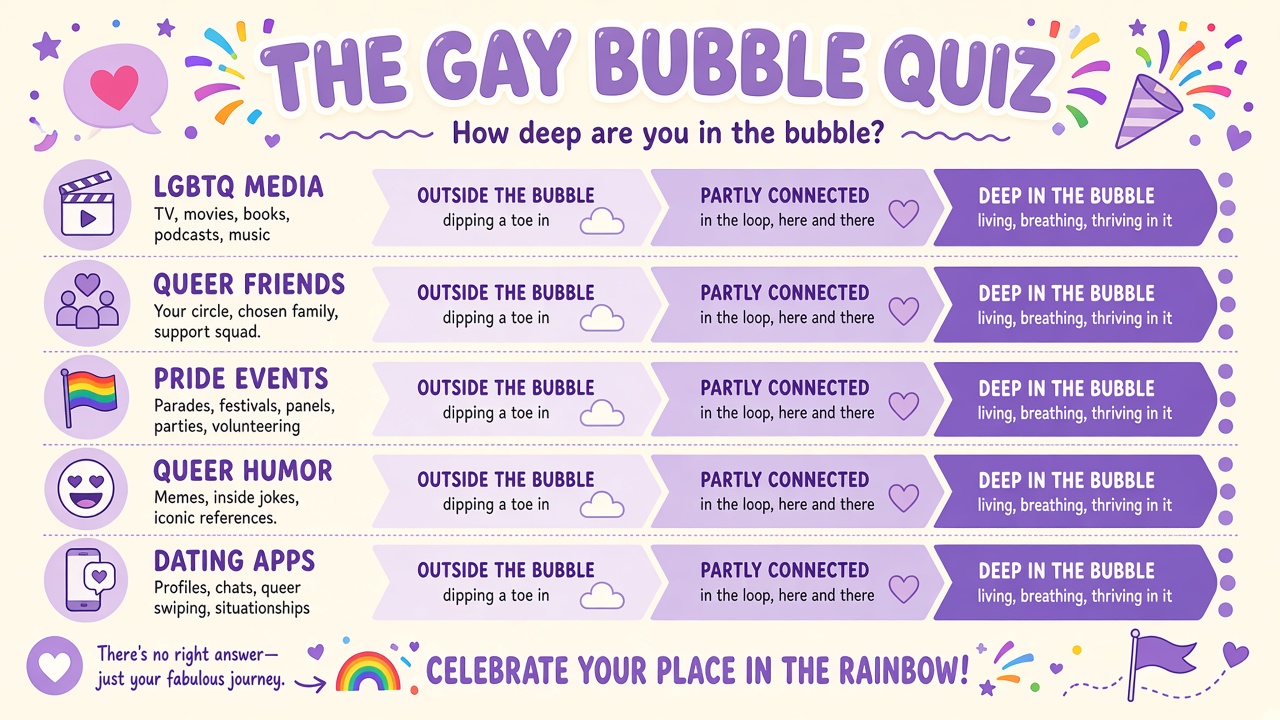
Five queer social world domains
The diagram below shows how domain scores appear in your results. High media fluency with moderate Pride comfort often lands you in Partly Connected even when you feel deeply queer in identity.
What this quiz can and cannot tell you
Can tell you
- Whether your self-reported habits lean toward outside the bubble, partly connected, or deep in the bubble on these items
- A bubble immersion index and five domain scores for media, friends, Pride, humor, and dating apps
- A bubble core flag when three or more of four core media and friend-group items rate Agree or Strongly agree
- A starting point for playful reflection about queer social worlds with friends
Cannot tell you
- Whether you are gay, lesbian, bisexual, queer, straight, or any other orientation
- That you belong in or outside LGBTQ+ community membership
- Whether allies are less valid or closeted people are less immersed than they feel
- How to gatekeep, rank, or purity-test anyone based on meme literacy or Pride attendance
What people mean by the gay bubble and why online quizzes go wrong
In queer slang, the gay bubble describes how immersed someone feels in LGBTQ+ media, friend networks, Pride culture, humor, and dating app ecosystems. Sociologist Mary Gray documented in her 2009 ethnography Out in the Country how rural LGBTQ+ youth build digital queer worlds online when local scenes feel thin. That pattern still shapes who scores high on media and humor items while landing low on in-person Pride comfort.
The Quiz Hub built this gay bubble quiz as a reflective screener for people who search gay bubble quiz or gay bubble test expecting a meme purity test or orientation detector. It uses original plain-language items across five domains with three playful bands rather than reproducing TikTok gatekeeping jokes or claiming to certify queerness. That trade-off favors readable copy and honest limits for casual users while naming why bubble scores vary. The GLAAD Media Reference reminds creators that LGBTQ+ identity is personal and should not be reduced to pop culture fluency alone.
| The Quiz Hub test | What it adds |
|---|---|
| LGBTQ+ test | Broader community resonance across pride affiliation, identity language, and advocacy comfort |
| Gaydar test | Perception bias education about stereotype reliance and privacy respect, not social world fluency |
| What kind of lesbian am I quiz | Playful lesbian archetype reflection for sapphic readers who want a sibling vibe check |
| This gay bubble quiz | Nineteen queer social world items with bubble core flag and three playful bands without gatekeeping |
Sample item: agreeing that you keep up with queer TV raises your LGBTQ+ media domain score. Agreeing that queer humor goes over your head lowers humor fluency even when you have plenty of LGBTQ+ friends. Geography, profession, and relationship structure can split domain scores without you being more or less queer. Browse more screeners on our sexuality and LGBTQ+ hub or read how we review quizzes in our editorial policy.
Gay bubble quiz FAQ
What does the gay bubble quiz measure?
This gay bubble quiz measures self-reported comfort and familiarity across five playful domains: LGBTQ+ media fluency, queer friend group connection, Pride and visibility comfort, queer humor and meme fluency, and queer dating app familiarity. Nineteen Likert items produce a bubble immersion index, five domain bars, a bubble core flag, and one of three fun bands. It is not a gatekeeping test and does not certify your orientation.
Does a high score mean I am gay or queer?
No. A Deep in the Bubble band means your answers suggest frequent immersion in queer social worlds on these items, not a diagnosis of orientation. Straight allies with queer friend groups, rural readers who binge queer shows, and closeted people who consume culture online can all score high. Only you decide which labels fit. This quiz is a playful mirror, not a membership card.
Does a low score mean I am not LGBTQ+ enough?
No. Outside the Bubble describes lower agreement with media, friend group, Pride, humor, and app familiarity items on this screener. Many LGBTQ+ people feel outside the bubble in some seasons of life, and many allies land low without being less valid. Geography, profession, family structure, and social phase all shape scores. There is no correct score for being queer.
How is this different from the LGBTQ+ test?
Our LGBTQ+ test takes a broader community lens across pride affiliation, multi-letter identity resonance, discrimination awareness, chosen family, and advocacy comfort. This gay bubble quiz focuses on playful social world fluency: queer media habits, friend networks, Pride comfort, gay humor literacy, and dating app familiarity. Pair them when you want both community reflection and a lighter vibe check.
How long does the gay bubble quiz take?
Most people finish in about 5 minutes. There are 19 items on a five-point agree scale from Strongly disagree to Strongly agree. You can pause and return in the same browser session thanks to autosave.
Who reviewed this content?
Dr. Morgan Chen, PhD, reviewed the test framing and result explanations. See our editorial policy for review standards.
Reviewed by