What the gaslighting victim questionnaire measures
This quiz does not administer the published Victim Gaslighting Questionnaire, predict legal outcomes from one session, or declare which partner is abusive from bar height. It measures how much you agree with unofficial VGQ-literacy statements grouped four ways: VGQ screening literacy about brief screeners and follow-up steps without abuse dunk threads or pasted total cosplay; reality-doubt context about memory-and-perception patterns versus identity labels without soul-sentence collapse; safety and advocate literacy about hotlines, safety questions, and confidential support without screenshot court cosplay; and unofficial VGQ limits about inspired framing, private reflection, and humility about mailed batteries. You rate 22 statements from strongly disagree to strongly agree, with reverse-worded items flipped first so agreeable mood cannot hide cosplay or verdict traps. Your answers also feed a second chart on closeness and trust habits, because shame about relationship talk sometimes blocks honest help-seeking questions. The total becomes an index from 0 to 100 where higher means more reported literacy habits on this screener, not proof your screening vocabulary is perfect forever.
VGQ screening literacy
Brief screeners without abuse verdict cosplay.
Reality-doubt context
Memory attacks deserve support, not dunk threads.
Safety and advocate literacy
Hotlines and plans without meme courts.
Unofficial VGQ limits
Educational reflection; not mailed VGQ forms.
How it works
Answer 22 agreement items
Rate each statement from Strongly disagree to Strongly agree. Tap Next after each answer.
Answers sort into four domains
Each answer feeds one of four VGQ literacy groups, and every item also feeds a closeness and trust layer.
See your index and charts
You get a 0 to 100 index, a band, four domain bars, and a second chart for intimacy habits.
Take the Gaslighting Victim Questionnaire (VGQ Inspired)
Answer 22 short statements to see your VGQ screening literacy index, four domain bars, and a closeness and trust chart.
What your result means
Your index is the average of all 22 answers, scaled from 0 to 100, with reverse-worded items flipped first. Read VGQ and advocate bars together with unofficial limit scores before you treat a high total as proof you need no advocate when doubt feels crushing. Educational reflection supports safer screening talk; advocates, clinicians, and crisis lines still own responses when safety is at risk.
| Band | Index range | Typical reading |
|---|---|---|
| Building VGQ literacy | 0 to 35 | Fewer agreed habits on VGQ vocabulary, reality-doubt context, advocate literacy, or unofficial limits on this screener. |
| Mixed VGQ literacy | 36 to 65 | Solid vocabulary in some domains with pasted-item traps, partner-verdict corners, bar-height abuse slips, or inventory cosplay. |
| Strong VGQ literacy | 66 to 100 | Frequent agreement with VGQ, doubt-context, and advocate literacy plus unofficial limits; still not VGQ scores or abuse authority. |
Tips at a glance
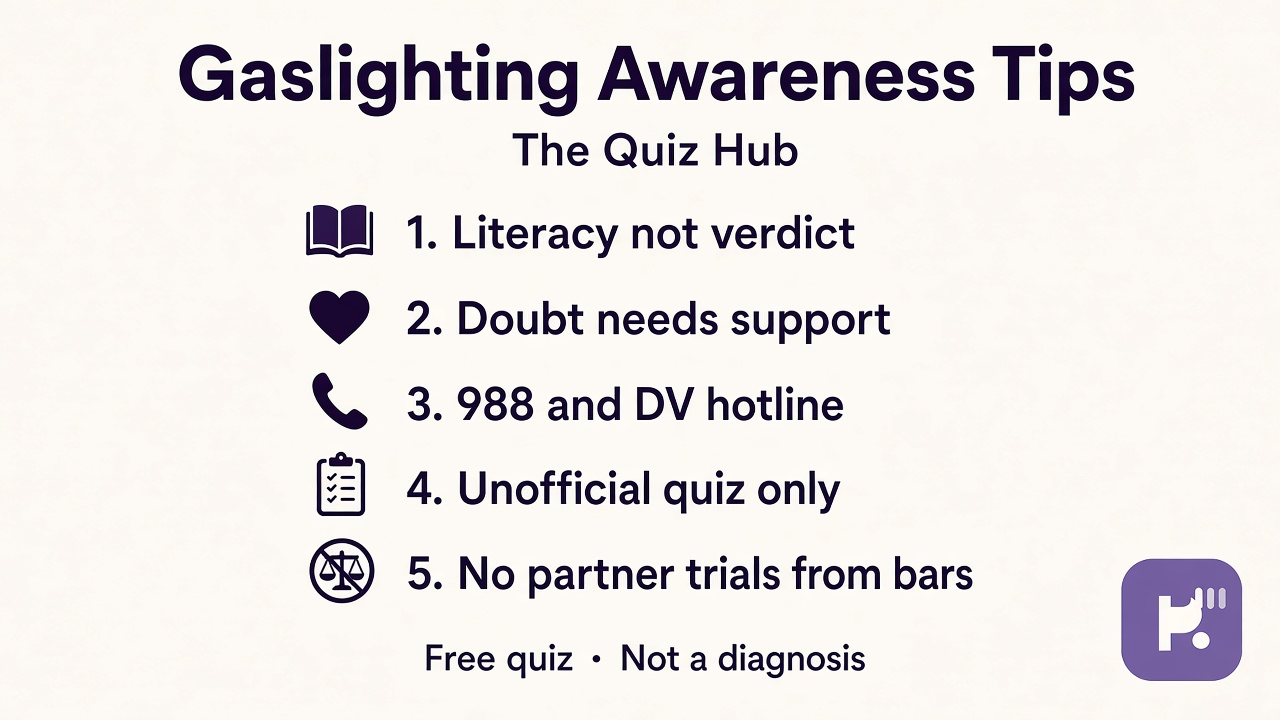
A quick takeaway graphic with topic tips (not your personal quiz scores). Start the quiz for your index, bands, and charts.
What this quiz can and cannot tell you
Can tell you
- Translate VGQ screening language into one honest advocate or trusted friend conversation starter
- Separate author measurement literacy from emotional abuse frequency siblings on this hub
- Notice abuse-verdict cosplay confusion without public partner dunk threads
- Spark better questions about screening research without claiming forensic authority
Cannot tell you
- Replace therapy, advocacy, emergency care, legal advice, or safety planning when harm feels serious
- Publish official VGQ scores or certify research cutoffs from this agree screener
- Prove you are or are not being gaslit from one literacy quiz
- Give permission to diagnose or shame partners in public threads from bar height
Why VGQ literacy needs screening context without pasted-item abuse verdict threads
Search traffic around gaslighting victim questionnaires often follows advocacy units citing brief screeners while social feeds paste item lists beside partner dunk threads as if both were one abuse machine. Those goals help when readers name screening versus safety planning steps, practice doubt-context humility, and refuse public ranking polls about who is really victimized. They hurt when literacy bars become proof someone may mock a friend for calling a hotline, or when agree totals replace listening when someone already named scary isolation. VGQ literacy works best when it pairs measurement language with unofficial limits and stays distinct from emotional abuse frequency siblings on this hub.
Dr. Elena Vasquez reviews YMYL relationship screeners with a simple split: reward honest VGQ language and honest refusal of inventory cosplay and abuse dunk threads at the same time. VGQ screening literacy tracks screener framing without verdict mailers. Reality-doubt context tracks memory-and-perception patterns without soul-label collapse. Safety and advocate literacy tracks hotline workflow without meme court orders. Unofficial VGQ limits track unofficial framing, private reflection, and humility about mailed batteries.
Real people mix bars. You might score high on VGQ naming while keeping advocate recall moderate, which often describes students who know acronyms yet still want verdict polls at holidays. You might score high literacy with softer limit items, which can mean you avoid public posts yet still treat quiz totals like partner audit notes. Reverse items catch overconfidence: VGQ paste cosplay, stranger abuse rights, screenshot court crowns, or bar-height verdict trials should not inflate scores meant to track layered habits.
Pair results with siblings on this hub instead of forcing one abuse story. Our emotional abuse questionnaire EAQ 1122 explores past-two-week frequency stems with separate wording rather than VGQ literacy on this page. Our dysfunctional relationships scale DRS stays on respect and repair lanes rather than unofficial VGQ limits here. Our narcissistic abuse quiz offers another reflection lane when entitlement patterns overlap. Browse the mental health and clinical hub for more YMYL screeners. Share scores as private conversation starters with consent, not as orders about who lacks valid suffering.
News cycles and family arguments move faster than one calm screening question on a sticky note. A VGQ bar might dip after one grief month while advocate recall stays high until you retake gently. When you share results, say unofficial literacy habits. When you borrow tips, credit advocates who taught you hotline numbers and friends who deserve privacy off-screen. Retake after one hard season and watch whether unofficial limit bars stay high even if measurement items rise, which often means you separated curious reading from abuse-verdict pressure.
| Test | Focus |
|---|---|
| Emotional abuse questionnaire EAQ 1122 | Past-two-week emotional abuse frequency stems rather than VGQ screening literacy on this page |
| Dysfunctional relationships scale DRS | Respect and repair themes rather than unofficial VGQ limits here |
| Narcissistic abuse quiz | Entitlement and cruelty patterns rather than VGQ framing on this screener |
Gaslighting Victim Questionnaire (VGQ Inspired) FAQ
What does the gaslighting victim questionnaire VGQ measure?
It measures how much you agree with statements about VGQ screening literacy, reality-doubt context, safety and advocate literacy, and unofficial VGQ limits. You get an index from 0 to 100 plus four bars. It reflects self-reported awareness habits on this screener, not official VGQ frequency totals.
Is this the same as the clinical VGQ screener?
No. The emotional abuse questionnaire sibling uses separate past-two-week frequency stems. This page focuses on VGQ-inspired screening literacy with unofficial limit items.
Can VGQ language tell me I am being gaslit?
No. Literacy items stress screening vocabulary and advocate follow-up habits with wide individual variation. VGQ language is not an abuse verdict from one agree session. If you feel unsafe, contact an advocate or clinician.
What should I do if I feel unsafe in my relationship?
Contact the National Domestic Violence Hotline at 1-800-799-7233, call or text 988 in the US, or reach local emergency services and a licensed advocate or clinician. This quiz cannot assess safety or replace emergency care.
Who reviewed this quiz?
Dr. Elena Vasquez reviewed the unofficial framing, screening not verdict separation, crisis resources, limit tone, and result explanations. See our editorial policy for review standards.
Reviewed by