What the Dysfunctional Relationships Scale screener measures
This quiz does not certify you on any published Dysfunctional Relationships Scale used in research clinics, and it cannot decide whether you should stay in a relationship. Only a qualified clinician using interview methods and safety screening can do that. It measures how often you have noticed habits therapists and researchers group when partnerships turn strained or coercive, organized four ways: respect and repair after conflict, jealousy and control that narrows autonomy, emotional safety when honesty feels dangerous, and leaving or help limits when outreach or boundaries feel blocked. You answer 22 how-often statements about the past month, with reverse-worded items so one good apology cannot hide frequent monitoring or fear on other days. Your responses also feed a second chart on closeness and trust habits, because control strain often rises when vulnerability feels risky. The total becomes an index from 0 to 100 where higher means more frequent reported dysfunctional strain on this screener, not proof your partner is abusive or that you must leave today.
Respect and repair
How often dignity, specific feedback, and follow-up talks followed hurt instead of contempt.
Jealousy and control
How often suspicion became monitoring, friendship rules, or demands that shrank mutual freedom.
Emotional safety
How often eggshell habits, fear, or forced apologies replaced honest disagreement.
Leaving and help limits
How often help-seeking, resource awareness, or clear limits showed up versus shame or stuck hope.
How it works
Answer 22 frequency items
Rate each statement from Never to Very often for the past month. Tap Next after each answer.
Answers sort into four domains
Each answer feeds one of four strain groups, and every item also feeds a closeness and trust layer.
See your index and charts
You get a 0 to 100 index, a band, and two bar charts you can bring to a therapist.
Take the Dysfunctional Relationships Scale
Answer 22 short statements to see your dysfunctional relationship strain index, four domain bars, and a closeness and trust chart.
What your result means
Your index is the average of all 22 answers, scaled from 0 to 100, with reverse-worded items flipped first. Higher means more frequent reported strain on this screener. Read jealousy control and emotional safety bars together before the total, since monitoring can look like care while fear grows.
| Band | Index range | Typical reading |
|---|---|---|
| Lower reported relationship strain | 0 to 35 | Fewer frequent disrespect, control, safety fear, or help-avoidance signals in the past month. |
| Mixed reported relationship strain | 36 to 65 | Some domains look steadier while respect, control, safety, or help habits spike under stress. |
| Higher reported relationship strain | 66 to 100 | Frequent disrespect, control, or safety fear; professional or safety support may help more than another argument. |
Tips at a glance
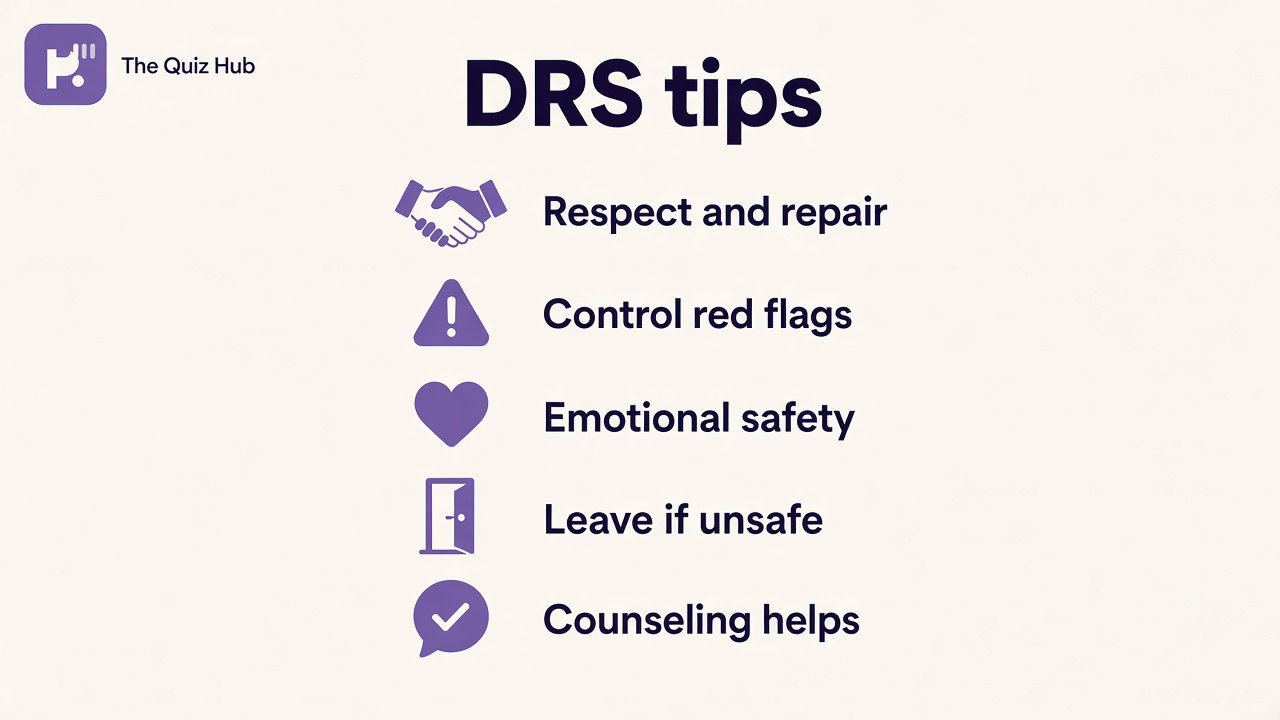
A quick takeaway graphic with topic tips (not your personal quiz scores). Start the quiz for your index, bands, and charts.
What this quiz can and cannot tell you
Can tell you
- Name respect, control, safety, and help-limit habits in plain language
- Highlight when repair, autonomy, or outreach habits are missing
- Give you vocabulary for therapy intake or trusted friend conversations
- Offer a baseline if you retake after trying one boundary or safety step
Cannot tell you
- Replace a certified DRS or any clinician-administered relationship violence screen
- Diagnose your partner or prove who is at fault without evaluation
- Replace abuse assessment, safety planning, or legal advice
- Tell you whether to stay, leave, or forgive from one score
Respect, control, safety, and knowing when help beats another fight
Dysfunctional relationship strain is not the same as every hard month. Ordinary couples miss repairs, get jealous during stress, and say things they regret. Strain becomes a pattern when disrespect sticks, control narrows daily life, honesty feels dangerous, and help stays out of reach because shame or fear wins. Researchers have used dysfunctional relationship scales in studies to group those habits; this online screener is inspired by that lens but is not the certified instrument.
Respect and repair cover how conflict ends, not whether you never fight. Contempt, character attacks, and punitive silence teach both people that hurt will not be answered with curiosity. Repair means cooling off, naming impact, and asking for one change without dragging every old receipt into the room. When repair is rare, jealousy and control bars often climb next because trust has nowhere to land.
Jealousy and control show up when suspicion becomes surveillance: phones, location, friendships, or wardrobe choices policed without mutual consent. Occasional insecurity is human; frequent monitoring is a strain signal worth naming in therapy or safety planning. Emotional safety is the bar that asks whether you can disagree, cry, or set a limit without bracing for punishment. Walking on eggshells, forced apologies, and hidden needs are not proof you are too sensitive; they are data about the climate you live in.
Leaving and help limits are not instructions to rush out the door. They measure whether you know crisis lines, advocates, or therapists exist, whether you can name a line you will not cross, and whether hope keeps you silent when fear is also present. Our dyadic adjustment scale DAS-2083 sibling emphasizes satisfaction and shared time when strain still feels like adjustment stress. The drama triangle questionnaire maps victim, rescuer, and persecutor loops when fights feel stuck in roles. The relationship anxiety quiz helps when worry and reassurance cycles amplify distance even when respect mostly holds.
Higher scores mean more frequent self-reported strain, not a curse word for your partner. Bring domain bars to intake so sessions start with examples, not shame. If control spikes pair with fear at home, skip online debate and prioritize safety resources. Retake after a month of one measurable boundary and compare bars, not only the total. Licensed clinicians help you separate fixable conflict from patterns that need safety planning first.
| Test | Focus |
|---|---|
| Dyadic adjustment scale DAS-2083 | Shared time and repair habits when strain still feels like adjustment stress |
| Drama triangle questionnaire | Victim, rescuer, and persecutor loops when conflict feels theatrical |
| Relationship anxiety quiz | Worry and reassurance habits when fear is more about attachment than control |
Dysfunctional Relationships Scale FAQ
What does this quiz measure?
It measures how often you noticed respect and repair, jealousy and control, emotional safety, and leaving or help limit habits in your romantic or close partnership during the past month. You get an index from 0 to 100 plus four domain bars. It reports self-reported frequency, not a clinical diagnosis.
Is this the official Dysfunctional Relationships Scale (DRS)?
No. This is an unofficial, inspired screener for self-reflection. It is not a certified clinical DRS and cannot replace a clinician-administered assessment or abuse screen.
Can this quiz tell me if my partner is abusive?
No. Only trained professionals using interviews, collateral information, and safety screening can assess abuse or coercion. Use this tool to describe patterns and decide whether therapy, advocacy, or safety planning might help.
What should I do if my score is high?
Try one stated boundary, protect one friendship or solo activity, and book a therapist or advocate if patterns repeat. If you feel unsafe or controlled, contact trusted support or domestic violence resources instead of relying on a score.
Who reviewed this quiz?
Dr. Elena Vasquez, PhD reviewed the YMYL framing, relationship limits, and safety notes. See our editorial policy for review standards.
Reviewed by