What the Emotional Abuse Questionnaire screener measures
This quiz does not administer the official Emotional Abuse Questionnaire (EAQ-1122) from research settings, and it cannot decide whether you should stay in a relationship or win a legal case. Only qualified clinicians, advocates, and courts using interview methods and safety screening can do that. It measures how often you noticed habits researchers and advocates group when emotional abuse warning signs appear, organized four ways: degrading and blame when insults or fault-shifting replace respect; control and isolation when monitoring or permission rules narrow daily life; fear and emotional safety when honesty feels dangerous; and safety planning and limits when self-blame, hotline awareness, or quiz-as-verdict myths block reflection and help. You answer 22 how-often statements about the past month, with reverse-worded items so one respectful disagreement cannot hide frequent monitoring or fear on other days. Your responses also feed a second chart on closeness and trust habits, because control strain often rises when vulnerability feels risky. The total becomes an index from 0 to 100 where higher means more frequent reported warning-sign patterns on this screener. Your responses suggest intensity and habits to discuss with support; they do not mean you failed or deserved harm.
Degrading and blame
How often put-downs, doubt about your memory, or blame for their mood replaced respectful conflict.
Control and isolation
How often surveillance, friendship rules, or money control narrowed mutual autonomy.
Fear and emotional safety
How often eggshell habits, forced apologies, or hidden needs replaced honest limits.
Safety planning and limits
How often self-blame, outreach shame, hotline awareness, and quiz humility showed up versus stuck silence.
How it works
Answer 22 frequency items
Rate each statement from Never to Very often for the past month. Tap Next after each answer.
Answers sort into four domains
Each answer feeds one of four warning-sign groups, and every item also feeds a closeness and trust layer.
See your index and charts
You get a 0 to 100 index, a band, and two bar charts you can bring to a therapist or advocate.
Take the Emotional Abuse Questionnaire (EAQ-1122)
Answer 22 short statements to see your emotional abuse warning sign index, four domain bars, and a closeness and trust chart.
What your result means
Your index is the average of all 22 answers, scaled from 0 to 100, with reverse-worded items flipped first. Higher means more frequent reported warning signs on this screener. Read control and fear bars together before the total, since monitoring can look like care while fear grows.
| Band | Index range | Typical reading |
|---|---|---|
| Lower reported warning sign strain | 0 to 35 | Fewer frequent put-down, control, fear, or blocked-help signals in the past month. |
| Mixed reported warning sign strain | 36 to 65 | Some domains look steadier while blame, control, fear, or help habits spike under stress. |
| Higher reported warning sign strain | 66 to 100 | Frequent put-downs, control, or fear; safety planning and professional support may help more than another argument. |
Tips at a glance
A quick takeaway graphic with topic tips (not your personal quiz scores). Start the quiz for your index, bands, and charts.
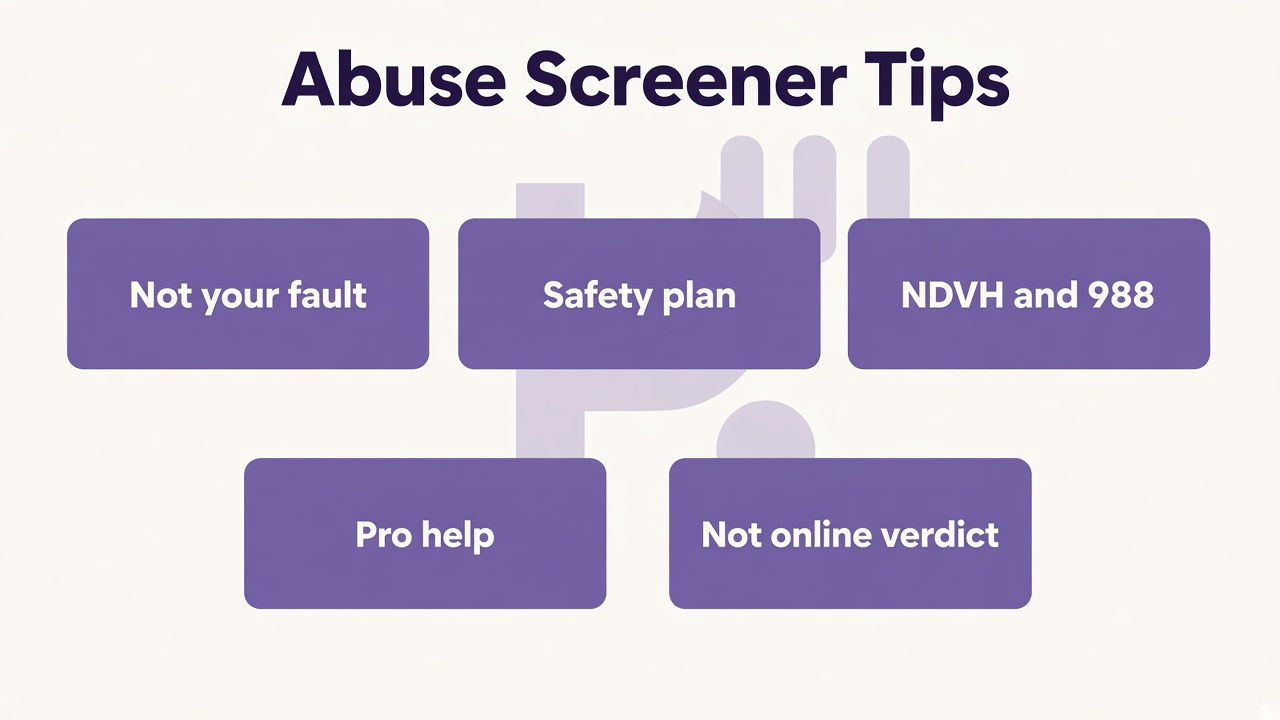
What this quiz can and cannot tell you
Can tell you
- Name put-down, control, fear, and help-limit habits in plain language for intake
- Highlight when respect, autonomy, or outreach habits are missing
- Support early conversations with therapists, advocates, or trusted friends
- Offer a baseline if you retake after one boundary or safety step
Cannot tell you
- Replace the validated EAQ-1122 or any clinician-administered abuse assessment
- Prove abuse in court, custody hearings, or immigration cases from one score
- Diagnose your partner or tell you whether to stay, leave, or forgive
- Replace safety planning, legal advice, or the National Domestic Violence Hotline
Warning signs, not your fault: blame, control, fear, and safety first
People search emotional abuse questionnaires when put-downs, jealousy rules, or walking on eggshells stop feeling like ordinary couple stress. Researchers have published instruments such as the Emotional Abuse Questionnaire (EAQ-1122) in study settings; this online screener is inspired by that warning-sign lens but is not the official validated form. Your responses suggest where habits cluster so you can describe them to an advocate or therapist, not so a bar chart replaces safety planning.
Degrading and blame cover how hurt lands, not whether you never disagree. Insults, mockery, silent punishment, and phrases like you are too sensitive teach both people that concerns will be met with shame instead of curiosity. Being told your memory is wrong whenever you raise a pattern is a warning sign advocates name often, even when no one uses the word gaslighting. Disagreement without character attacks is a reverse signal that respect sometimes still shows up, which many people want to protect or rebuild with help.
Control and isolation show up when suspicion becomes surveillance: phones, location, friendships, money, or medical appointments policed without mutual consent. Occasional insecurity is human; frequent monitoring is a strain signal worth naming in therapy or safety planning. Emotional safety is the domain that asks whether you can cry, set a limit, or leave a room without bracing for payback. Forced apologies and hidden needs are not proof you are too dramatic; they are data about the climate you live in.
Safety planning and limits are not instructions to rush out the door. They measure whether self-blame keeps you silent, whether you know the National Domestic Violence Hotline at 1-800-799-7233 or call or text 988 when crisis spikes, and whether online tools get mistaken for legal verdicts. Abuse is not your fault; shame often outlasts the loudest insult. Our dysfunctional relationships scale (DRS) sibling emphasizes respect, jealousy control, and repair when strain still feels like partnership conflict. The gaslighting victim questionnaire (VGQ) adds doubt-and-reality themes when memory and perception feel under attack. The narcissistic abuse quiz offers another reflection lane when entitlement and cruelty patterns overlap. Browse the mental health and clinical test hub for more YMYL screeners with study-not-diagnosis framing.
Higher scores mean more frequent self-reported warning signs, not a curse word for your partner and not proof for court. Bring domain bars to intake so sessions start with examples, not shame. If control spikes pair with fear at home, skip online debate and prioritize 1-800-799-7233, 988, or a local advocate. Retake after a month of one measurable boundary when safe and compare bars, not only the total. Licensed clinicians and advocates help you separate fixable conflict from patterns that need safety planning first.
| Test | Focus |
|---|---|
| Dysfunctional relationships scale (DRS) | Respect, jealousy control, and repair when strain still feels like partnership conflict |
| Gaslighting victim questionnaire (VGQ) | Doubt and reality themes when perception feels under attack |
| Narcissistic abuse quiz | Entitlement and cruelty patterns when emotional harm overlaps with control |
Emotional Abuse Questionnaire (EAQ-1122) FAQ
What does this quiz measure?
It measures how often you noticed degrading and blame, control and isolation, fear and emotional safety, and safety planning limit habits in a close relationship during the past month. You get an index from 0 to 100 plus four domain bars. Your responses suggest self-reported frequency for reflection, not a clinical diagnosis or legal finding.
Is this the official Emotional Abuse Questionnaire (EAQ-1122)?
No. This is an unofficial, inspired screener for self-reflection. It is not the validated EAQ-1122 used in research clinics and cannot replace a clinician-administered assessment or advocate-led safety screen.
Can this quiz prove abuse in court or tell me to leave?
No. Only trained professionals and legal processes using interviews, evidence rules, and safety screening can assess abuse or decide stay-or-leave questions. Use this tool to describe patterns and consider therapy, advocacy, or safety planning. Abuse is not your fault.
Why are some statements worded as respect or hotline awareness?
Reverse-worded items catch overconfidence. Agreeing that you were disagreed with respectfully, kept friendships without surveillance, felt safe naming a small limit, looked up 1-800-799-7233 or safety steps, or kept screeners separate from legal verdicts should not inflate a warning-sign index meant to track strain.
What should I do if my score is high or I feel unsafe?
Call the National Domestic Violence Hotline at 1-800-799-7233, call or text 988 (US) if crisis feels immediate, or contact a licensed therapist or advocate with domain examples from your results. Prioritize safety over retakes when fear or control is active.
Who reviewed this quiz?
Dr. Elena Vasquez, PhD reviewed the YMYL framing, crisis resources, not-your-fault language, unofficial EAQ-1122 limits, and result explanations. See our editorial policy for review standards.
Reviewed by