What this financial anxiety quiz measures
This page does not administer published Personal Financial Anxiety Scale forms or any insurer-ready clinical worksheet, and it cannot diagnose generalized anxiety disorder, panic disorder, or obsessive compulsive patterns from one score. It measures how often you noticed habits clinicians and financial counselors often discuss when money worry strains daily life, organized four ways: bill and payday dread when due dates, income gaps, or avoidance spiked before facts; account checking loops when apps, hiding, or partner conflict rode on fear more than amounts; future money spirals when retirement, housing, debt, or job-loss stories ran ahead of plans; and financial anxiety quiz limits when unofficial screeners replaced support visits, skipped 988 during despair spikes, or mocked others money stress. You answer 22 how-often statements about the past month, with reverse-worded items so one calm bill week, one spending log, one support plan, or one crisis lookup cannot hide frequent strain on other days. Your responses also feed a second chart on closeness and trust habits, because shame about money sometimes blocks asking for help. The total becomes an index from 0 to 100 where higher means more frequent reported financial anxiety worry patterns on this screener. Your responses suggest intensity to discuss with support; they do not prove you must accept dismissal from every clinic or planner.
Bill and payday dread
How often due dates, gaps, and avoidance spiked before you checked facts.
Account checking loops
How often app refreshes, hiding, or conflict rode on money fear.
Future money spirals
How often long-range what-ifs crowded sleep or focus beyond today.
Financial anxiety quiz limits
How often support planning, 988 awareness, and quiz humility beat diagnosis myths.
How it works
Answer 22 frequency items
Rate each statement from Never to Very often for the past month. Tap Next after each answer.
Answers sort into four domains
Each answer feeds one of four money-worry groups, and every item also feeds a closeness and trust layer.
See your index and charts
You get a 0 to 100 index, a band, and two bar charts you can bring to a clinician or counselor.
Take the Financial Anxiety Quiz
Answer 22 short statements to see your financial anxiety worry pattern index, four domain bars, and a closeness and trust chart.
What your result means
Your index is the average of all 22 answers, scaled from 0 to 100, with reverse-worded items flipped first. Higher means more frequent reported bill dread, checking, or spiral habits on this screener. Read financial anxiety quiz limits with checking-loop bars before you treat any total as diagnostic proof. Persistent hopelessness or safety worries deserve crisis support, not only budgeting tips.
| Band | Index range | Typical reading |
|---|---|---|
| Lower reported money worry pattern strain | 0 to 35 | Fewer frequent bill dread, checking loop, future spiral, or limit-myth patterns in the past month. |
| Mixed reported money worry pattern strain | 36 to 65 | Some manageable money days alongside stronger due-date, checking, spiral, or limit-myth spikes on other days. |
| Higher reported money worry pattern strain | 66 to 100 | Frequent bill dread, checking loops, future spirals, or limit myths; professional evaluation and crisis lines may help more than another solo retake. |
Tips at a glance
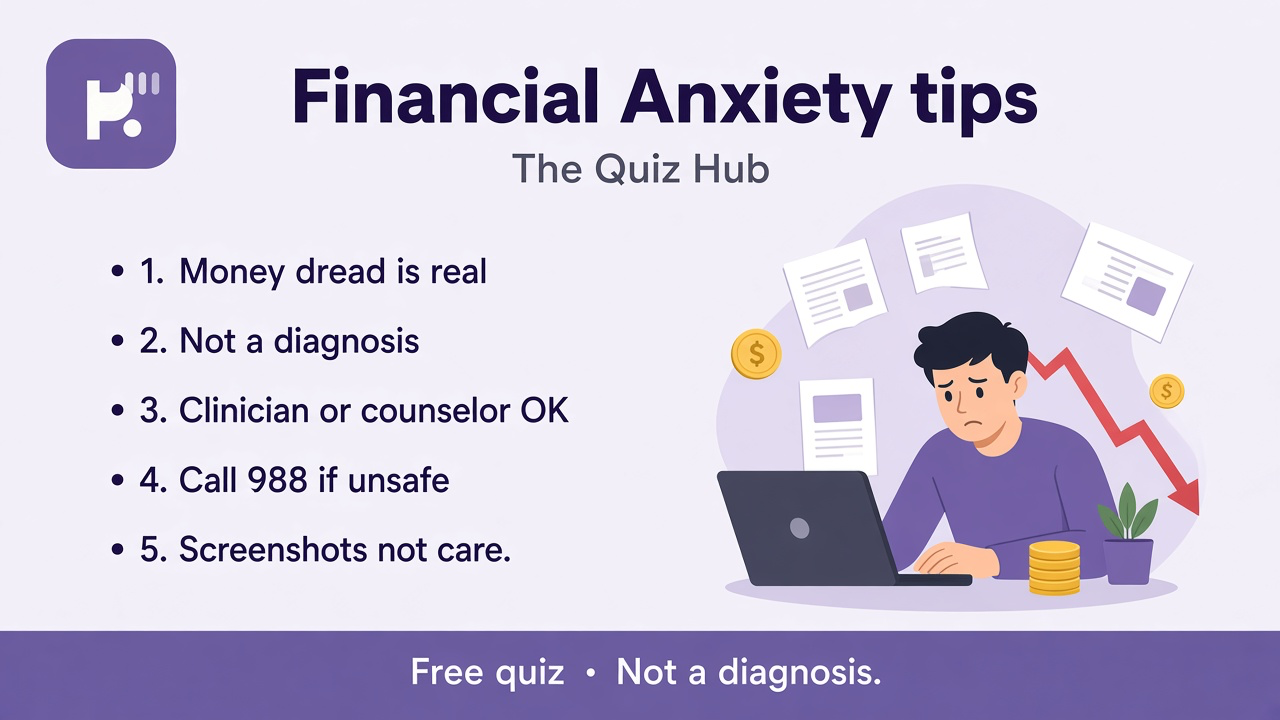
A quick takeaway graphic with topic tips (not your personal quiz scores). Start the quiz for your index, bands, and charts.
What this quiz can and cannot tell you
Can tell you
- Name bill dread, checking loop, and future spiral patterns in plain language for counseling intake
- Highlight when support planning, worry logs, or crisis outreach habits are missing
- Support honest money conversations without forcing one online label
- Offer a baseline if you retake after one week of spending-and-sleep tracking
Cannot tell you
- Diagnose generalized anxiety disorder, panic disorder, or OCD from one score
- Replace therapy, psychiatric care, or accredited financial planning
- Certify creditworthiness or loan outcomes from one bar chart
- Substitute for crisis care when hopelessness or safety fears feel urgent
Bill dread, checking loops, and quiz-not-diagnosis limits
Traffic to financial anxiety screeners mixes real bill stress with fear that helpers will only blame willpower. Clinicians discuss how money worry can overlap with generalized anxiety, trauma, ADHD, and relationship conflict, which is why interview-based assessment matters more than hobby totals. This online screener uses that reflection lens unofficially; it cannot replace licensed evaluation or tell you which treatment or budgeting path fits without your history and safety context.
Bill and payday dread covers stomach drops before due dates, sleep loss over paycheck timing, avoided mail, and relief that fades when the next bill arrives. Account checking loops cover compulsive app refreshes, hiding purchases, statement avoidance, and arguments where fear dwarfs the price tag. Future money spirals cover job-loss rehearsals, social comparison doom, retirement what-ifs, and headlines that feel like personal verdicts.
Real people mix bars. You might score high bill dread with strong limit outreach, which can mean strain yet you still plan support visits instead of debating alone. You might score high checking loops with moderate spiral burden, which often describes inflation seasons yet you still keep short spending notes sometimes. Reverse items catch overconfidence: calm bill reviews, one small planning steps, support appointments, crisis lookups, and quiz humility should not inflate a strain index meant to track frequency of money worry habits.
Pair results with siblings on this hub instead of forcing one label story. Our personal financial anxiety scale sibling names a published-style lens when clinicians ask for that framing, not this past-month habit bank. Our express diagnostic of economic attitudes tracks saving and spending agreement habits with separate wording, not due-date dread frequency here. Our fear of missing out scale FOMO angles toward scroll and spend pull rather than bill-checking loops on this page. Our fear test stays playful on general fear habits rather than money-specific past-month frequency sentences here. Browse the mental health and clinical test hub for more YMYL screeners with study-not-diagnosis framing.
Higher scores mean more frequent self-reported money worry patterns on this tool, not proof you must give up on help. Bring domain bars to intake so visits start with dated examples, not shame. If hopelessness spikes, skip online verdict wars and prioritize 988 or a clinician. Retake after one week of honest spending-and-sleep tracking when safe and compare bars, not only the total.
| Test | Focus |
|---|---|
| Personal financial anxiety scale | Published-style financial anxiety framing rather than this past-month four-domain habit bank |
| Express diagnostic of economic attitudes | Saving and spending agreement habits rather than bill dread and checking loop frequency here |
| Fear of missing out scale FOMO | Scroll and social spend pull rather than due-date dread and banking app loops on this quiz |
Financial Anxiety Quiz FAQ
What does the financial anxiety quiz measure?
It measures how often you noticed bill and payday dread, account checking loops, future money spirals, and financial anxiety limit habits during the past month. You get an index from 0 to 100 plus four domain bars. Your responses suggest self-reported frequency for reflection, not a clinical diagnosis.
Does a high score mean I have generalized anxiety disorder?
A high score means you reported frequent money worry patterns on this unofficial screener. Only a licensed clinician can evaluate anxiety disorders or rule out other causes after history and appropriate assessment. Bring bar examples to a visit instead of treating totals as proof.
How is this different from a generic anxiety quiz?
Generic anxiety screeners use broad worry language. This financial anxiety quiz focuses on due dates, banking apps, future money spirals, and money shame habits with its own stem bank. Stems do not overlap; use each screener separately.
Why are some items worded about clinicians or 988?
Limit items track whether unofficial screeners replace mental health care or crisis support. Agreeing that you planned support visits, used 988 when despair felt urgent, or refused to treat bars as diagnosis should not inflate a worry strain index.
What should I do if my score is high or I feel hopeless?
Call or text 988 (US) if crisis feels immediate, or contact a licensed clinician or accredited financial counselor with domain examples from your results. Prioritize support over retakes when hopelessness or safety fears spike.
Who reviewed this quiz?
Dr. Elena Vasquez, PhD reviewed the YMYL framing, crisis resources, unofficial instrument limits, sibling separation from generic anxiety and FOMO wording, and result explanations. See our editorial policy for review standards.
Reviewed by