What this fear-of-missing-out scale measures
This page does not administer a published Fear of Missing Out clinic battery, and it cannot diagnose internet use disorder, social anxiety, or mood conditions from one score. It measures how often you noticed habits clinicians and sleep doctors discuss when comparison strains daily life, organized four ways: scroll and comparison when feeds, reels, or group chats made your own choices feel behind; sleep and rest when late-night scrolling, morning re-checks, or skipped basics traded rest for fear of being left out; social consent and plans when guilt yeses, friend pressure, or budget strain beat honest nos and consent checks; and FOMO scale limits when unofficial screeners replaced therapy, skipped clinicians when loops stuck, or ignored 988 when hopelessness peaked. You answer 22 how-often statements about the past month, with reverse-worded items so one timer exit, phone-outside-bedroom night, honored no, offline joy, therapist booking, or crisis lookup cannot hide frequent comparison on other days. Your responses also feed a second chart on closeness and trust habits, because FOMO sometimes masks trust hesitation. The total becomes an index from 0 to 100 where higher means more frequent reported FOMO strain on this screener. Your responses suggest intensity to discuss with support; they do not prove you must live inside feeds forever.
Scroll and comparison
How often feeds and reels made your life feel behind or empty.
Sleep and rest
How often missing-out fear traded sleep and basics for scrolling.
Social consent and plans
How often guilt or pressure beat honest nos and friend consent.
FOMO scale limits
How often therapy planning and 988 awareness beat cert myths.
How it works
Answer 22 frequency items
Rate each statement from Never to Very often for the past month. Tap Next after each answer.
Answers sort into four domains
Each answer feeds one of four FOMO groups, and every item also feeds a closeness and trust layer.
See your index and charts
You get a 0 to 100 index, a band, and two bar charts you can bring to a therapist or counselor.
Take the Fear of Missing Out Scale (FOMO)
Answer 22 short statements to see your fear-of-missing-out strain index, four domain bars, and a closeness and trust chart.
What your result means
Your index is the average of all 22 answers, scaled from 0 to 100, with reverse-worded items flipped first. Higher means more frequent reported FOMO habits on this screener. Read FOMO scale limits with scroll bars before you treat any total as diagnostic proof. Persistent hopelessness or safety worries deserve crisis support, not only digital detox tips.
| Band | Index range | Typical reading |
|---|---|---|
| Lower reported FOMO strain | 0 to 35 | Fewer frequent scroll comparisons, sleep tradeoffs, or consent-pressure habits in the past month. |
| Mixed reported FOMO strain | 36 to 65 | Some restful stretches alongside scroll spikes, sleep loss, or consent slips on other days. |
| Higher reported FOMO strain | 66 to 100 | Frequent scroll comparison, sleep sacrifice, or consent pressure; professional support and crisis lines may help more than another solo retake. |
Tips at a glance
A quick takeaway graphic with topic tips (not your personal quiz scores). Start the quiz for your index, bands, and charts.
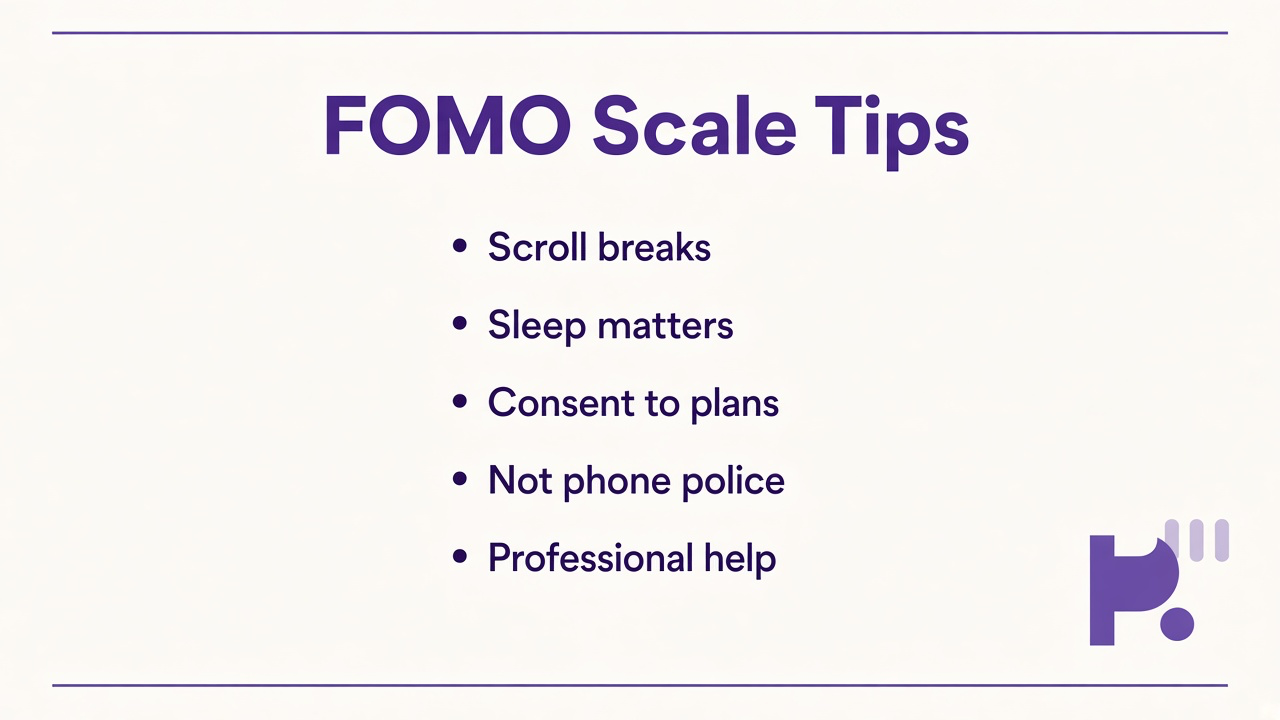
What this quiz can and cannot tell you
Can tell you
- Name scroll loops, sleep sacrifice, and consent-pressure habits in plain language for therapy intake
- Highlight when timers, rest, honest nos, or crisis outreach habits are missing
- Support honest overlap conversations with clinicians without forcing one online label
- Offer a baseline if you retake after one week of scroll-timer and sleep-boundary practice
Cannot tell you
- Diagnose internet use disorder, social anxiety, or mood conditions from one score
- Replace licensed FOMO instruments, sleep medicine, or couples therapy about phone use
- Certify that you mastered digital balance or social skills from one screener
- Substitute for crisis care when hopelessness or safety fears feel urgent
Feeds, sleep, consent, and quiz-not-licensed-FOMO limits
People search FOMO scale pages when every notification feels like a verdict, when they cannot sleep yet cannot stop scrolling, or when saying no to plans sparks panic. Clinicians discuss how comparison loops and poor sleep amplify anxiety even when someone still performs at school or work. This online screener uses that reflection lens unofficially; it cannot replace interview-based assessment or tell you which boundary plan fits without your budget, trauma, and safety context.
Scroll and comparison covers refresh habits, mood drops after highlight reels, and assuming brighter posts mean fuller lives. Timers and offline joys without posting are small experiments worth tracking. Sleep and rest covers late-night streams, morning re-checks, and treating tiredness as social failure instead of a rest signal. Social consent covers guilt yeses, pressuring tapped-out friends, and honoring honest nos without fake excuses.
Real people mix bars. You might score high scroll strain with strong sleep boundaries some weeks. You might score high consent pressure with strong therapist outreach. Reverse items catch overconfidence: timer exits, phone-outside-bedroom nights, honored nos, friend consent checks, clinician bookings, and crisis lookups should not inflate a strain index meant to track frequency of comparison and sleep sacrifice.
Pair results with siblings on this hub instead of forcing one label story. Our fear of missing out scale FOMOS sibling uses past-week wording with a distinct stem bank. Our social media addiction scale sibling emphasizes broader platform strain when you want separate reflection. Our fear of compassion scale covers warmth-receiving fear rather than scroll comparison here. Browse the mental health and clinical test hub for more YMYL screeners with study-not-diagnosis framing.
Higher scores mean more frequent self-reported FOMO strain on this tool, not proof you must attend every event. Bring domain bars to intake so sessions start with examples, not shame. If hopelessness spikes, skip online debate and prioritize 988 or a clinician. Retake after one week of timer-plus-sleep-boundary practice when safe and compare bars, not only the total.
| Test | Focus |
|---|---|
| Fear of missing out scale FOMOS | Past-week FOMO habits with distinct stems from this past-month FOMO screener |
| Social media addiction scale | Broader platform-use strain habits rather than missing-out comparison frequency here |
| Fear of compassion scale | Kindness-receiving fear habits rather than scroll and event comparison on this page |
Fear of Missing Out Scale (FOMO) FAQ
What does the fear-of-missing-out scale measure?
It measures how often you noticed scroll comparison, sleep tradeoffs, social consent slips, and FOMO limit habits during the past month. You get an index from 0 to 100 plus four domain bars. Your responses suggest self-reported frequency for reflection, not a clinical diagnosis.
Is this the same as published FOMO research scales?
No. Published FOMO instruments use validated item banks and trained scoring. This page is an unofficial FOMO screener with its own past-month stems for reflection only, not licensed certification.
Does a high score mean I am addicted to my phone?
A high score means you reported frequent comparison, sleep sacrifice, or consent-pressure habits here. It is not an internet addiction diagnosis. If use disrupts sleep, work, or safety, contact a licensed clinician or call or text 988 (US) when crisis feels immediate.
Why mention consent and not phone police?
Intent brief readers asked for boundary literacy without shaming friends who stay home. Consent items track honest nos and friend checks; they do not mean you must attend unsafe scenes.
How is this different from the FOMOS sibling test?
This page uses past-month frequency stems about scroll, sleep, and consent. The FOMOS sibling uses past-week wording and a separate stem bank so retakes are not duplicate items.
Who reviewed this scale?
Dr. Elena Vasquez, PhD reviewed the YMYL framing, crisis resources, unofficial scale limits, sibling separation from FOMOS and social-media scales, and result explanations. See our editorial policy for review standards.
Reviewed by