
What this failure avoidance motivation questionnaire measures
This page does not administer a published fear-of-failure or achievement-motivation clinical battery, and it cannot diagnose anxiety, depression, or learning disorders from one score. It measures how often you noticed habits counselors and coaches often discuss when fear of failing strains school, work, or creative goals, organized four ways: fear-driven postponement when starting felt like proof you might fail or permanent mistakes; perfectionism delay when rewrite loops, perfect-mood waiting, or polish past deadlines replaced shipping; comparison and feedback avoidance when peer highlight reels, hidden drafts, or skipped mentor meetings blocked growth; and quiz not clinical limits when unofficial screeners replaced counselors, minors faced fear alone without trusted adults, or crisis outreach stayed missing. You answer 22 how-often statements about the past two weeks, with reverse-worded items so one brave feedback meeting or time-boxed draft cannot hide frequent fear delays on other days. Your responses also feed a second chart on closeness and trust habits, because shame about failing sometimes blocks asking for help. The total becomes an index from 0 to 100 where higher means more frequent reported failure avoidance motivation on this screener. Your responses suggest intensity to discuss with support; they do not prove you are lazy or beyond improvement.
Fear-driven postponement
How often fear of failing delayed starts on tasks you cared about.
Perfectionism delay
How often rewrite loops, perfect-mood waiting, or polish past deadlines stalled progress.
Comparison and feedback avoidance
How often peer comparison, hidden drafts, or dodged critique replaced practice.
Quiz not clinical limits
How often counselor planning, minor safety framing, and quiz humility showed up versus label myths.
How it works
Answer 22 frequency items
Rate each statement from Never to Very often for the past two weeks. Tap Next after each answer.
Answers sort into four domains
Each answer feeds one of four failure-avoidance groups, and every item also feeds a closeness and trust layer.
See your index and charts
You get a 0 to 100 index, a band, and two bar charts you can bring to a counselor or coach.
Take the Failure Avoidance Motivation Questionnaire
Answer 22 short statements to see your failure avoidance motivation index, four domain bars, and a closeness and trust chart.
What your result means
Your index is the average of all 22 answers, scaled from 0 to 100, with reverse-worded items flipped first. Higher means more frequent reported fear delay, perfectionism stall, or comparison habits on this screener. Read quiz-not-clinical limits with fear bars before you treat any total as diagnostic proof. Persistent hopelessness or safety worries deserve crisis support, not only productivity tips.
| Band | Index range | Typical reading |
|---|---|---|
| Lower reported failure avoidance motivation | 0 to 35 | Fewer frequent fear-driven delays, perfectionism stalls, comparison loops, or quiz-as-clinical myths in the past two weeks. |
| Mixed reported failure avoidance motivation | 36 to 65 | Some progress stretches alongside fear delays, perfectionism stalls, comparison habits, or limit myths on other days. |
| Higher reported failure avoidance motivation | 66 to 100 | Frequent fear delays, perfectionism stalls, or feedback hiding; counselor, coach, and crisis support may help more than another solo retake. |
Tips at a glance
A quick takeaway graphic with topic tips (not your personal quiz scores). Start the quiz for your index, bands, and charts.
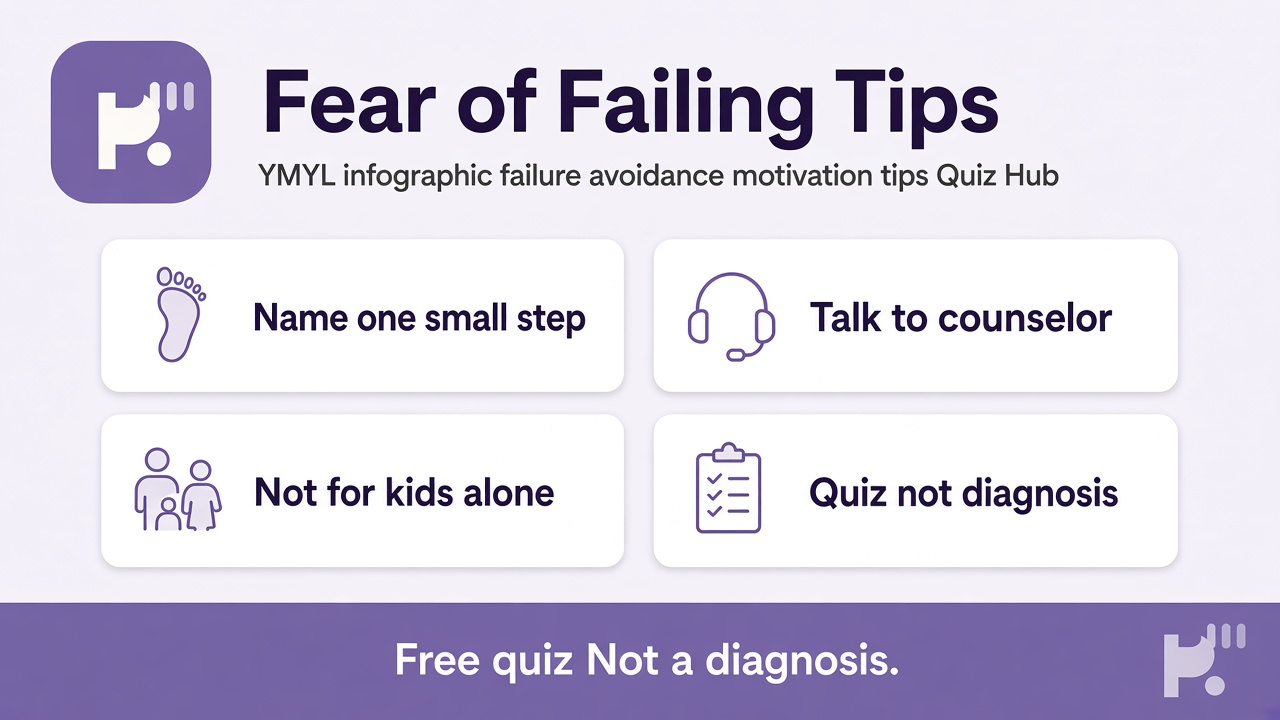
What this quiz can and cannot tell you
Can tell you
- Name fear-driven delay, perfectionism, and feedback-avoidance habits in plain language for counselor intake
- Highlight when small-step, time-box, or help-seeking habits are missing
- Support honest overlap conversations with clinicians without forcing one online label
- Offer a baseline if you retake after one week of named first steps and feedback practice
Cannot tell you
- Diagnose anxiety disorders, depression, or learning conditions from one score
- Replace published fear-of-failure batteries, school placement tests, or career licensing exams
- Prove you should quit a field or relationship from one web bar
- Substitute for crisis care when hopelessness or safety fears feel urgent
Fear delays, perfectionism stalls, and quiz-not-clinical limits
People search failure avoidance motivation pages when the first step on a graded task feels heavier than the whole syllabus, when rewrite loops eat deadlines, or when comparing to classmates online replaces practice. Counselors and coaches discuss fear of failure as avoidance that protects short-term shame yet costs long-term growth, often alongside perfectionism, social comparison, and feedback phobia. This online screener uses that reflection lens unofficially; it cannot replace interview-based assessment or tell you which single diagnosis fits without history.
Fear-driven postponement covers delaying tasks because starting felt like proof you might fail, swapping busywork for scary priorities, and tomorrow myths after rough nights. Naming one small step and talking with a counselor or coach are protective signals worth tracking even when fear bars run high. Perfectionism delay covers endless rewrites, perfect-mood waiting, missed deadlines from over-polish, and treating one imperfect line as proof you should quit. Time-boxed drafts and body-aware pauses are skills many people build with support, not moral trophies.
Comparison and feedback avoidance covers highlight-reel scrolling, hidden drafts, skipped office hours, and comparing rough tries to finished posts. Asking for specific feedback and limiting comparison scrolling belong in the same story as strain bars. Quiz not clinical limits covers refusing licensed-form myths, involving trusted adults for minors, and planning counselor or crisis-line support instead of screenshot diagnoses.
Pair results with siblings on this hub instead of forcing one label story. Our executive dysfunction test sibling tracks past-two-weeks initiation and memory strain with a separate stem bank, not fear-of-failing wording here. Our error orientation motivation scale EOMS sibling emphasizes mistake and shame literacy with agree-scale limits, not frequency delay habits on this page. Browse the mental health and clinical test hub for more YMYL screeners with study-not-diagnosis framing.
Higher scores mean more frequent self-reported failure avoidance on this tool, not proof you should shame yourself alone. Bring domain bars to intake so sessions start with examples, not guilt. If hopelessness spikes, skip online debate and prioritize 988 or a clinician. Retake after one week of named first steps and one feedback conversation when safe and compare bars, not only the total.
| Test | Focus |
|---|---|
| Executive dysfunction test | Task initiation and working memory slips with separate stems, not fear-of-failing frequency wording here |
| Error orientation motivation scale EOMS | Mistake literacy and shame loops on an agree scale, not past-two-weeks avoidance frequency here |
| Experiential avoidance questionnaire | ACT-lite push-away habits rather than achievement fear and perfectionism delay on this page |
Failure Avoidance Motivation Questionnaire FAQ
What does this failure avoidance motivation questionnaire measure?
It measures how often you noticed fear-driven postponement, perfectionism delay, comparison and feedback avoidance habits, and quiz-not-clinical limit habits during the past two weeks. You get an index from 0 to 100 plus four domain bars. Your responses suggest self-reported frequency for adult reflection, not a clinical diagnosis.
Is this a licensed clinical fear-of-failure test?
No. Published motivation and fear-of-failure batteries use validated item banks and trained scoring in research settings. This page is an unofficial screener with its own stems for reflection only, not a licensed clinical form, and not a substitute for counseling or school placement testing.
Why focus on perfectionism and comparison?
Intent brief readers asked for failure-avoidance literacy without copying licensed items. Perfectionism delay and social comparison often ride alongside fear of starting; counselor support still matters when those bars run high.
Can children or teens use this screener alone?
Minors facing fear of failing deserve trusted adults, school counselors, or clinicians, not unofficial web bars by themselves. Limit items remind readers that screeners are not substitutes for adult support when shame disrupts sleep or safety.
What should I do if my score is high or I keep avoiding important tasks?
Schedule a counselor or coach visit with domain examples, try one named first step plus one feedback request this week, and call or text 988 (US) if hopelessness or safety worries feel urgent. Prioritize support over retakes when strain spikes.
Who reviewed this questionnaire?
Dr. Sarah Chen, PhD reviewed the YMYL framing, crisis resources, quiz-not-clinical limits, minor-not-alone boundaries, sibling separation from executive dysfunction and EOMS pages, and result explanations. See our editorial policy for review standards.
Reviewed by
