What this unofficial EOMS literacy page measures
This page does not administer the published Error Orientation Motivation Scale, replicate validation study scoring, or issue employer performance ratings. It measures how much you agree with statements in four groups: errors as learning about reframing slips, naming fixes, separating skill gaps from character attacks, and rejecting quit-forever myths; shame and blame about hiding after mistakes, outward blame storms, embarrassment without permanent identity, and rejecting shame-free team fantasies; motivation loops about asking specific feedback, practice reps, restarting with shorter plans, crediting helpers, and celebrating correction wins; and unofficial EOMS limits about study-only framing, peer-reviewed forms you still need for research fidelity, and refusing to treat web bars like published manual cutoffs or hiring proof. You rate 22 statements from strongly disagree to strongly agree, with reverse-worded items so autopilot perfection or blame answers cannot inflate every bar. Your answers also feed a second chart on closeness and trust habits, because error shame sometimes overlaps with isolation or harsh self-talk toward partners. The total becomes an index from 0 to 100 where higher means more endorsed error orientation literacy on this screener, not official EOMS points or clinical labels.
Errors as learning
Reframe slips, name fixes, and share lessons without quit-forever myths.
Shame and blame
Notice hide-and-blame loops without denying that mistakes sting.
Motivation loops
Feedback, practice reps, restarts, and credit after setbacks.
Unofficial EOMS limits
Not published EOMS; HR and clinicians stay primary for formal use.
How it works
Answer 22 agreement items
Rate each statement from Strongly disagree to Strongly agree. Tap Next after each answer.
Answers sort into four domains
Each answer feeds one of four error orientation groups, and every item also feeds a closeness and trust layer.
See your index and charts
You get a 0 to 100 index, a band, and two bar charts you can compare after one feedback experiment.
Take the Error Orientation Motivation Scale (EOMS)
Answer 22 short statements to see your error orientation literacy index, four domain bars, and a closeness and trust chart.
What your result means
Your index is the average of all 22 answers, scaled from 0 to 100, with reverse-worded myth items flipped first. Read unofficial EOMS limits with shame and blame bars before you treat any total as published scale scoring or hiring immunity. Persistent shame deserves skilled support, not only meme reframes.
| Band | Index range | Typical reading |
|---|---|---|
| Building error orientation literacy | 0 to 35 | Fewer agreed facts on learning frames, shame awareness, motivation loops, or unofficial limits on this screener. |
| Mixed error orientation literacy | 36 to 65 | Solid learning language in some domains with shame traps or unofficial-limit gaps on others. |
| Stronger error orientation literacy | 66 to 100 | Frequent agreement on learning frames, shame awareness, motivation loops, and unofficial limits; still not published EOMS. |
Tips at a glance
A quick takeaway graphic with topic tips (not your personal quiz scores). Start the quiz for your index, bands, and charts.
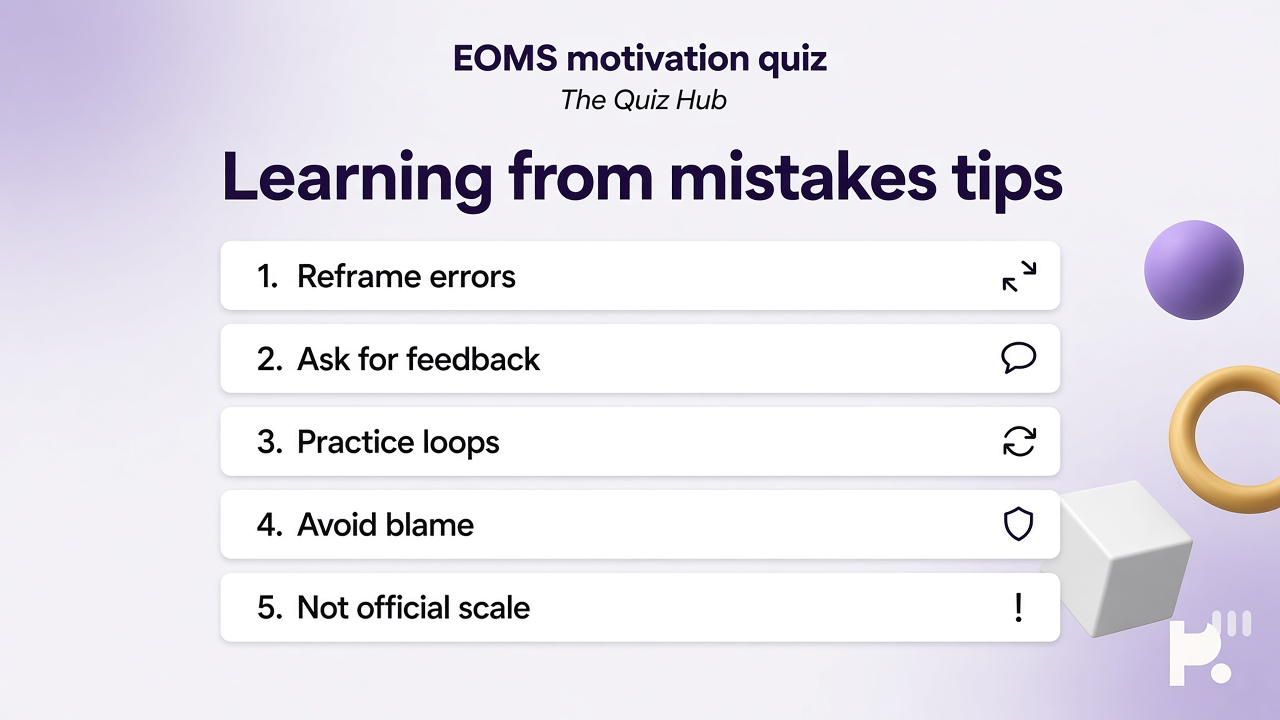
What this quiz can and cannot tell you
Can tell you
- Highlight learning, shame awareness, and motivation habits worth trying after the next mistake
- Separate unofficial literacy from published EOMS validation forms
- Encourage feedback and practice loops without blame storms
- Spark better team retro questions without web score hiring claims
Cannot tell you
- Replace the published Error Orientation Motivation Scale or its scoring manuals
- Prove workplace readiness or diagnose disorders from one agree screener
- Excuse repeated harm or negligence without accountability and repair
- Substitute for therapy when shame or perfectionism disrupts safety and relationships
Mistake literacy before published scale confusion and blame storms
Students and workers search EOMS and error orientation topics when feedback hurts, blame meetings loom, and unofficial quizzes get mistaken for validated instruments. Those goals help when readers treat bars as reflection notes for learning habits. They hurt when shame becomes identity, teammates get mocked for typos, or screeners pose as published EOMS forms in hiring packets.
Dr. James Whitfield reviews personality psychology literacy screeners with a simple split: reward honest agreement with widely taught learning-from-error habits and honest limits on instrument overclaim at the same time. Errors as learning keeps reframe language, fix naming, and shared lesson habits visible beside quit-forever traps. Shame and blame keeps hide-and-blame awareness visible beside shame-free team myths. Motivation loops keeps feedback requests, practice reps, and restart plans visible beside no-help motivation fantasies. Unofficial EOMS limits keeps published form language honest so readers know peer-reviewed validation packets differ from fan pages.
Real readers mix bars. You might score high on learning frames while shame items wobble after a harsh manager year, which often describes new repair skills atop old fear. You might score high on motivation loops with moderate limits, which can mean solid practice habits yet little experience with official scale names. Reverse items catch sloppy answers: any error means quit forever, healthy teams never feel shame, motivation never needs support, or web bars enter the official EOMS manual should not inflate bars meant to track layered reflection habits.
Pair results with siblings on this hub instead of forcing one mistake story. Our Dunning-Kruger effect test stays on confidence calibration when errors tempt overclaim or underclaim. Our Enneagram personality test angles toward nine-type model literacy without workplace review framing. Browse the personality and psychology hub for more unofficial instrument screeners. Caption shares as reflection notes, not validation badges.
Project seasons shift faster than one retro slide. New teams, classrooms, and therapy work change which shame loops activate. When you share results, say published EOMS beats unofficial bars for research fidelity. When you borrow tips, credit mentors who modeled repair talk. Retake after one feedback month and watch whether unofficial limit bars stay high even when learning bars rise, which often means you separated performative blame from actual practice loops.
| Test | Focus |
|---|---|
| Dunning-Kruger effect test | Confidence calibration after learning gaps rather than shame and blame loops here |
| Enneagram personality test | Nine-type model literacy rather than workplace error orientation framing |
| Personality and psychology hub | More unofficial model screeners when you want reflection without HR forms |
Error Orientation Motivation Scale (EOMS) FAQ
What does this unofficial EOMS page measure?
It measures how much you agree with statements about errors as learning, shame and blame awareness, motivation loops, and unofficial EOMS limits. You get an index from 0 to 100 plus four bars. It describes self-rated reflection habits on this screener, not published EOMS scores.
Is this the published Error Orientation Motivation Scale?
No. This is unofficial literacy trivia inspired by common error orientation themes. It does not use the published EOMS item set, scoring manual, or validation study permissions. Do not treat your index as official EOMS points.
Can employers use my results instead of performance reviews?
No. This is a private reflection tool, not a 360 review instrument or hiring database. Follow your workplace feedback and HR processes for formal evaluations.
Why include shame and blame items beside learning frames?
Error orientation searches often skip emotional loops. Shame and blame bars keep reflection honest about hide-and-blame habits that block learning even when people know reframe memes.
Who reviewed this quiz?
Dr. James Whitfield, PhD reviewed the unofficial EOMS framing, error orientation literacy limits, and result explanations. See our editorial policy for review standards.
Reviewed by