
What this experiential avoidance questionnaire measures
This page does not administer a validated Acceptance and Action Questionnaire from research clinics, and it cannot diagnose anxiety, PTSD, or mood disorders from one score. It measures how often you noticed habits counselors discuss when avoidance strains daily life, organized four ways: inner-experience avoidance when sadness, shame, intrusive thoughts, or grief got pushed away instead of named; control and distraction when busyness, scrolling, substances, reassurance, or micromanaging replaced brief grounding; willingness and presence when you treated feelings as enemies, refused valued acts until pain vanished, or practiced small acceptance with limits; and ACT quiz limits when unofficial screeners replaced therapy, skipped clinicians when loops stuck, or ignored 988 when hopelessness peaked. You answer 22 how-often statements about the past month, with reverse-worded items so one exposure plan, grounding minute, counselor booking, or crisis lookup cannot hide frequent suppression or numbing on other days. Your responses also feed a second chart on closeness and trust habits, because shame about avoidance sometimes blocks asking for help. The total becomes an index from 0 to 100 where higher means more frequent reported experiential avoidance on this screener. Your responses suggest intensity to discuss with support; they do not prove feelings must stay enemies forever.
Inner experience avoidance
How often painful thoughts or emotions got pushed away instead of named with support.
Control and distraction
How often busyness, scrolling, substances, or reassurance replaced sitting with discomfort.
Willingness and presence
How often feelings stayed signals, grounding showed up, and small values steps continued.
ACT quiz limits
How often quiz humility, micro-exposure planning, clinician outreach, and 988 awareness showed up.
How it works
Answer 22 frequency items
Rate each statement from Never to Very often for the past month. Tap Next after each answer.
Answers sort into four domains
Each answer feeds one of four avoidance groups, and every item also feeds a closeness and trust layer.
See your index and charts
You get a 0 to 100 index, a band, and two bar charts you can bring to a therapist or counselor.
Take the Experiential Avoidance Questionnaire
Answer 22 short statements to see your experiential avoidance index, four domain bars, and a closeness and trust chart.
What your result means
Your index is the average of all 22 answers, scaled from 0 to 100, with reverse-worded items flipped first. Higher means more frequent reported push-away or control-loop habits on this screener. Read ACT quiz limits with inner-experience bars before you treat any total as diagnostic proof. Persistent hopelessness or safety worries deserve crisis support, not only mindfulness tips.
| Band | Index range | Typical reading |
|---|---|---|
| Lower reported experiential avoidance | 0 to 35 | Fewer frequent push-away loops, numbing busyness, control habits, or quiz-as-ACT myths in the past month. |
| Mixed reported experiential avoidance | 36 to 65 | Some willingness stretches alongside push-away habits, control loops, or limit myths on other days. |
| Higher reported experiential avoidance | 66 to 100 | Frequent push-away, numbing, or control habits; professional support and crisis lines may help more than another solo retake. |
Tips at a glance
A quick takeaway graphic with topic tips (not your personal quiz scores). Start the quiz for your index, bands, and charts.
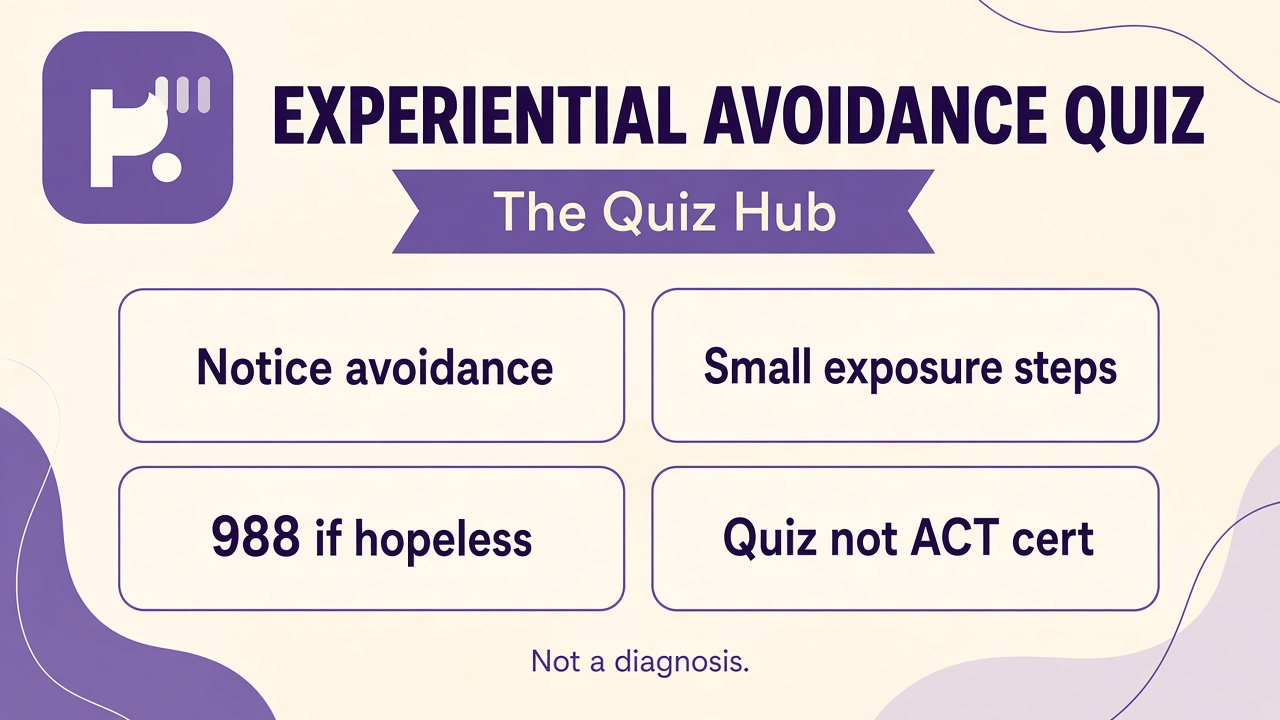
What this quiz can and cannot tell you
Can tell you
- Name push-away, numbing, and control-loop habits in plain language for therapy intake
- Highlight when willingness, micro-exposure, counselor planning, or crisis outreach habits are missing
- Support honest overlap conversations with clinicians without forcing one online label
- Offer a baseline if you retake after one week of named-feeling and grounding practice
Cannot tell you
- Diagnose PTSD, OCD, or mood disorders from one score
- Replace ACT therapy, exposure protocols, trauma treatment, or medication decisions
- Certify that you completed ACT training or mastered defusion skills
- Substitute for crisis care when hopelessness or safety fears feel urgent
Experiential avoidance, feelings as signals, and quiz-not-ACT limits
People search experiential avoidance questionnaire pages when emotions feel dangerous, when busyness replaced grief, or when ACT blogs made acceptance sound like loving every feeling without boundaries. Clinicians trained in Acceptance and Commitment Therapy discuss experiential avoidance as the habit of trying not to feel what you feel, which often shrinks valued life even when suppression brings short relief. This online screener uses that reflection lens unofficially; it cannot replace interview-based assessment or tell you which exposure pace fits without your trauma history.
Inner-experience avoidance covers arguing with thoughts for hours, hiding sadness around others, or using mantras to erase discomfort before you listen. Naming a feeling and choosing a small next step is a protective signal worth tracking, even when pain stays loud. Control and distraction covers hyper-busy schedules, scroll numbing, quick relief habits, reassurance loops, and micromanaging when unpredictability feels unbearable. One brief exposure step with support is not reckless heroics; it is often how willingness rebuilds when avoidance has been running the month.
Willingness and presence covers refusing the myth that anxiety proves brokenness, allowing discomfort while keeping values-aligned actions smaller than the story demands, and remembering trauma-informed care still matters inside ACT language. Reverse items catch overconfidence: feelings are never enemies, ACT means zero limits, suppression is always strength, or web bars certify skill mastery should not inflate an avoidance index meant to track frequency of push-away habits.
Pair results with siblings on this hub instead of forcing one label story. Our emotional regulation questionnaire ERQ sibling tracks reappraisal and suppression habits with separate wording. Our emotion regulation situations page frames situational regulation choices rather than month-long avoidance frequency here. Our experiencing uncertainty and threat sibling uses distinct stems for threat intolerance, not push-away loops on this page. Browse the mental health and clinical test hub for more YMYL screeners with study-not-diagnosis framing.
Higher scores mean more frequent self-reported avoidance on this tool, not proof you must keep numbing alone forever. Bring domain bars to intake so sessions start with examples, not shame. If hopelessness spikes, skip online debate and prioritize 988 or a clinician. Retake after one week of named-feeling plus supported micro-exposure when safe and compare bars, not only the total.
| Test | Focus |
|---|---|
| Emotional regulation questionnaire ERQ | Reappraisal and suppression style habits with separate stems, not month-long ACT-lite avoidance frequency here |
| Emotion regulation situations | Situational regulation choices rather than push-away and willingness frequency on this questionnaire |
| Experiencing uncertainty and threat | Threat intolerance and uncertainty habits with a distinct stem bank from this avoidance page |
Experiential Avoidance Questionnaire FAQ
What does this experiential avoidance questionnaire measure?
It measures how often you noticed inner-experience avoidance, control and distraction loops, willingness and presence habits, and ACT quiz limit habits during the past month. You get an index from 0 to 100 plus four domain bars. Your responses suggest self-reported frequency for reflection, not a clinical diagnosis.
Is this the same as the AAQ or AAQ-II used in ACT research?
No. Published Acceptance and Avoidance Questionnaires use validated item banks and trained scoring. This page is an unofficial ACT-inspired screener with its own stems for reflection only, not ACT certification and not a licensed evaluation.
Does a high score mean I need ACT therapy or exposure right now?
A high score means you reported frequent avoidance habits here. Whether ACT, exposure, DBT, or medication fits depends on history, safety, and a clinician interview, not one web bar. Pair bars with limit items and seek professional guidance before forcing exposure alone.
Why mention feelings not enemies and small exposure steps?
Intent brief readers asked for ACT-lite literacy without turning acceptance into toxic positivity. Willingness items track signals and micro-steps; they do not mean you must tolerate abuse or skip trauma-informed pacing.
What should I do if my score is high or I feel hopeless?
Call or text 988 (US) if crisis feels immediate, or contact a licensed clinician with domain examples from your results. Prioritize support over retakes when hopelessness or safety fears spike.
Who reviewed this questionnaire?
Dr. Sarah Chen, PhD reviewed the YMYL framing, crisis resources, unofficial scale limits, sibling separation from uncertainty-threat items, and result explanations. See our editorial policy for review standards.
Reviewed by
