What the Emotional Regulation Questionnaire ERQ measures
This quiz does not administer the validated Gross and John Emotional Regulation Questionnaire, diagnose borderline personality disorder, PTSD, ADHD, or any other condition, or tell you that more reappraisal always wins. Only a licensed clinician using interview methods, safety screening, and history can do that. It measures how often you noticed regulation strategy patterns grouped four ways: cognitive reappraisal when you reinterpreted stress, softened catastrophic stories, or updated harsh first impressions before acting; expressive suppression when you kept a calm exterior, hid upset, joked away check-ins, or felt drained after performing fine; regulation skills practice when you paused before heated messages, named feelings, repaired after snaps, repeated clinician-taught skills, or considered therapy when one strategy was not enough; and ERQ literacy limits when you resist believing this page copies official ERQ cutoffs, that reappraisal always beats suppression, that suppression never protects safety, or that high web bars replace professional help when numbness, rage, or crisis thoughts persist. You answer 22 how-often statements about the past two weeks, with reverse-worded items so one open day cannot hide frequent suppression across other days. Your responses also feed a second chart on closeness and trust habits, because some people suppress hardest when vulnerability already feels unsafe. The total becomes an index from 0 to 100 where higher means more frequent reported strategy patterns on this unofficial screener. Your responses suggest habits to discuss with support; they do not mean you are permanently stuck in one style.
Cognitive reappraisal
How often you reframed stress, softened stories, or updated harsh impressions before acting.
Expressive suppression
How often you guarded expression, hid upset, or felt drained after performing calm.
Regulation skills practice
How often you paused, labeled feelings, repaired, and repeated skills beyond one good day.
ERQ literacy limits
How often you treat strategies as context-shaped habits, not official ERQ scores or moral rank.
How it works
Answer 22 frequency items
Rate each statement from Never to Very often for the past two weeks. Tap Next after each answer.
Answers sort into four domains
Each answer feeds one of four strategy groups, and every item also feeds a closeness and trust layer.
See your index and charts
You get a 0 to 100 index, a band, and two bar charts you can bring to a clinician.
Take the Emotional Regulation Questionnaire (ERQ)
Answer 22 short statements to see your regulation strategy index, four domain bars, and a closeness and trust chart.
What your result means
Your index is the average of all 22 answers, scaled from 0 to 100, with reverse-worded items flipped first. Higher means more frequent reported strategy patterns on this screener. Read reappraisal and suppression bars together before the total, because reframing inside while hiding outside is a common mixed pair.
| Band | Index range | Typical reading |
|---|---|---|
| Lower reported strategy frequency | 0 to 35 | Fewer frequent reappraisal, suppression, skills-practice, or quiz-as-validated-ERQ patterns in the past two weeks. |
| Mixed reported strategy frequency | 36 to 65 | Some reframing or open days alongside suppression spikes, skills gaps, or ERQ hype on others. |
| Higher reported strategy frequency | 66 to 100 | Frequent reappraisal, suppression, or skills strain; context and support matter more than self-attack. |
Tips at a glance
A quick takeaway graphic with topic tips (not your personal quiz scores). Start the quiz for your index, bands, and charts.
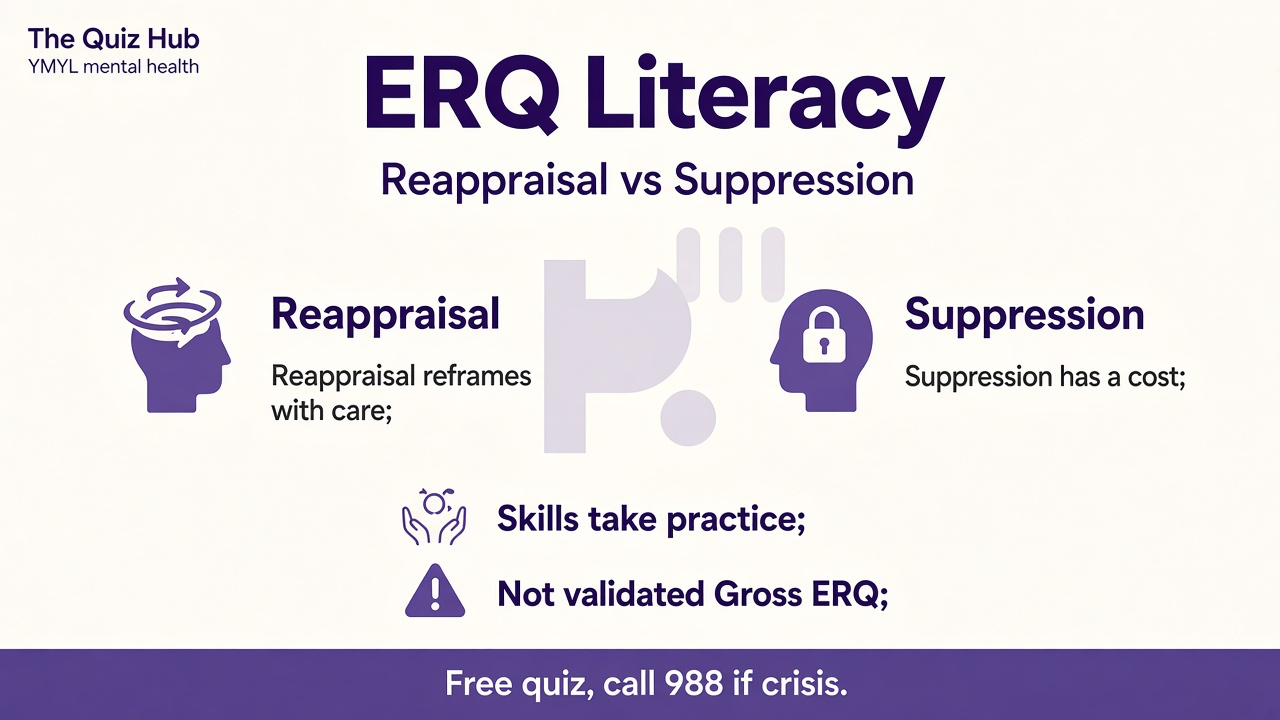
What this quiz can and cannot tell you
Can tell you
- Name reappraisal versus suppression habits in plain language for intake
- Highlight when guarded expression or endless reframing pairs with loneliness or skipped repair
- Support early conversations with therapists, DBT skills groups, or couples counselors
- Offer a baseline if you retake after one expression or pause experiment
Cannot tell you
- Replace the validated Gross and John ERQ or clinical interviews with fixed cutoffs
- Prove suppression is always toxic or reappraisal is always healthy without context
- Diagnose dysregulation, trauma conditions, or mood disorders without evaluation
- Tell you that struggling means moral failure instead of a skills gap that takes time
Reappraisal, suppression, and ERQ literacy without validated-instrument hype
People search emotional regulation questionnaire ERQ when a chart promises two bars (reframe more, hide less) yet their week still holds blowups, numbness, or shame about how they express feelings at work and home. Gross and John's research scale measures self-reported reappraisal and suppression with validated items and norms; social posts often skip that this page is not that instrument, that culture shapes expression, and that trauma history changes what feels safe. This screener scores frequency so your responses suggest where habits cluster, not whether you earn a diagnosis from a bar chart.
Cognitive reappraisal is the first domain because many skills groups teach reinterpretation before action. Seeing another angle, finding one workable fact on a hard day, or updating a harsh read of someone's tone can lower heat enough to choose words carefully. Refusing to reframe because it sounds like toxic positivity is its own trap; reappraisal works best when it honors facts and body signals, not when it erases harm. Reverse items capture when you already noticed your first story was harsher than reality, signs reflection is landing, not proof you will never catastrophize again.
Expressive suppression is the second domain because guarded expression is common and costly in different doses. Keeping a calm face, hiding upset from family, or joking away check-ins can protect safety in some rooms yet drain intimacy when it is the only tool. Letting feelings show with a trusted person when bottling up worsened the week is a healthy counter-move this screener treats as reverse-scored so it does not inflate a suppression index meant to track hiding. Agreeing that you felt drained after performing fine should not be read as moral failure; it is data for whether expression needs more context-aware practice.
Regulation skills practice is the third domain because strategies work best with pause, labels, and repair. Breath before heated messages, naming anger or shame before debating blame, and specific apologies after snaps are habits clinicians rehearse for months. Considering therapy when reappraisal or suppression alone is not enough is a support move, not defeat. Treating one good day as proof you never need sleep or boundaries should not inflate an index meant to track real strain on other days.
ERQ literacy limits are the fourth domain, patterned after YMYL honesty on screeners. Believing this page copies official ERQ cutoffs, that reappraisal always wins, or that high bars replace professional help when crisis thoughts persist should not inflate strategy frequency meant to track lived weeks. Suppression can protect safety sometimes; reappraisal can skip the body when it becomes spin. Our emotion regulation situations quiz sibling emphasizes pause-and-repair habits in heated scenes when you want situation-specific reflection. Our Difficulties in Emotion Regulation Scale sibling stresses non-diagnostic limits on research-shaped items. Our emotion regulation critics review offers literacy on pop scale hype when you want critique beside strategy reflection. Browse the mental health and clinical test hub for more screeners with study-not-diagnosis language.
Retake after two weeks of one concrete experiment (one honest check-in with a safe person, one pause before a trigger message, one repair script, or one outreach to a clinician) and compare domain bars. Your responses suggest whether habits are shifting, not whether you deserve care. Licensed clinicians turn examples into skills plans this page cannot deliver. If distress feels unbearable tonight, call or text 988 in the US or your local crisis line before debating results alone.
| Test | Focus |
|---|---|
| Emotion regulation situations quiz | Pause, label, and repair in heated scenes rather than broad reappraisal-versus-suppression frequency |
| Difficulties in Emotion Regulation Scale Ders 18 1928 | Scale-shaped self-reflection with study-not-diagnosis framing, not unofficial ERQ stems |
| Emotion regulation critics review | Pop scale literacy and hype limits rather than reappraisal and suppression frequency |
Emotional Regulation Questionnaire (ERQ) FAQ
What does this ERQ quiz measure?
It measures how often you noticed reappraisal, suppression, skills-practice, and literacy-limit patterns in four areas during the past two weeks. You get an index from 0 to 100 plus four domain bars. Your responses suggest self-reported strategy frequency for reflection, not a validated Gross and John ERQ profile or clinical diagnosis.
Is more reappraisal always better than suppression?
No. Research often links habitual suppression with social costs in some settings, yet hiding feelings can protect safety in others. Reappraisal can help when it honors facts and body signals. Context, culture, trauma history, and role power matter. Use bars to describe habits, not to shame yourself or rank relatives.
Is this the official Emotional Regulation Questionnaire from Gross and John?
No. This is an unofficial frequency screener inspired by common ERQ search intent, not the validated instrument with published norms and cutoffs. Clinicians use interviews, history, and sometimes validated scales inside structured assessment. Treat your bars as conversation starters, not clinic verdicts.
How does this relate to therapy or DBT skills?
Therapists and DBT skills groups teach pause, labeling, opposite action, and repair over months of practice. This page is education and self-reflection only. If intensity disrupts sleep, work, relationships, or safety for weeks, qualified care beats retaking the same quiz for a greener bar.
What should I do if my score is high or I feel in crisis?
Contact a trauma-informed therapist or your primary care clinician with domain examples from your results. Call or text 988 (US) if you feel hopeless, unsafe, or in emotional crisis. Seek urgent help if urges turn into threats or violence toward yourself or others.
Who reviewed this quiz?
Dr. Elena Vasquez, PhD reviewed the YMYL framing, crisis resources, reappraisal-versus-suppression limits, and result explanations. See our editorial policy for review standards.
Reviewed by