
What this uncertainty and threat page measures
This page does not administer a validated clinical threat-intolerance battery from research labs, and it cannot diagnose anxiety disorders, predict outcomes, or replace licensed therapy. It measures how often you noticed habits clinicians discuss when ambiguity strains daily life, organized four ways: threat intolerance when slow replies, open calendars, or unfinished plans pushed worst-case movies; uncertainty naming and grounding when you said not-knowing-yet, used feet-on-floor or breath cues, or asked clarifying questions instead of demanding instant certainty; doom headline limits when disaster alerts, outrage threads, or all-day news grazing fed loops past sleep; and quiz not fortune teller when unofficial screeners replaced therapists, encouraged retake prophecy, or ignored humility about what frequency bars can see. You answer 22 how-often statements about the past month, with reverse-worded items so one grounding win, mute button, or therapist plan cannot hide frequent catastrophe spirals on other days. Your responses also feed a second chart on closeness and trust habits, because shame about threat worry sometimes blocks asking for help. The total becomes an index from 0 to 100 where higher means more frequent reported threat intolerance or safety-gap habits on this screener. Your responses suggest intensity to discuss with support; they do not prove disaster is coming.
Threat intolerance
How often ambiguity felt dangerous and worst-case endings replayed before facts arrived.
Naming uncertainty and grounding
How often you named not-knowing, used body cues, or refused gray-zone emergencies.
Doom headline limits
How often alert diets and scheduled news windows beat all-day headline grazing.
Quiz not fortune teller
How often quiz humility and therapist planning beat retake prophecy myths.
How it works
Answer 22 frequency items
Rate each statement from Never to Very often for the past month. Tap Next after each answer.
Answers sort into four domains
Each answer feeds one of four uncertainty and threat groups, and every item also feeds a closeness and trust layer.
See your index and charts
You get a 0 to 100 index, a band, and two bar charts you can bring to a therapist after immediate safety feels stable.
Take the Experiencing Uncertainty and Threat
Answer 22 short statements to see your uncertainty and threat habit index, four domain bars, and a closeness and trust chart.
What your result means
Your index is the average of all 22 answers, scaled from 0 to 100, with reverse-worded items flipped first. Higher means more frequent reported threat intolerance, headline strain, grounding gaps, or quiz-as-fortune habits on this screener. Read quiz not fortune teller with threat intolerance bars before you treat any total as predictive proof. Persistent hopelessness or safety fears deserve crisis support, not only headline tips.
| Band | Index range | Typical reading |
|---|---|---|
| Lower reported threat intolerance strain | 0 to 35 | Fewer frequent catastrophe spirals, headline binges, grounding skips, or quiz-as-prophecy habits in the past month. |
| Mixed reported threat intolerance strain | 36 to 65 | Some steadier stretches alongside catastrophe spirals, headline loops, grounding gaps, or quiz-as-fortune myths on other weeks. |
| Higher reported threat intolerance strain | 66 to 100 | Frequent catastrophe spirals, headline binges, or quiz-as-prophecy habits; therapy and crisis lines may help more than another solo retake. |
Tips at a glance
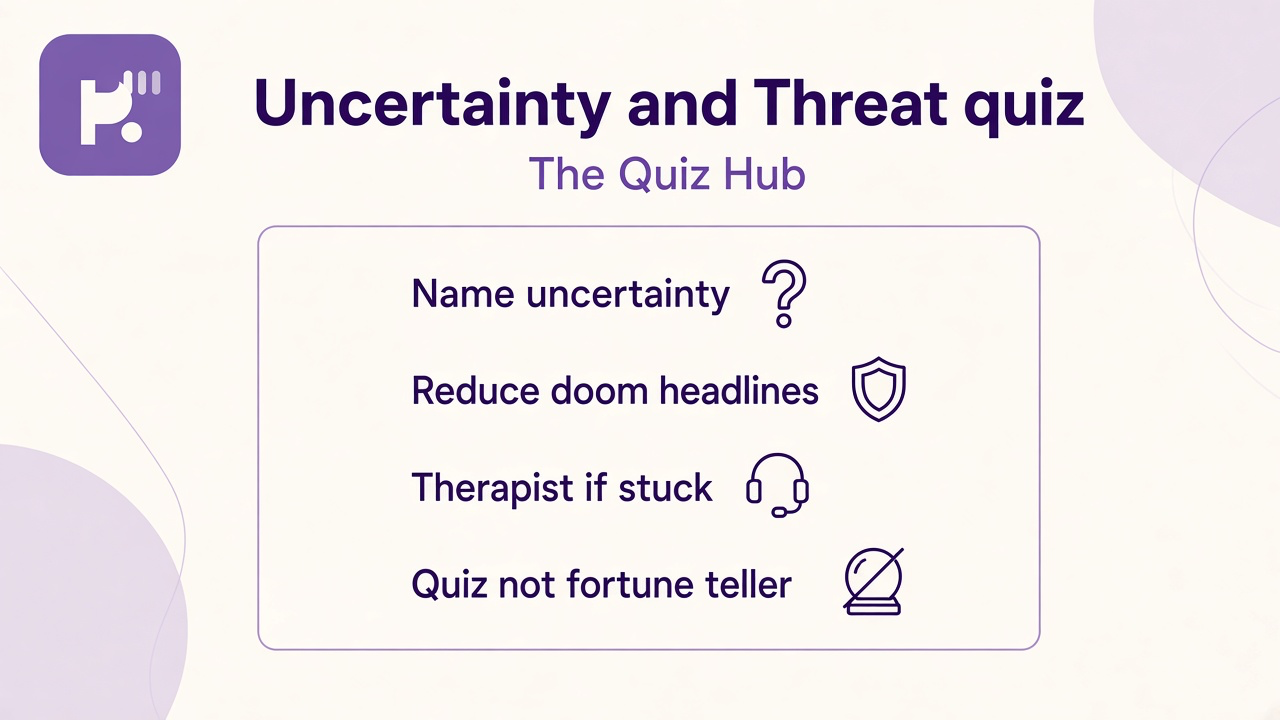
A quick takeaway graphic with topic tips (not your personal quiz scores). Start the quiz for your index, bands, and charts.
What this quiz can and cannot tell you
Can tell you
- Name threat intolerance, headline, and grounding gaps in plain language for therapy intake
- Highlight when uncertainty naming, alert limits, or therapist planning habits are missing
- Support honest conversations with clinicians without forcing one online label
- Offer a baseline if you retake after one week of alert limits and body breaks
Cannot tell you
- Diagnose generalized anxiety or any other disorder from one score
- Predict whether your feared outcome will happen
- Replace exposure therapy, medication decisions, or crisis counseling
- Substitute for 988 or clinicians when hopelessness or safety fears feel urgent
Threat intolerance, grounding, doom headlines, and quiz-not-fortune-teller limits
People search uncertainty and threat pages when ambiguous texts land, when medical results wait, or when headlines make every open loop feel like personal doom. Clinicians discuss intolerance of uncertainty as a habit pattern where not-yet-known gets treated as dangerous even before evidence arrives. This unofficial page uses that reflection lens; it cannot predict your future or tell you whether one score means disaster is imminent.
Threat intolerance covers slow replies, blank calendar spaces, and unfinished plans that spark worst-case movies. Uncertainty naming covers saying not-knowing-yet, writing worries on paper, asking clarifying questions, and refusing to treat every gray zone as tonights emergency. Body grounding covers feet-on-floor, breath, sensory checks, walks, and meals when your body feels wired, not whether you must meditate perfectly every hour.
Doom headline limits cover push alerts, disaster feeds, and comment threads that keep threat loops loud past sleep. Quiz not fortune teller covers refusing to treat fan screeners as prophecy, planning therapist visits when stuck, and remembering frequency bars name habits for reflection only. Reverse items catch honesty: naming catastrophe jumps, tolerating open loops, grounding, muting alerts, scheduled news windows, therapist plans, and quiz humility should not inflate an index meant to track frequency of threat strain.
Pair results with siblings on this hub instead of forcing one label story. Our existential search scale sibling tracks restless meaning seeking with a separate stem bank, not threat-intolerance wording here. Our experiencing an existential crisis page frames acute meaning-crisis habits with distinct limits. Our existential anxiety questionnaire EAQ sibling uses its own past-month worry bank with zero shared sentences. Browse the mental health and clinical test hub for more YMYL screeners with study-not-diagnosis framing.
Higher scores mean more frequent self-reported threat intolerance on this tool, not proof you must stay hypervigilant forever. Bring domain bars to intake so sessions start with examples such as headline triggers or text spirals, not shame. If hopelessness spikes, skip online debate and prioritize 988 or a clinician. Retake after one week of alert limits and body breaks when safe and compare bars, not only the total.
| Test | Focus |
|---|---|
| Existential search scale | Restless meaning search and feed comparison habits rather than threat intolerance and headline loops here |
| Experiencing an existential crisis | Acute meaning-crisis habit framing rather than ambiguity and doom headline frequency here |
| Existential anxiety questionnaire EAQ | Past-month existential worry themes with its own wording, not uncertainty-threat stems here |
Experiencing Uncertainty and Threat FAQ
What does this uncertainty and threat screener measure?
It measures how often you noticed threat intolerance, uncertainty naming and grounding, doom headline limits, and quiz-not-fortune-teller habits during the past month. You get an index from 0 to 100 plus four domain bars. Your responses suggest self-reported frequency for reflection, not a clinical diagnosis or prediction about your future.
How do I name uncertainty without pretending everything is fine?
Naming uncertainty means saying not-knowing-yet in plain language, writing one worry on paper, or asking a clarifying question instead of rehearsing a finished disaster story. It is honesty about open loops, not forced positivity.
Why reduce doom headlines if I want to stay informed?
Scheduled news windows and muted nonessential alerts can lower threat loops while you still follow important updates through trusted sources. All-day headline grazing often steals sleep without making outcomes clearer.
When should I see a therapist if threat worry feels stuck?
Consider a licensed clinician when worry disrupts sleep, focus, or relationships for weeks, or when you treat online scores as prophecy. Therapy modalities such as CBT or ACT often address intolerance of uncertainty with structured support this quiz cannot provide.
Can this quiz predict whether my feared outcome will happen?
No. Quiz-not-fortune-teller items state that explicitly. Frequency bars name habits for reflection; they cannot forecast health, relationships, or world events.
How is this different from existential anxiety quizzes on this hub?
EAQ, ECQ, and search-scale siblings use entirely different sentence wording focused on meaning worry, mortality cues, or restless seeking. This page targets ambiguity, headlines, and threat intolerance with zero duplicate stems. Compare totals only as separate mirrors.
Who reviewed this quiz?
Dr. Sarah Chen, PhD reviewed the YMYL framing, crisis resources, unofficial assessment limits, sibling separation, and result explanations. See our editorial policy for review standards.
Reviewed by
