What the Dyadic Adjustment Scale screener measures
This quiz does not certify you on the published Dyadic Adjustment Scale (DAS-32 or DAS-14), and it cannot decide whether you should stay in a relationship. Only a qualified clinician using interview methods and safety screening can do that. It measures how often you have noticed couple adjustment habits researchers group when partners rate satisfaction and stability, organized four ways: shared activities and protected us-time, affection and communication that stays warm and direct, conflict repair after disagreements, and realistic limits that avoid scoreboard thinking or social media verdicts. You answer 22 how-often statements about the past month, with reverse-worded items so one good weekend cannot hide frequent standoffs or parallel living on other days. Your responses also feed a second chart on closeness and trust habits, because adjustment strain often rises when vulnerability feels risky. The total becomes an index from 0 to 100 where higher means more frequent reported strain on this screener, not proof the partnership failed.
Shared activities
How often joint rituals, outings, or protected time felt present versus parallel schedules.
Affection and communication
How often warmth, listening, and touch carried connection instead of loaded silence.
Conflict repair
How often fights cooled into apology, pauses, or follow-up instead of cold wars.
Realistic limits
How often expectations stayed grounded without mind-reading demands or doom labels.
How it works
Answer 22 frequency items
Rate each statement from Never to Very often for the past month. Tap Next after each answer.
Answers sort into four domains
Each answer feeds one of four adjustment groups, and every item also feeds a closeness and trust layer.
See your index and charts
You get a 0 to 100 index, a band, and two bar charts you can bring to a therapist.
Take the Dyadic Adjustment Scale Screener
Answer 22 short statements to see your couple adjustment strain index, four domain bars, and a closeness and trust chart.
What your result means
Your index is the average of all 22 answers, scaled from 0 to 100, with reverse-worded items flipped first. Higher means more frequent reported adjustment strain on this screener. Read conflict repair and affection bars together before the total, since warm talk can hide unfinished fights or lonely evenings.
| Band | Index range | Typical reading |
|---|---|---|
| Lower reported adjustment strain | 0 to 35 | Fewer frequent strain signals across shared time, warmth, repair, and expectations. |
| Mixed reported adjustment strain | 36 to 65 | Some domains look steady while others spike during stress or disconnection. |
| Higher reported adjustment strain | 66 to 100 | Frequent strain signals; structured support may help more than another silent week. |
Tips at a glance
A quick takeaway graphic with topic tips (not your personal quiz scores). Start the quiz for your index, bands, and charts.
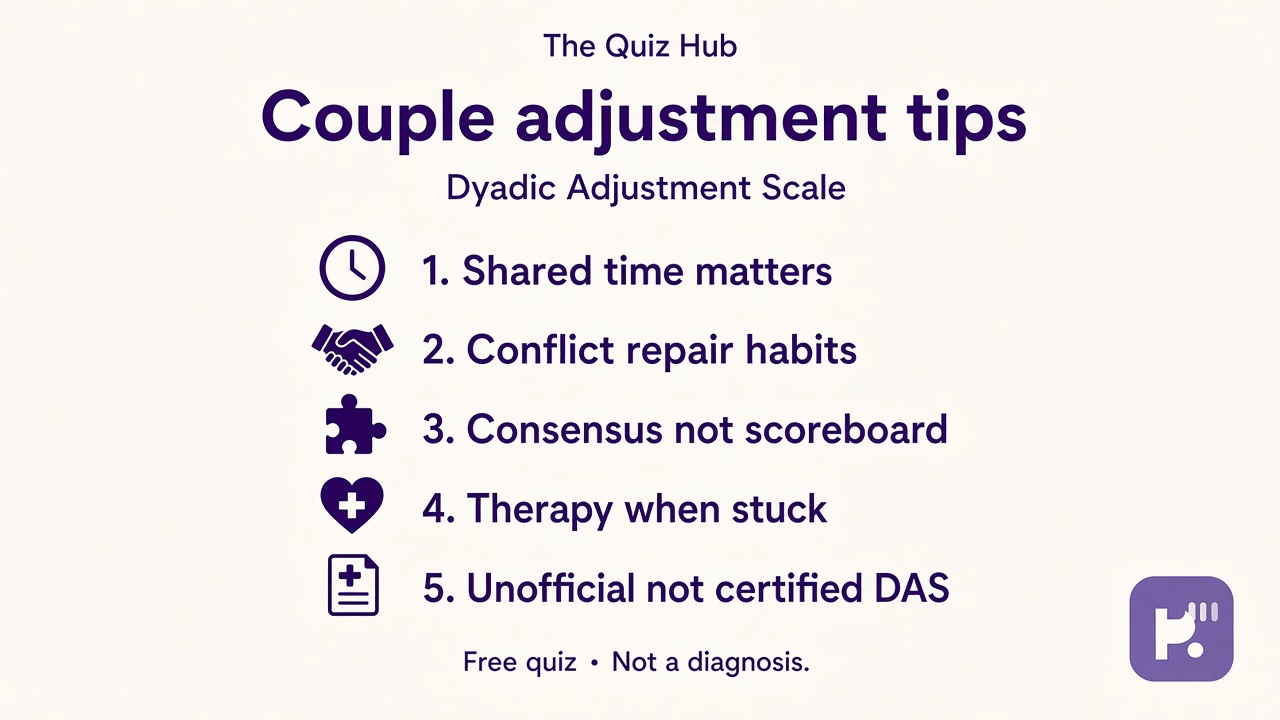
What this quiz can and cannot tell you
Can tell you
- Name shared time, affection, repair, and expectation habits in plain language
- Highlight when realistic thinking or follow-up talks are missing
- Give you vocabulary for couples or individual therapy intake
- Offer a baseline if you retake after trying one ritual or repair rule
Cannot tell you
- Replace the certified DAS or any clinician-administered adjustment measure
- Diagnose marital pathology or relationship disorders without evaluation
- Replace abuse assessment, safety planning, or legal advice
- Tell you whether to stay, leave, or reconcile from one score
Dyadic adjustment: shared life, warmth, repair, and grounded hopes
Researchers developed dyadic adjustment scales to study how partners rate satisfaction, consensus, and cohesion. Clinicians still use those tools in research and some intake settings, but your score on a screen at home is not the same as a proctored DAS. What matters for self-reflection is the pattern: do you share time that feels mutual, speak with warmth, return after conflict, and hold expectations that allow bad weeks without declaring the whole bond dead?
Shared activities are not only fancy dates. Grocery runs, dog walks, and ten quiet minutes with phones away count when both people opt in. Parallel living under one roof is a common strain signal: schedules overlap but connection does not. Affection and communication cover thanks said out loud, listening without multitasking, and touch that feels welcome rather than tense. When hurt stays unspoken until it becomes sarcasm, adjustment strain rises even if nobody yelled.
Conflict repair separates couples who fight from couples who stay stuck. Dragging old receipts into new fights, freezing for days, or apologizing without changed behavior trains both people to expect pain without resolution. Pause-and-return plans, specific apologies, and follow-up check-ins rebuild trust in small steps. Our drama triangle questionnaire maps victim, rescuer, and persecutor loops when fights feel theatrical. The couples satisfaction index CSI offers a sibling satisfaction screener with a different item set.
Realistic limits mean you state needs instead of demanding mind-reading, talk about money or time without perpetual scorekeeping, and resist treating Instagram highlights as the grading rubric for your kitchen table. One hard month can mean sleep debt, job loss, or grief, not automatic proof you picked the wrong person. Higher strain on this screener is a reason to seek skills and support, not shame.
Retake after a month of one measurable ritual and one repair rule, then compare domain bars, not only the total. Licensed clinicians help couples translate scores into conversations that protect safety and dignity. If strain pairs with fear at home, skip online debate and prioritize safety resources before another quiz.
| Test | Focus |
|---|---|
| Couples satisfaction index CSI | Sibling satisfaction screener with a different item balance and scoring frame |
| Drama triangle questionnaire | Victim, rescuer, and persecutor loops when conflict feels stuck in roles |
Dyadic Adjustment Scale Screener FAQ
What does this quiz measure?
It measures how often you noticed shared activities, affection and communication, conflict repair, and realistic limit habits with your partner or closest relationship during the past month. You get an index from 0 to 100 plus four domain bars. It reports self-reported frequency, not a clinical diagnosis.
Is this the official Dyadic Adjustment Scale (DAS)?
No. This is an unofficial, inspired screener for self-reflection. It is not the certified DAS-32 or DAS-14 and cannot replace a clinician-administered adjustment measure.
Can this quiz tell me if my marriage is over?
No. One online score cannot pass or fail a partnership. It organizes habits so you can notice strain and decide whether therapy, skills work, or safety planning might help.
What should I do if my score is high?
Try one protected us-time block, one stated need per week, and one repair talk after conflict. Book a therapist if strain repeats. If you feel unsafe or controlled, contact trusted support or domestic violence resources instead of relying on a score.
Who reviewed this quiz?
Dr. Elena Vasquez, PhD reviewed the YMYL framing, relationship limits, and safety notes. See our editorial policy for review standards.
Reviewed by