What the Drama Triangle Questionnaire measures
This quiz does not diagnose borderline, narcissistic, or any other personality label, and it cannot decide whether you should stay in a relationship. Only a qualified clinician using interview methods and safety screening can do that. It measures how often you have noticed conflict habits therapists discuss when Karpman victim, rescuer, and persecutor roles rotate in close relationships, grouped four ways: victim-role helplessness and indirect blame, rescuer-role fixing without consent, persecutor-role criticism and scorekeeping, and stepping back through pause, curiosity, and professional help when loops repeat. You answer 22 how-often statements about the past month, with reverse-worded items so one good repair talk cannot hide frequent blame or rescue on other days. Your responses also feed a second chart on closeness and trust habits, because triangle roles often spike when vulnerability feels dangerous. The total becomes an index from 0 to 100 where higher means more frequent reported triangle strain on this screener, not proof you are toxic or doomed.
Victim role
How often helplessness, silent expectations, or unfairness talk replaced direct requests.
Rescuer role
How often you fixed, advised, or carried moods before help was invited.
Persecutor role
How often blame, sarcasm, or character attacks heated conflict.
Stepping back
How often you paused, asked needs, or sought therapy instead of replaying the loop.
How it works
Answer 22 frequency items
Rate each statement from Never to Very often for the past month. Tap Next after each answer.
Answers sort into four domains
Each answer feeds one of four role groups, and every item also feeds a closeness and trust layer.
See your index and charts
You get a 0 to 100 index, a band, and two bar charts you can bring to a therapist.
Take the Drama Triangle Questionnaire
Answer 22 short statements to see your drama triangle pattern index, four domain bars, and a closeness and trust chart.
What your result means
Your index is the average of all 22 answers, scaled from 0 to 100, with reverse-worded items flipped first. Higher means more frequent reported triangle strain on this screener. Read rescuer and stepping back bars together before the total, since fixing without pause can look caring while burnout grows.
| Band | Index range | Typical reading |
|---|---|---|
| Lower reported triangle strain | 0 to 35 | Fewer frequent victim, rescuer, or persecutor loops in the past month. |
| Mixed reported triangle strain | 36 to 65 | Some domains spike while stepping back habits appear on better days. |
| Higher reported triangle strain | 66 to 100 | Frequent role loops; professional support may help more than another argument. |
Tips at a glance
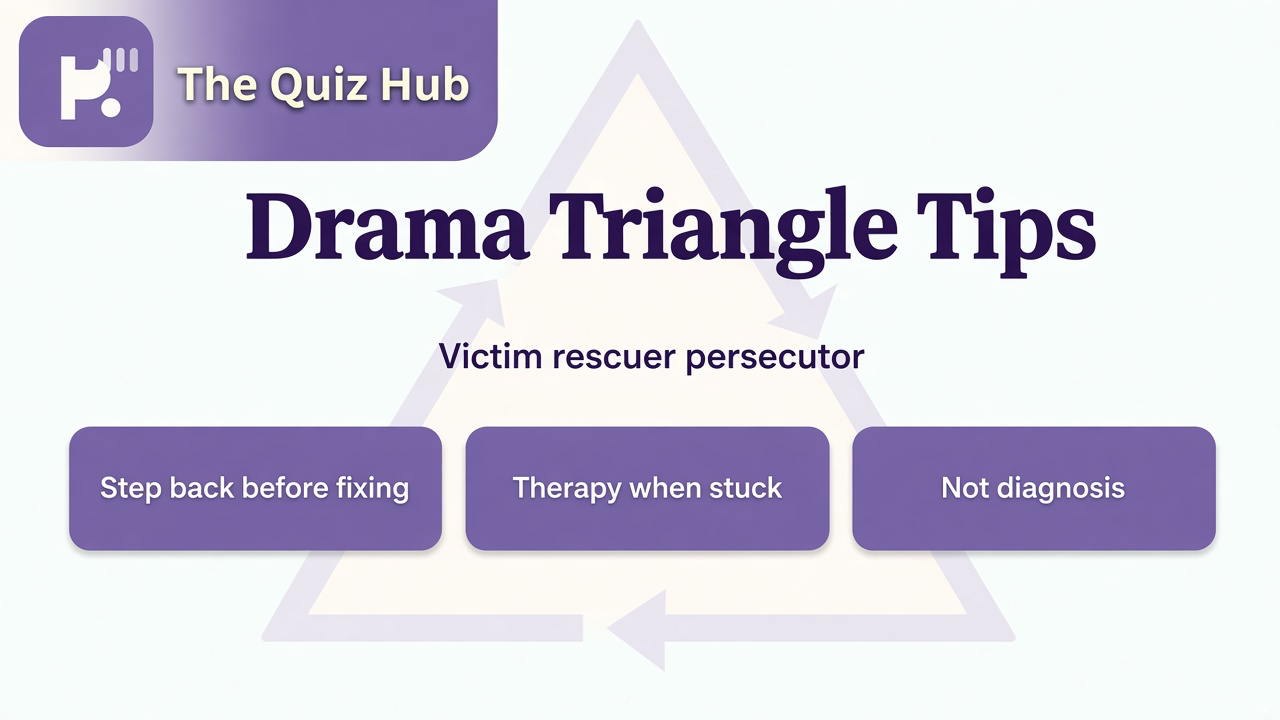
A quick takeaway graphic with topic tips (not your personal quiz scores). Start the quiz for your index, bands, and charts.
What this quiz can and cannot tell you
Can tell you
- Name victim, rescuer, and persecutor habits in plain language
- Highlight when pause-and-ask skills are missing
- Give you vocabulary for couples or individual therapy intake
- Offer a baseline if you retake after trying one boundary
Cannot tell you
- Diagnose personality disorders or relationship pathology without evaluation
- Replace abuse assessment, safety planning, or legal advice
- Prove who is the real villain in a partnership
- Tell you whether to stay, leave, or forgive from one score
Karpman roles: victim, rescuer, persecutor, and stepping off the triangle
Stephen Karpman drama triangle describes three rotating roles people slip into under stress, not three permanent personality types. The victim corner feels trapped and powerless, often hoping someone else will change the story. The rescuer corner rushes to fix, advise, or soothe because sitting with discomfort feels unbearable. The persecutor corner blames, lectures, or punishes because anger can feel safer than grief. One person can visit all three corners in a single evening; couples often trade roles until everyone is exhausted.
Victim habits are not the same as being harmed. Real injustice exists, and naming it matters. Triangle victim language shows up when you stop making requests, assume mind-reading should be enough, or complain sideways to friends while the live issue festers. Rescuer habits feel noble but can disable partners, parentify friends, and hide your own needs until resentment explodes into persecutor tone. Persecutor habits turn one behavior into a character verdict and drag old receipts into new fights.
Stepping back is the skill lane this screener treats as its own bar. Pause before the reactive text. Ask what they need instead of launching a fix kit. Schedule the talk when cortisol drops. Therapy is not admission of failure; it is structured practice for couples who love each other and still drown in the same script. Our codependency level test emphasizes caretaking and self-worth overlap when rescuer bars run high. The am I a people pleaser quiz adds saying-no habits when your yes is really rescue in disguise.
Higher scores mean more frequent self-reported loops, not a curse word. Bring domain bars to intake so sessions start with examples, not shame. If persecutor spikes pair with fear at home, skip online debate and prioritize safety resources. If rescuer spikes pair with empty stepping back, experiment with one week of no unsolicited advice and notice what feelings surface when you are not managing everyone.
Retake after a month of one measurable boundary and compare bars, not only the total. Triangle awareness is a map, not a moral scoreboard. Licensed clinicians help you step off the dance floor together when love is still there but the choreography hurts.
| Test | Focus |
|---|---|
| Codependency level test | Caretaking and self-worth overlap when rescuer fixing runs the show |
| Am I a people pleaser quiz | Saying-no habits when rescue masquerades as kindness |
Drama Triangle Questionnaire FAQ
What does this quiz measure?
It measures how often you noticed victim, rescuer, persecutor, and stepping-back habits in close relationships during the past month. You get an index from 0 to 100 plus four domain bars. It reports self-reported frequency, not a clinical diagnosis.
What is the Karpman drama triangle?
It is a model of three conflict roles people rotate through under stress: feeling helpless as victim, fixing as rescuer, or blaming as persecutor. This questionnaire tracks how often those habits show up for you, not whether you are a bad person.
Can this quiz diagnose me or my partner?
No. Only a licensed clinician can diagnose mental health or personality conditions after full evaluation. Use this tool to describe patterns and decide whether therapy might help.
What should I do if my score is high?
Try one pause-and-ask boundary, protect sleep before big talks, and book a therapist if loops repeat. If you feel unsafe or controlled, contact trusted support or domestic violence resources instead of relying on a score.
Who reviewed this quiz?
Dr. Elena Vasquez, PhD reviewed the YMYL framing, relationship limits, and safety notes. See our editorial policy for review standards.
Reviewed by