What the Dyadic Adjustment Scale DAS-2088 measures
This quiz does not diagnose marital discord, attachment disorders, or any clinical label, and it cannot decide whether you should stay in a relationship. Only a qualified clinician using interview methods and safety screening can do that. It measures how often you have noticed dyadic adjustment habits therapists discuss when couples drift on alignment and satisfaction, grouped four ways: consensus on decisions without resentful yeses or silent assumptions, respect under stress without mockery or ultimatums, intimacy comfort without using touch as a weapon or living as roommates, and honesty about satisfaction limits instead of performing fine while disappointment grows. You answer 22 how-often statements about the past month, with reverse-worded items so one good talk cannot hide frequent hidden resentment on other days. Your responses also feed a second chart on closeness and trust habits, because adjustment strain often spikes when vulnerability feels dangerous. The total becomes an index from 0 to 100 where higher means more frequent reported dyadic strain on this unofficial screener, not proof your marriage is broken.
Consensus on decisions
How often plans became stalemates, resentful agreements, or win-lose debates instead of shared clarity.
Respect under stress
How often tone turned sharp, mocking, or ultimatum-driven when pressure rose.
Intimacy comfort
How often affection felt awkward, withheld, or replaced by polite distance.
Honesty about limits
How often you hid disappointment or limits behind a calm everything-is-fine face.
How it works
Answer 22 frequency items
Rate each statement from Never to Very often for the past month. Tap Next after each answer.
Answers sort into four domains
Each answer feeds one of four adjustment groups, and every item also feeds a closeness and trust layer.
See your index and charts
You get a 0 to 100 index, a band, and two bar charts you can bring to a therapist.
Take the Dyadic Adjustment Scale DAS-2088
Answer 22 short statements to see your DAS-2088 dyadic adjustment index, four domain bars, and a closeness and trust chart.
What your result means
Your index is the average of all 22 answers, scaled from 0 to 100, with reverse-worded items flipped first. Higher means more frequent reported dyadic strain on this unofficial screener. Read satisfaction honesty and respect under stress bars together before the total, since performing fine while snapping under load can look stable while trust thins.
| Band | Index range | Typical reading |
|---|---|---|
| Lower reported dyadic strain | 0 to 35 | Fewer frequent consensus gaps, stress disrespect, intimacy distance, or hidden satisfaction limits in the past month. |
| Mixed reported dyadic strain | 36 to 65 | Some domains spike while respect, intimacy, or honesty habits appear on better weeks. |
| Higher reported dyadic strain | 66 to 100 | Frequent strain patterns; professional support may help more than another silent night. |
Tips at a glance
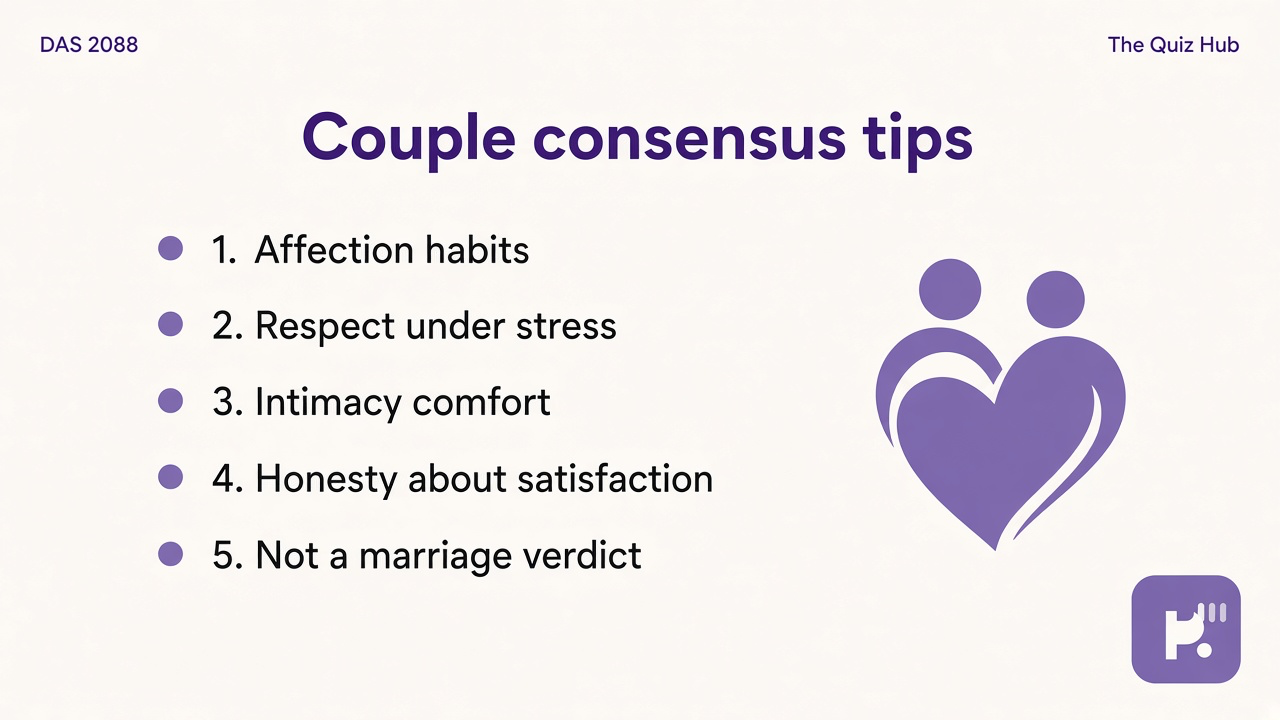
A quick takeaway graphic with topic tips (not your personal quiz scores). Start the quiz for your index, bands, and charts.
What this quiz can and cannot tell you
Can tell you
- Name consensus, respect, intimacy, and honesty habits in plain language
- Highlight when ask-before-assume or direct limit talks are missing
- Give you vocabulary for couples or individual therapy intake
- Offer a baseline if you retake after trying one measurable boundary
Cannot tell you
- Replace the certified Spanier Dyadic Adjustment Scale or clinical marital assessment
- Diagnose relationship pathology or personality conditions without evaluation
- Replace abuse assessment, safety planning, or legal advice
- Tell you whether to stay, leave, or divorce from one score
Dyadic adjustment: decisions, respect, intimacy, and honest satisfaction limits
Dyadic adjustment is the everyday work of aligning two lives without losing either person. Researchers often study consensus, satisfaction, cohesion, and affection as overlapping lanes. This unofficial DAS-2088 screener emphasizes four habits you can notice at home: whether decisions feel shared or score-kept, whether stress respect holds when you are tired, whether intimacy stays reachable instead of weaponized, and whether anyone admits when satisfaction has limits before resentment hardens.
Consensus is not identical agreement on every preference. It is clarity about who decides what, how money and time get negotiated, and whether a yes means yes. Resentful agreement trains both people to stop asking. Silent assumptions about chores, guests, or future goals explode later because nobody tested the plan aloud. Ask-before-assume is a small skill with large payoff: one sentence about what matters before you lock the calendar.
Respect under stress is where many couples lose the plot. Sharp tone, mockery, and ultimatums feel like release in the moment but teach the nervous system that conflict is dangerous. Dragging old receipts into new fights turns repair into prosecution. Pausing to hear before defending is not surrender; it is data gathering. If stress disrespect pairs with fear at home, skip online score debate and prioritize safety resources.
Intimacy comfort tracks whether closeness is still a language you speak. Roommate seasons happen during grief, new parenthood, or chronic illness, yet long avoidance can become a habit that outlasts the crisis. Withholding touch to send a message without words often backfires because the message received is rejection, not invitation to talk. Vulnerable desire talks are awkward; they are also how couples learn what affection means now, not five years ago.
Honesty about satisfaction limits is the lane that keeps fine from becoming a performance. Hiding disappointment about time, sex, or shared dreams protects short-term calm at long-term cost. Comparing silently to social media couples adds shame without instructions. Naming one limit with one request is harder than scrolling and seething, and it is the material therapists use in the first session. Our dyadic adjustment scale DAS-2083 sibling emphasizes shared time and conflict repair habits with different question stems, so pairs of scores are not duplicate content. The dysfunctional relationships scale DRS adds respect and control red flags when strain feels bigger than adjustment. The relationship anxiety quiz helps when worry and reassurance loops amplify distance even when respect mostly holds.
Retake after a month of one measurable boundary and compare bars, not only the total. Adjustment awareness is a map, not a marriage report card. Licensed clinicians help you translate habits into requests, boundaries, and safety plans when love is still there but the rhythm hurts.
| Test | Focus |
|---|---|
| Dyadic adjustment scale DAS-2083 | Sibling screener on shared time and conflict repair with non-overlapping stems |
| Dysfunctional relationships scale DRS | Respect, control, and repair red flags when strain feels structural |
Dyadic Adjustment Scale DAS-2088 FAQ
What does this quiz measure?
It measures how often you noticed consensus gaps, stress disrespect, intimacy distance, and hidden satisfaction limits in your closest relationship during the past month. You get an index from 0 to 100 plus four domain bars. It reports self-reported frequency, not a clinical diagnosis.
Is this the official Spanier Dyadic Adjustment Scale?
No. DAS-2088 is an unofficial reflection screener inspired by dyadic adjustment themes. It is not the certified instrument clinicians administer and should not be compared to published DAS norms.
Can this quiz tell me if I should stay married?
No. Only you, with trusted support and possibly licensed counseling, can make that decision. Use this tool to describe habits and decide whether therapy might help, not as a stay-or-leave verdict.
What should I do if my score is high?
Try one ask-before-assume talk and one honest limit conversation without global blame. Book a couples or individual therapist if patterns repeat. If you feel unsafe or controlled, contact trusted support or domestic violence resources instead of relying on a score.
Who reviewed this quiz?
Dr. Elena Vasquez, PhD reviewed the YMYL framing, relationship limits, and safety notes. See our editorial policy for review standards.
Reviewed by