What this behavioral test measures
This behavioral test screens eight tendency areas that show up in teams, classrooms, and everyday social settings. Each domain uses original agree-disagree statements about how you tend to act under normal pressure, not clinical symptom checklists or proprietary hiring batteries.
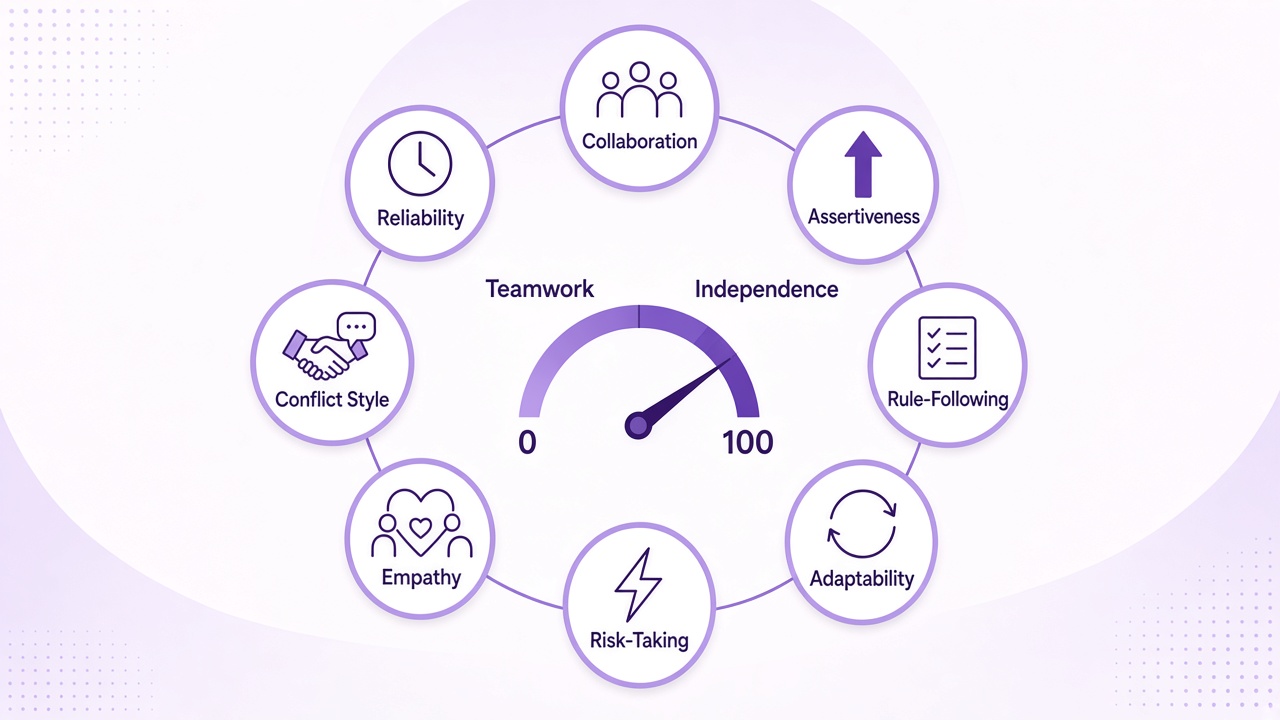
Collaboration
Preference for coordinating with others versus working independently first.
Assertiveness
Willingness to speak up, set boundaries, and push back when overlooked.
Rule-following
Habit of reading procedures and honoring steps before improvising.
Adaptability
Ease adjusting plans and routines when priorities or tools change.
Risk-taking
Comfort proposing new approaches that might fail visibly.
Empathy in teams
Attention to teammate mood and morale when making decisions.
Conflict style
Tendency to address tension directly and follow up after disagreements.
Reliability
Track record of finishing commitments and honoring small promises.
How it works
Three steps from first statement to your behavioral profile. Click Start Test to open the interactive quiz in a full-screen modal.
Answer 26 statements
Rate how much you agree with each item on a five-point scale from strongly disagree to strongly agree. There is no timer and no auto-advance between items.
Items map to eight domains
Your answers accumulate scores across collaboration, assertiveness, rule-following, adaptability, risk-taking, empathy in teams, conflict style, and reliability. Some items are reverse-coded so that agreeing with avoidance lowers your score.
View index and trait poles
Results show a behavioral reflection index from 0 to 100, a band label, your top two trait poles, and eight domain bars ranked highest to lowest.
Take the behavioral test
Rate 26 workplace and social behavioral statements about how you tend to collaborate, follow through, and handle tension today. Your answers produce a behavioral reflection index and one of three bands with top trait poles plus an eight-domain breakdown chart.
Opens in a focused modal. No account required. Results stay on screen.
What your result means
Your behavioral reflection index is the sum of scored items normalized to 0 through 100. Higher percentages mean more agreement with collaborative, reliable, and direct habit items and less agreement with avoidance or improvisation-under-pressure items. The band label groups that score into plain-language stages for self-reflection.
| Behavioral band | Percentage range | Typical reading |
|---|---|---|
| Emerging Workplace Patterns | 0 to 35% | More friction with follow-through, assertiveness, or direct conflict on these items |
| Balanced Behavioral Style | 36 to 65% | Mixed strengths across domains; chart shows where growth edges sit |
| Consistent Behavioral Profile | 66 to 100% | Steadier workplace habits on this snapshot; one domain may still lag |
Eight domains and trait poles
Each domain maps to two trait poles. Strong collaboration scores lean Team-oriented; lower scores lean Independent. The diagram below shows how domain scores feed a behavioral reflection index and highlight your top two poles.
What this test can and cannot tell you
Can tell you
- How your self-reported behavioral habits cluster across eight domains
- A band label and reflection index for today
- Your top two trait poles and which domain bars score lowest
- A starting point for coaching, team feedback, or communication practice
Cannot tell you
- Whether you have a personality disorder or any clinical diagnosis
- Whether you should be hired, promoted, or selected for leadership
- Official DISC, Hogan, or other published psychometric percentile scores
- How managers or peers objectively rate your workplace behavior
Workplace behavioral models and online quizzes
Industrial psychologists have long studied observable workplace behavior separately from deep personality traits. William Moulton Marston's 1928 emotional response patterns later became DISC training language. Hogan and other publishers sell validated behavioral inventories for organizations, while many free online quizzes use shortened Likert items similar in format to this one.
The Quiz Hub behavioral test borrows the eight-domain workplace framing with twenty-six original statements. It is not DISC, not Hogan, not a hiring screen, and not comparable to published norm tables. For emotional skill context that overlaps with team empathy, take our live EQ test. For broader trait percentiles, take our live Big Five personality test. For workplace pace language, take our live DISC behavioral style test. For confidence under observation, take our live confidence test.
Sample item: agreeing that colleagues can count on you to finish promises on time raises your reliability domain score. Agreeing that you avoid difficult conversations even when issues repeat lowers your conflict style score on a reverse-coded item. Social desirability bias can inflate scores when people answer how they think they should act at work. Read how we review quizzes in our editorial policy.
Behavioral test FAQ
What does this behavioral test measure?
This behavioral test screens self-reported agreement with 26 statements across eight workplace and social domains: collaboration, assertiveness, rule-following, adaptability, risk-taking, empathy in teams, conflict style, and reliability. It produces a behavioral reflection index from 0 to 100, eight domain bars with trait poles, and a band such as Emerging Workplace Patterns, Balanced Behavioral Style, or Consistent Behavioral Profile. It is an informal snapshot, not a personality diagnosis.
Can I use this behavioral test for hiring or job screening?
No. The Quiz Hub behavioral test is for personal reflection and education only. Scores are not validated for employment screening, leadership selection, or clinical intake. Employers should use professionally administered instruments with trained interpreters when behavioral assessment is required.
What are trait poles on the behavioral test results?
Each domain has two trait poles, such as Team-oriented versus Independent for collaboration or Direct versus Avoidant for conflict style. Your domain percentage determines which pole you lean toward on that snapshot. The results page highlights your top two trait poles, the domains where your answers scored highest.
How long does the behavioral test take?
Most people finish in about six minutes. There are twenty-six statements on a five-point agree-disagree scale. You can pause and return in the same browser session.
How is this different from the EQ test or psychometric test?
The EQ test focuses on emotional intelligence habits such as self-awareness and conflict repair. This behavioral test focuses on observable workplace tendencies such as collaboration pace, rule-following, and reliability. Our planned psychometric test will blend broader self-report and reasoning items. Pair all three for a wider reflection map, but none replace professional assessment.
Who reviewed this content?
Dr. James Whitfield, PhD, reviewed the test framing and result explanations. See our editorial policy for review standards.
Reviewed by