What this avoidant personality disorder test measures
This avoidant personality disorder test estimates how often AVPD-style trait signals showed up for you in the past month. Twenty-four original frequency items group into four domains drawn from DSM-5 avoidant personality themes: social inhibition, criticism sensitivity, inadequacy self-view, and interpersonal avoidance. Your AVPD trait screener index averages these patterns into a 0 to 100 score with plain-language bands. A parallel fear-of-intimacy stack shows how rejection fear may guard closeness. It reflects your self-report, not a clinician's evaluation.
Social inhibition
Holding back in new groups, freezing when noticed, and declining invitations because judgment feels likely.
Criticism sensitivity
Scanning for disapproval, replaying awkward moments, and bracing for ridicule after minor mistakes.
Inadequacy self-view
Seeing yourself as unappealing, socially inept, or inferior compared with peers you admire.
Interpersonal avoidance
Avoiding roles unless acceptance feels guaranteed, and limiting risk that could expose you to shame.
How it works
Three steps from first question to your AVPD trait report with fear-of-intimacy stack. Click Start Test to open the interactive quiz in a full-screen modal.
Answer 24 frequency items
Rate how often each avoidant trait pattern showed up in the past month, from Never to Very often. You click Next after each answer; nothing auto-advances.
Items map to four AVPD domains
Your answers accumulate percentages for social inhibition, criticism sensitivity, inadequacy self-view, and interpersonal avoidance, plus a fear-of-intimacy stack index.
View band and domain bars
Results show Lower, Mixed, or Higher AVPD Trait Signals with trait domain bars and intimacy stack layers. Higher bands include crisis resources.
Take the avoidant personality disorder test
Rate 24 statements about avoidant trait patterns from the past month. Your answers produce an AVPD trait screener index from 0 to 100, four trait domain scores, a fear-of-intimacy stack chart, and a band label for reflection or therapy conversation.
Opens in a focused modal. No account required. Results stay on screen.
What your result means
Your AVPD trait screener index is the normalized total across all 24 items on a 0 to 100 scale, with reverse scoring on protective items so higher scores mean more avoidant trait signals overall. Domain bars show endorsement rates so you can see whether social inhibition, criticism sensitivity, inadequacy, or interpersonal avoidance drives your result most. The fear-of-intimacy stack chart shows how closeness guarding layers alongside trait signals.
| Band | Index range | Typical reading |
|---|---|---|
| Lower AVPD Trait Signals | 0 to 35 | Fewer avoidant trait signals on this screener; shyness or introversion may still appear |
| Mixed AVPD Trait Signals | 36 to 65 | Blend of social caution and rejection fear; worth tracking if persistent |
| Higher AVPD Trait Signals | 66 to 100 | Frequent inhibition, criticism scanning, or avoidance; professional support may help |
What your AVPD trait report looks like
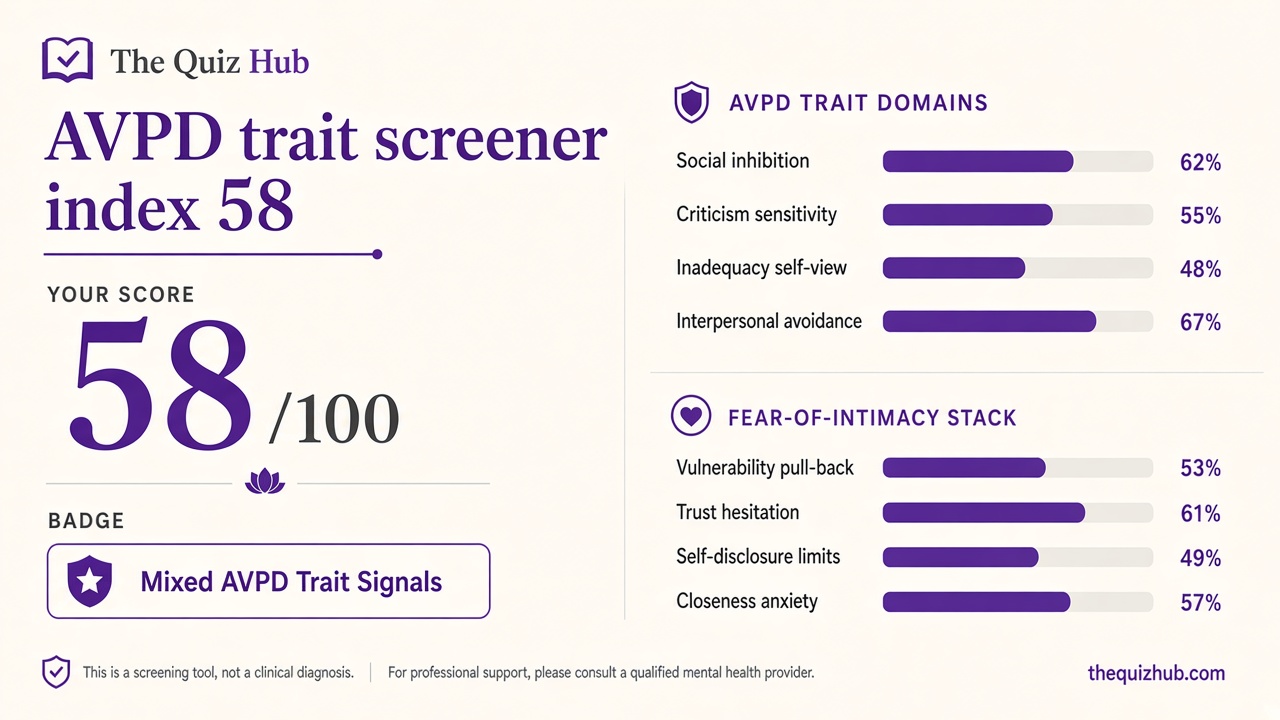
After all 24 items, you get an AVPD trait screener index from 0 to 100, a band label, four trait domain bars, and a fear-of-intimacy stack chart with vulnerability pull-back, trust hesitation, self-disclosure limits, and closeness anxiety layers. Percentages reflect how you handle rejection fear, not a clinical verdict about your diagnosis.
What this test can and cannot tell you
Can tell you
- How often AVPD-style trait signals showed up for you in the past month
- An AVPD trait screener index and four domain bars for inhibition, criticism sensitivity, inadequacy, and avoidance
- A fear-of-intimacy stack chart showing how closeness guarding layers with trait signals
- A starting point for therapy conversation or retaking after treatment progress
Cannot tell you
- Whether you have avoidant personality disorder or any clinical diagnosis
- Whether your social fears are personality traits, social anxiety, or situational stress without evaluation
- How fast you should change or whether therapy will work for you
- What treatment you need without a licensed clinician's evaluation
Rejection fear, inadequacy, and intimacy guarding
Psychologist Theodore Millon described avoidant personality patterns as a blend of social inhibition, shame sensitivity, and a self-view that feels unappealing to others. The DSM-5 (American Psychiatric Association, 2013) lists criteria such as avoiding occupational or social contact unless acceptance feels certain, restraint in intimate relationships because of shame fears, and preoccupation with criticism. Research by Lynn Alden and colleagues on social anxiety and avoidant traits shows overlap between performance fear and broader rejection sensitivity that shapes daily choices.
The Quiz Hub built this avoidant personality disorder test as an original self-report screener inspired by AVPD trait themes from the DSM-5 and Millon's clinical descriptions, not a reproduction of the MCMI or any published clinical instrument. Readers often compare it to sibling tools on this site. Our social anxiety test screens fear of negative evaluation in public settings. The shyness test maps reserved temperament rather than rejection-driven avoidance. The fear of intimacy quiz measures closeness avoidance in relationships without AVPD trait domain bars.
| The Quiz Hub test | What it adds |
|---|---|
| Social anxiety test | Performance and evaluation fear in public, not inadequacy self-view across daily roles |
| Shyness test | Reserved temperament and approach inhibition, not DSM-5 AVPD trait clusters |
| Trust issues quiz | Betrayal imprint and trust hesitation, not social inhibition or criticism scanning |
| Am I insecure quiz | Relationship insecurity and reassurance seeking, not occupational avoidance patterns |
| Fear of intimacy quiz | FOIS-inspired intimacy avoidance only, without AVPD trait domain bars |
| This AVPD test | Four-domain trait screener index plus fear-of-intimacy stack for past-month avoidant signals |
Sample item types include frequency ratings such as whether you held back from speaking in groups because you feared sounding foolish, or whether you avoided roles unless you felt sure of being liked. High criticism sensitivity with high inadequacy self-view often lands in Mixed or Higher AVPD Trait Signals. New jobs, dating, or family events can spike scores temporarily. Read how we review quizzes in our editorial policy or browse more tools on our mental health and clinical hub.
Avoidant personality disorder test FAQ
What is avoidant personality disorder?
Avoidant personality disorder (AVPD) is a clinical pattern marked by social inhibition, feelings of inadequacy, and hypersensitivity to criticism or rejection. The DSM-5 lists criteria such as avoiding work or social contact unless acceptance feels certain, viewing oneself as unappealing, and limiting intimacy because of shame fears. This avoidant personality disorder test measures how often similar trait signals showed up for you in the past month. It is not a clinical diagnosis.
What does this avoidant personality disorder test measure?
Twenty-four original frequency items ask how often you notice social inhibition, criticism sensitivity, inadequacy self-view, or interpersonal avoidance. Scores map to four AVPD trait domains plus a parallel fear-of-intimacy stack with vulnerability pull-back, trust hesitation, self-disclosure limits, and closeness anxiety layers. You receive an AVPD trait screener index from 0 to 100 and a band from Lower through Higher AVPD Trait Signals.
What is the fear-of-intimacy stack on this test?
The fear-of-intimacy stack is a second results chart inspired by FOIS-style intimacy avoidance themes, adapted to avoidant trait framing. Each of the 24 items also maps to one of four stack layers. The stack index summarizes how often rejection fear shapes closeness guarding alongside AVPD-style trait signals.
How is this different from the social anxiety test?
The social anxiety test screens performance fear and fear of negative evaluation in public settings. This avoidant personality disorder test uses a broader trait frame that includes inadequacy self-view, criticism scanning, and interpersonal avoidance even outside performance moments. Both are screeners, not diagnoses.
Can this test diagnose avoidant personality disorder?
No. The AVPD trait screener index describes self-reported pattern frequency on this abbreviated quiz. Only a licensed clinician can evaluate avoidant personality disorder through structured interviews and history. Online tests cannot confirm or deny a diagnosis.
Who reviewed this content?
Dr. Elena Vasquez, PhD, reviewed the test framing and result explanations. See our editorial policy for review standards.
Reviewed by