What this strict parents quiz measures
This are my parents strict quiz estimates how often strict parenting impact signals show up with your parents or primary caregivers. Twenty-two original frequency items group into four domains drawn from developmental psychology research on authoritarian parenting: harsh discipline and punishment, rigid rule enforcement, high expectations and comparison, and conditional warmth and approval. Your strict parenting impact index averages these patterns into a 0 to 100 score with plain-language bands. A parallel fear-of-intimacy stack chart shows how those patterns may shape closeness habits today. It reflects your self-report, not a clinical label for your parents.
Harsh discipline and punishment
Yelling, physical punishment, long groundings, threats of removal, and lectures without hearing your side.
Rigid rule enforcement
Non-negotiable house rules, punishment for questioning authority, strict penalties on curfews and dress, and surprise rule changes.
High expectations and comparison
Sibling comparisons, disappointment without top ranks, nitpicking small mistakes, family shame, and near-perfection demands.
Conditional warmth and approval
Cold silence until apology, affection tied to obedience, disappointment in you as a person, and comfort withheld until fault is admitted.
How it works
Three steps from first question to your strict parenting impact report. Click Start Quiz to open the interactive quiz in a full-screen modal.
Answer 22 frequency items
Rate how often each strict parenting pattern shows up when you think about your parents or caregivers, from Never to Almost always. You click Next after each answer; nothing auto-advances.
Items map to four strict parenting domains
Your answers accumulate percentages for discipline, rule rigidity, expectations, and conditional warmth, plus a fear-of-intimacy stack index across four closeness layers.
View band, domain bars, and stack chart
Results show Lower, Mixed, or Higher Strict Parenting Impact with domain bars, stack layers, and reflection prompts. Higher bands include crisis resources.
Take the strict parents quiz
Rate 22 statements about discipline and approval patterns with your parents or caregivers. Your answers produce a strict parenting impact index from 0 to 100, four domain scores, a fear-of-intimacy stack chart, and a band label for reflection or therapy conversation.
Opens in a focused modal. No account required. Results stay on screen.
What your result means
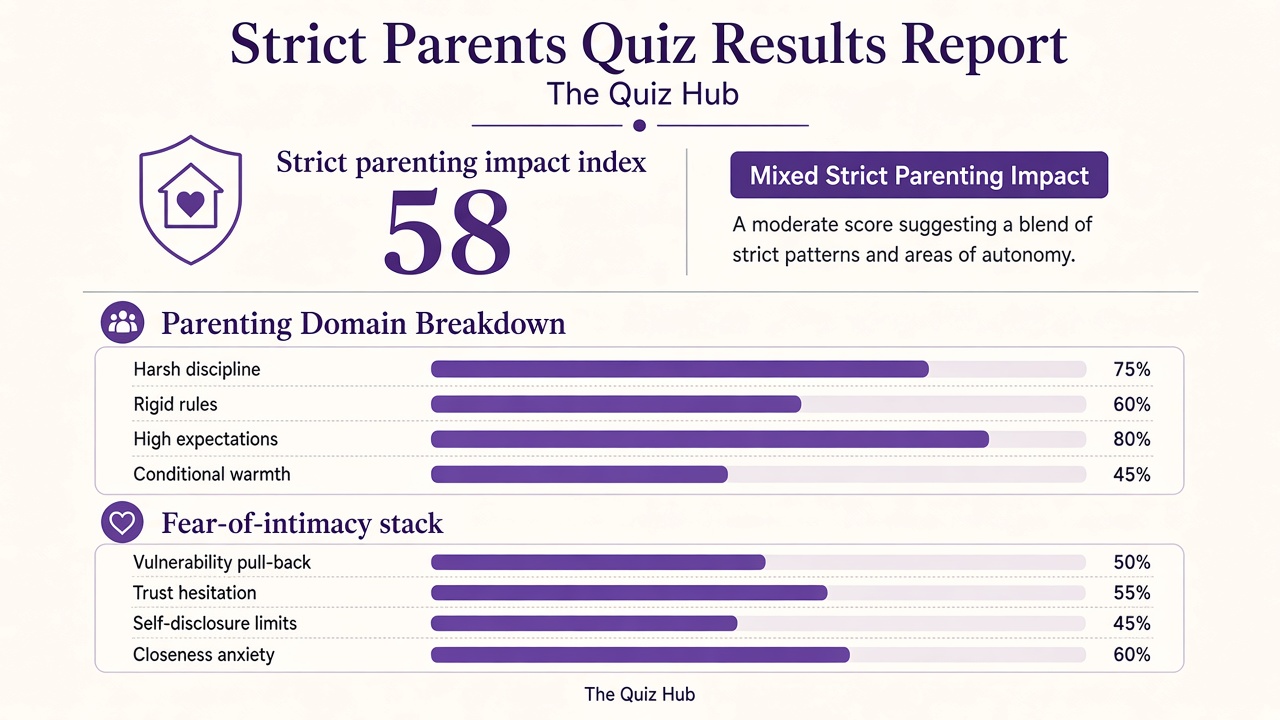
Your strict parenting impact index is the normalized total across all 22 items on a 0 to 100 scale, with reverse scoring on protective items so higher scores mean more strict parenting pattern concern overall. Domain bars show endorsement rates so you can see whether harsh discipline, rigid rules, high expectations, or conditional warmth drives your result most. The fear-of-intimacy stack index summarizes parallel closeness guarding layers that often travel with shame-based home environments.
| Band | Index range | Typical reading |
|---|---|---|
| Lower Strict Parenting Impact | 0 to 35 | Fewer strict parenting pattern signals; firm boundaries or cultural respect norms may still appear |
| Mixed Strict Parenting Impact | 36 to 65 | Blend of structure and shame-based discipline; worth tracking if persistent across seasons |
| Higher Strict Parenting Impact | 66 to 100 | Frequent punishment, rigid obedience, or love tied to performance; professional support may help |
What your strict parents report looks like
After all 22 items, you get a strict parenting impact index from 0 to 100, a band label, four domain bars for harsh discipline, rigid rule enforcement, high expectations, and conditional warmth, plus a fear-of-intimacy stack chart with vulnerability pull-back, trust hesitation, self-disclosure limits, and closeness anxiety layers. Percentages reflect how you experience your parents or caregivers, not a clinical verdict.
What this quiz can and cannot tell you
Can tell you
- How often strict parenting impact signals showed up for you with parents or caregivers
- A strict parenting impact index, four domain bars, and a fear-of-intimacy stack chart
- Which strict parenting domain or stack layer feels strongest in your current family experience
- A starting point for therapy conversation or retaking after moving out or repair attempts
Cannot tell you
- Whether your parents are clinically abusive or narcissistic without professional evaluation
- Whether cultural or religious discipline norms explain your scores without your own judgment
- Whether relationships can heal without honest dialogue and mutual effort
- What treatment you need without a licensed clinician's evaluation
Authoritarian parenting, Baumrind research, and family therapy
Developmental psychologist Diana Baumrind published foundational work on parenting styles in the 1960s, distinguishing authoritarian parents (high demands, low responsiveness) from authoritative parents who set clear limits with warmth and explanation. Decades of follow-up research link harsh, shame-based discipline to higher anxiety, lower self-esteem, and difficulty trusting partners in adulthood. Adult children of strict homes often learn to hide mistakes, over-prepare before sharing, or assume closeness will bring judgment even when they succeed at work.
The Quiz Hub built this are my parents strict quiz as an original self-report screener inspired by those themes, not a reproduction of any single published instrument. Readers often compare it to sibling tools on this site. Our overprotective parents quiz screens monitoring, vetoed choices, enmeshment, and sheltered exposure rather than punishment frequency. The abusive parents quiz focuses on physical intimidation, verbal cruelty, control tactics, and neglect with a harm-focused YMYL frame. The toxic parents quiz measures criticism, guilt trips, and boundary violations rather than obedience demands alone.
| The Quiz Hub test | What it adds |
|---|---|
| Overprotective parents quiz | Monitoring, autonomy limits, enmeshment, sheltered exposure plus fear-of-intimacy stack |
| Abusive parents quiz | Physical intimidation, verbal cruelty, control tactics, and neglect signals |
| Toxic parents quiz | Criticism, guilt trips, boundary violations, and emotional safety strain |
| Emotionally immature parents quiz | Self-absorption, validation gaps, parentification, intimacy modeling |
| Fear of intimacy quiz | FOIS-inspired closeness avoidance in romantic bonds, not parent frequency items |
| This strict parents quiz | Four-domain strict parenting impact index plus fear-of-intimacy stack for family-of-origin shame patterns |
Sample item types include frequency ratings such as whether parents compared your grades to siblings, or whether they went cold until you apologized their way. High harsh discipline with high conditional warmth scores often lands in Mixed or Higher Strict Parenting Impact. Religious discipline, immigrant family respect norms, and becoming a parent yourself can shift scores temporarily. Read how we review quizzes in our editorial policy or browse more tools on our relationships and dating hub.
Strict parents quiz FAQ
What counts as strict parenting?
Developmental psychologists describe strict or authoritarian parenting as high demands paired with low warmth: harsh punishment, rigid obedience rules, shame for mistakes, and affection tied to performance. It differs from firm but responsive parenting that explains consequences and adjusts rules with age. This are my parents strict quiz measures how often those discipline and approval signals showed up for you with parents or primary caregivers. It is not a clinical diagnosis of your parents.
What does this strict parents quiz measure?
Twenty-two original frequency items ask how often you notice harsh discipline and punishment, rigid rule enforcement, high expectations and comparison, and conditional warmth and approval when you think about your parents or caregivers. Scores map to four strict parenting domains plus a parallel fear-of-intimacy stack with vulnerability pull-back, trust hesitation, self-disclosure limits, and closeness anxiety layers. You receive a strict parenting impact index from 0 to 100 where higher scores mean more strict parenting pattern signals, plus a band from Lower through Higher Strict Parenting Impact.
What is the fear-of-intimacy stack on this quiz?
The fear-of-intimacy stack is a second results chart inspired by FOIS-style intimacy avoidance themes, adapted to family-of-origin framing. Each of the 22 items also maps to one of four stack layers: vulnerability pull-back, trust hesitation, self-disclosure limits, and closeness anxiety. The stack index summarizes how often strict home environments may shape hiding mistakes, doubting others, avoiding honest talks, or repeating distance patterns today.
How is this different from the overprotective parents quiz?
The are my parents overprotective quiz screens monitoring, vetoed choices, emotional enmeshment, and sheltered exposure with a control-through-care frame. This strict parents quiz focuses on punishment frequency, non-negotiable obedience, shame comparisons, and love tied to good behavior. Both include a fear-of-intimacy stack chart, but the item banks measure different family dynamics.
Can this quiz prove my parents were abusive or bad people?
No. The strict parenting impact index describes self-reported pattern signals on this abbreviated screener. Cultural respect norms, religious discipline, or one difficult season can raise scores without abuse. Only you plus trusted professionals can assess family dynamics. Online quizzes cannot confirm or deny abuse or diagnose personality disorders.
Who reviewed this content?
Dr. Elena Vasquez, PhD, reviewed the test framing and result explanations. See our editorial policy for review standards.
Reviewed by