What this am I ugly quiz measures
This am I ugly quiz screens seven body image distress domains tied to the fear of being seen as unattractive. Each domain uses original agree-disagree statements. Higher scores mean kinder appearance self-talk on these items, not a beauty ranking. The word ugly describes shame habits, not your face or body.
Mirror self-talk
First thoughts when you look in the mirror and how long harsh loops replay.
Influencer comparison
Measuring your everyday look against filtered or curated online images.
Photo avoidance
Dodging cameras, deleting tags, or dreading how you will look in pictures.
Rejection assumption
Assuming others will lose interest because of how you look.
Compliment dismissal
Trusting inner criticism more than sincere praise about your appearance.
Feature fixation
One disliked feature dominating how you see your whole face or body.
Appearance withdrawal
Skipping social, school, or work plans because of appearance shame.
How it works
Three steps from first statement to your body image band. Click Start Quiz to open the interactive test in a full-screen modal.
Answer 24 statements
Rate how much you agree with each item on a five-point scale from strongly disagree to strongly agree. There is no timer and no auto-advance between items.
Items map to seven domains
Your answers accumulate scores across mirror talk, comparison, photos, rejection fears, compliments, feature fixation, and withdrawal. Some items are reverse-coded so that agreeing with harsh self-labels lowers your score.
View index and domain chart
Results show a body image reflection index from 0 to 100, a band label, seven domain bars ranked lowest to highest, and crisis support if severe distress items are flagged.
Take the am I ugly quiz
Rate 24 statements about how you talk to yourself when mirrors, photos, or compliments appear. Your answers produce a body image reflection index and one of three bands with a seven-domain breakdown chart.
Opens in a focused modal. No account required. Results stay on screen.
What your result means
Your body image reflection index is the sum of scored items normalized to 0 through 100. Higher percentages mean more agreement with kinder appearance self-talk items and less agreement with shame-driven items. The band label groups that score into plain-language stages for reflection today.
| Body image band | Percentage range | Typical reading |
|---|---|---|
| Harsher Self-Criticism | 0 to 35% | More mirror attack, comparison pain, or withdrawal on these items |
| Mixed Appearance Anxiety | 36 to 65% | Blend of kind and anxious body image habits; domain chart shows where |
| Kinder Self-Reflection | 66 to 100% | Steadier appearance self-talk; one domain may still lag |
Seven domains of body image reflection
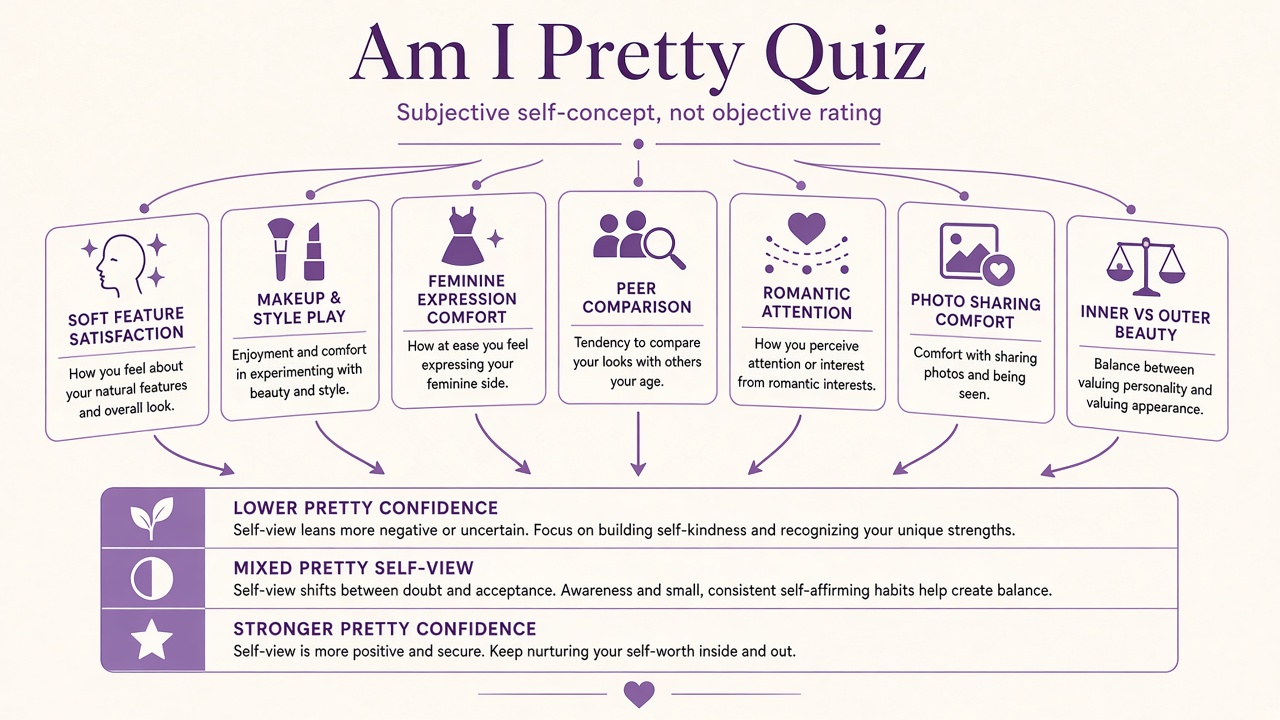
The diagram below shows how domain scores feed an overall body image reflection index. Strong compliment acceptance with weak photo comfort, for example, can still land you in a Mixed Appearance Anxiety band until cameras feel safer.
What this quiz can and cannot tell you
Can tell you
- How your appearance self-talk clusters across seven distress domains
- A band label and percentage for reflection today
- Which domain bar scores lowest and may deserve attention first
- Whether severe distress items suggest professional support may help
Cannot tell you
- Whether you are ugly, unattractive, or below average in looks
- Whether you have body dysmorphic disorder or an eating disorder
- Scores comparable to clinical body image inventories
- How others objectively rate your appearance
Body image distress and the search for an ugly label
Psychologist Thomas Cash developed the Body Image Ideals Questionnaire and related work showing that appearance distress lives in thoughts and behaviors, not in a single objective score strangers assign online. The National Institute of Mental Health notes that body image concerns can overlap with social anxiety, depression, and eating disorders, which deserve professional evaluation when they limit daily life.
The Quiz Hub am I ugly quiz borrows that clinical framing with twenty-four original statements about mirror talk, comparison, and withdrawal. It is not a beauty rating app, not a body dysmorphic disorder screener, and not comparable to published BIQ norms. For broader self-worth beyond appearance, take our live self esteem test. For intrinsic dignity versus conditional worth, take our live self worth quiz. For performance confidence under observation, take our live confidence test.
Sample item: agreeing that filtered influencer posts make you feel wrong lowers your comparison domain score on a reverse-coded item. Agreeing that you can accept a sincere compliment raises your compliment dismissal score. Social media algorithms and bullying memories often spike harsh mirror talk temporarily. Read how we review quizzes in our editorial policy.
Am I ugly quiz FAQ
Does this am I ugly quiz tell me whether I am ugly?
No. This quiz measures body image distress patterns such as harsh mirror talk, influencer comparison, photo avoidance, assumed rejection, compliment dismissal, feature fixation, and social withdrawal from appearance shame. It produces a body image reflection index from 0 to 100 with Harsher Self-Criticism, Mixed Appearance Anxiety, or Kinder Self-Reflection bands. It never labels you ugly.
Why reframe the am I ugly search into body image reflection?
Ugly is a cruel oversimplification that flattens a whole person into one insult. Clinical body image research treats distress as patterns of thought and behavior, not a fixed beauty score. This test maps those patterns so you can notice shame loops without treating the label as fact.
How long does the am I ugly quiz take?
Most people finish in about six minutes. There are twenty-four agree-disagree statements on a five-point scale. You can pause and return in the same browser session.
What do the three body image bands mean?
Harsher Self-Criticism (0 to 35%) suggests sharper appearance self-attack on these items. Mixed Appearance Anxiety (36 to 65%) shows a blend of kind and anxious body image habits. Kinder Self-Reflection (66 to 100%) suggests steadier mirror and social self-talk on this snapshot.
Should I take the self esteem test too?
Yes, if you want broader context. This am I ugly quiz focuses on appearance-specific distress. Our self esteem test screens self-worth, competence, and acceptance across twenty-one items. Pair them when mirror shame feels tied to global self-doubt.
Who reviewed this content?
Dr. Elena Vasquez, PhD, reviewed the test framing and result explanations. See our editorial policy for review standards.
Reviewed by