What this am I attractive quiz measures
This am I attractive quiz screens how you feel about your appearance today across seven reflective domains. Each domain uses original agree-disagree statements. The quiz measures appearance confidence, not whether you match any single beauty standard.
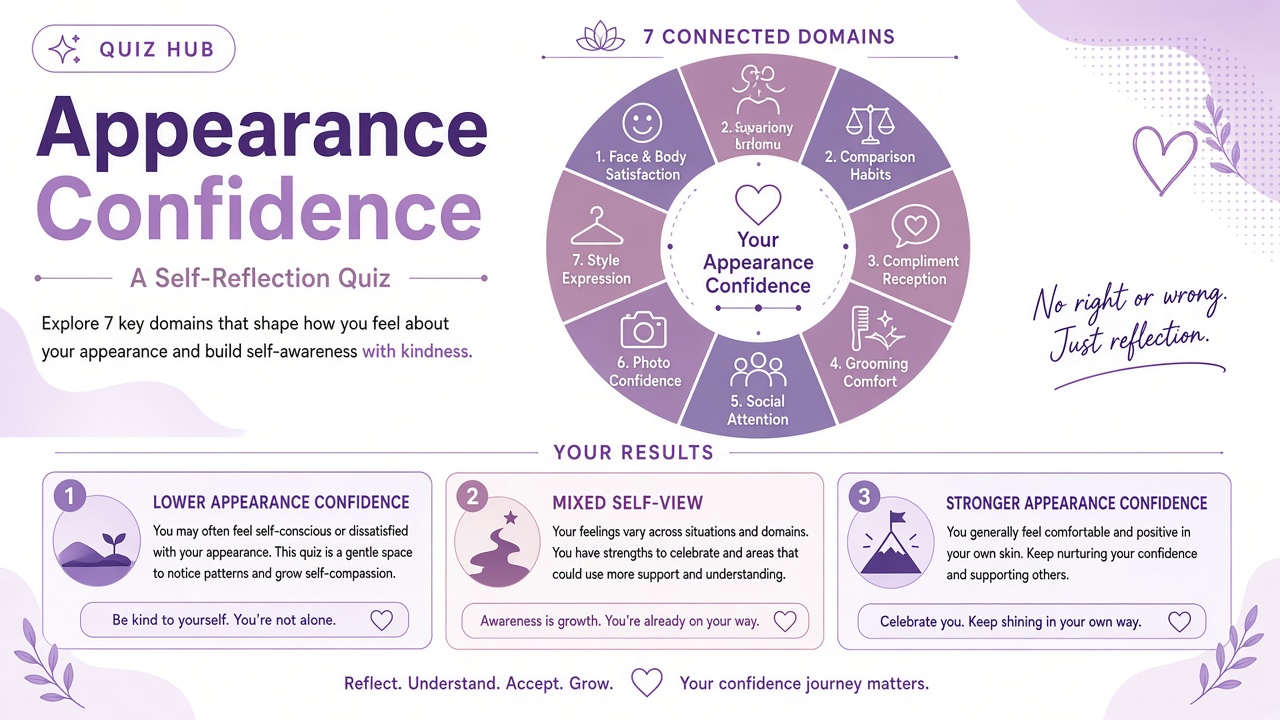
Face & body satisfaction
Mirror comfort, feature acceptance, and day-to-day satisfaction with how you look.
Comparison habits
How often you rank your looks against others on social media or in person.
Compliment reception
Whether you can accept kind words about your appearance without dismissing them.
Grooming comfort
Ease with hygiene and grooming effort without guilt or dread.
Social attention
How you interpret glances, stares, and neutral expressions from others.
Photo confidence
Willingness to appear in and share photos without heavy avoidance.
Style expression
Whether clothing and presentation feel authentic rather than hiding-focused.
How it works
Three steps from first statement to your appearance confidence band. Click Start Quiz to open the interactive test in a full-screen modal.
Answer 24 statements
Rate how much you agree with each item on a five-point scale from strongly disagree to strongly agree. There is no timer and no auto-advance between items.
Items map to seven domains
Your answers accumulate scores across face/body satisfaction, comparison, compliments, grooming, social attention, photos, and style. Some items are reverse-coded so that agreeing with harsh self-talk lowers your score.
View band and domain chart
Results show an overall appearance confidence index, a band label from Lower through Stronger Appearance Confidence, per-domain bars, and suggested next steps.
Take the am I attractive quiz
Rate 24 appearance self-perception statements about how you see yourself today. Your answers produce an overall index and one of three bands with a seven-domain breakdown chart. Beauty is subjective; there is no objective attractiveness score.
Opens in a focused modal. No account required. Results stay on screen.
What your result means
Your overall appearance confidence index is the sum of scored items normalized to 0 through 100. Higher percentages mean more agreement with comfort items and less agreement with comparison or self-criticism items. The band label groups that score into plain-language stages without ranking your objective beauty.
| Appearance confidence band | Percentage range | Typical reading |
|---|---|---|
| Lower Appearance Confidence | 0 to 35% | More appearance worry or comparison strain; consider support if persistent |
| Mixed Self-View | 36 to 65% | Blend of acceptance and self-doubt; domain chart shows where |
| Stronger Appearance Confidence | 66 to 100% | Steadier comfort with look and style on this snapshot |
Seven domains of appearance confidence
The diagram below shows how domain scores feed an overall appearance confidence index. Strong style expression with shaky photo confidence, for example, can still land you in a Mixed Self-View band until patterns shift.
What this quiz can and cannot tell you
Can tell you
- How your self-reported appearance confidence clusters across seven domains
- A band label and percentage for reflection today
- Which domain bar scores lowest and may deserve attention first
- A starting point for therapy intake or body-neutral work
Cannot tell you
- Whether you are objectively attractive to others
- Whether you have body dysmorphic disorder or any medical diagnosis
- What grooming routine, diet, or cosmetic change you should pursue
- How others rate your looks on a universal beauty scale
Appearance confidence and body-positive reflection
Researchers in body image psychology distinguish between how others might perceive someone and how that person feels about their own appearance. The American Psychological Association notes that body image includes thoughts, feelings, and behaviors tied to appearance, and that distress in this area can affect mood and social life without reflecting any objective flaw.
The Quiz Hub am I attractive quiz reframes the search phrase into a body-positive self-perception snapshot. It does not score your face against a beauty ideal. For broader self-worth beyond looks, take our live self esteem test with twenty-one Rosenberg-inspired items. For situational trust in decisions and social ease, take our live confidence test. For intrinsic value separate from appearance, take our live self worth quiz.
Sample item: agreeing that you frequently compare your looks to people on social media lowers your comparison habits domain score on a reverse-coded item. Agreeing that you can accept compliments without dismissing them raises your compliment reception score. Social media filters and curated feeds can inflate comparison strain without changing how you look in person. Read how we review quizzes in our editorial policy.
Am I attractive quiz FAQ
Does this am I attractive quiz rate my objective beauty?
No. Beauty is subjective and varies by culture, context, and personal taste. This quiz screens self-reported appearance confidence across seven domains such as mirror comfort, comparison habits, and photo willingness. It produces an appearance confidence index from 0 to 100, not a verdict on how others see you.
What is the difference between attractive am I and am I attractive quiz?
Both search phrases point to the same The Quiz Hub page. We use am-i-attractive-quiz as the canonical URL. The redirect attractive-am-i sends older links to this test so one page owns the intent.
How long does the am I attractive quiz take?
Most people finish in about six minutes. There are twenty-four agree-disagree statements on a five-point scale. You can pause and return in the same browser session.
What do the three appearance confidence bands mean?
Lower Appearance Confidence (0 to 35%) suggests more appearance worry or self-criticism on these items. Mixed Self-View (36 to 65%) shows a blend of acceptance and doubt. Stronger Appearance Confidence (66 to 100%) suggests steadier comfort with how you look on this snapshot.
Should I pair this with the self esteem test?
Yes when global self-worth also feels shaky. Appearance confidence and self-esteem overlap but measure different angles. Our self esteem test screens self-worth, competence, and acceptance with twenty-one items. Use both for a wider reflection map, not a diagnosis.
Who reviewed this content?
Dr. Elena Vasquez, PhD, reviewed the test framing and result explanations. See our editorial policy for review standards.
Reviewed by