What this boyfriend obsession quiz measures
This am I too obsessed with my boyfriend quiz estimates how often fixation patterns show up toward your current partner. Twenty original frequency items group into four domains drawn from limerence and obsessive love screening themes: partner preoccupation, identity fusion, surveillance checking, and life narrowing. Each item also maps to a fear-of-intimacy stack layer so you can see whether vulnerability pull-back, trust hesitation, self-disclosure limits, or closeness anxiety feels strongest alongside fixation. Your relationship obsession index averages these patterns into a 0 to 100 score with plain-language bands.
Partner preoccupation
Morning thoughts about him, replaying conversations, planning around his replies, and trouble focusing elsewhere.
Identity fusion
Mood tied to his warmth, self-worth through his attention, comparison to rivals, and hiding parts of yourself.
Surveillance checking
Social media monitoring, secret checking habits, location anxiety, and re-reading old texts for tone shifts.
Life narrowing
Skipping friends, dropping hobbies, canceling solo plans, and letting his preferences run your calendar.
How it works
Three steps from first question to your obsession report with fear-of-intimacy stack. Click Start Quiz to open the interactive quiz in a full-screen modal.
Answer 20 frequency items
Rate how often each fixation pattern shows up when you think about your boyfriend, from Never to Almost always. You click Next after each answer; nothing auto-advances.
Items map to obsession domains and intimacy stack
Your answers accumulate percentages for partner preoccupation, identity fusion, surveillance checking, and life narrowing, plus four fear-of-intimacy stack layers.
View band and dual charts
Results show Lower, Mixed, or Higher Obsession Signals with domain bars and a fear-of-intimacy stack chart. Higher bands include crisis resources.
Take the boyfriend obsession quiz
Rate 20 statements about fixation habits toward your boyfriend. Your answers produce a relationship obsession index from 0 to 100, four obsession domain scores, a fear-of-intimacy stack chart, and a band label for reflection or therapy conversation.
Opens in a focused modal. No account required. Results stay on screen.
What your result means
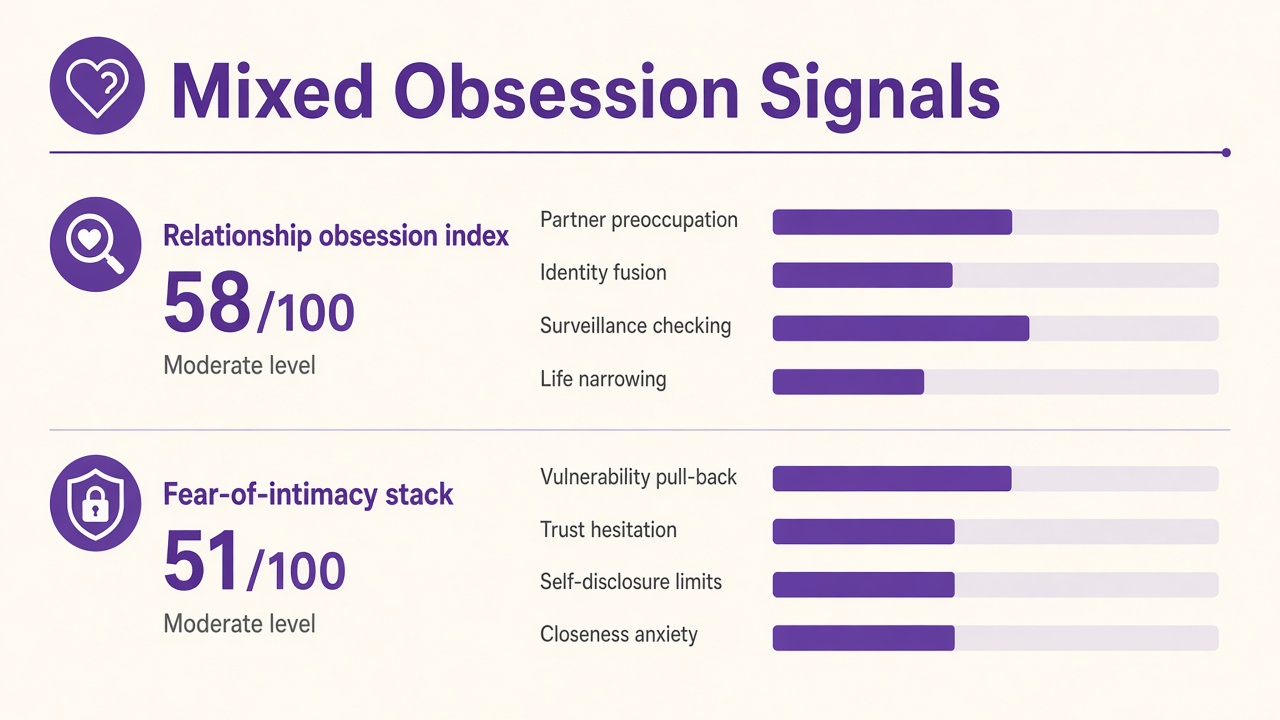
Your relationship obsession index is the normalized total across all 20 items on a 0 to 100 scale, with reverse scoring on protective items so higher scores mean more fixation signals overall. The fear-of-intimacy stack index uses the same answers mapped to vulnerability, trust, disclosure, and closeness anxiety layers. Domain bars show endorsement rates so you can see whether preoccupation, fusion, checking, or life narrowing drives your result most.
| Band | Index range | Typical reading |
|---|---|---|
| Lower Obsession Signals | 0 to 35 | Fewer fixation patterns on this screener; normal excitement during early dating may still appear |
| Mixed Obsession Signals | 36 to 65 | Blend of healthy interest and fixation habits; worth tracking if persistent |
| Higher Obsession Signals | 66 to 100 | Frequent preoccupation, fusion, checking, or life narrowing; professional support may help |
What your obsession report looks like
After all 20 items, you get a relationship obsession index from 0 to 100, a band label, four obsession domain bars, and a fear-of-intimacy stack chart with vulnerability pull-back, trust hesitation, self-disclosure limits, and closeness anxiety layers. Percentages reflect fixation habits you notice, not a clinical verdict about obsessive love.
What this quiz can and cannot tell you
Can tell you
- How often boyfriend obsession patterns showed up for you on this screener
- A relationship obsession index and four domain bars plus a fear-of-intimacy stack chart
- Which fixation domain feels strongest in your current habits toward him
- A starting point for therapy conversation or retaking after a boundary talk
Cannot tell you
- Whether you have obsessive love disorder, limerence, or any clinical diagnosis
- Whether your boyfriend finds you obsessed without his own honest feedback
- Whether your relationship is healthy or doomed without mutual effort and dialogue
- What treatment you need without a licensed clinician's evaluation
Limerence, fixation, and the fear-of-intimacy stack
Psychologist Dorothy Tennov coined limerence in 1979 to describe involuntary fixation on a romantic target: intrusive thoughts, mood swings tied to reciprocation, and idealization that can crowd ordinary life. Clinicians who study obsessive love note overlapping patterns such as surveillance checking, identity fusion, and shrinking friendships for the relationship. Healthy early dating can feel intense without crossing into persistent obsession, so context and duration matter as much as any single score.
The Quiz Hub built this am I too obsessed with my boyfriend quiz as an original self-report screener inspired by those themes, not a reproduction of Tennov's Limerence Scale or any single published instrument. Readers often compare it to sibling tools on this site. Our am I clingy quiz screens proximity demand and contact overload rather than mental preoccupation or surveillance checking. The relationship anxiety quiz maps worry loops such as reassurance seeking and jealousy scan. The fear of intimacy quiz measures closeness-limiting avoidance without a boyfriend fixation lens.
| The Quiz Hub test | What it adds |
|---|---|
| Am I clingy quiz | Proximity and contact volume index, not mental fixation or social media checking |
| Relationship anxiety quiz | Worry index: reassurance seeking, jealousy scan, catastrophizing, self-worth strain |
| Relationship OCD quiz | ROCD-inspired doubt and reassurance loops, not general boyfriend preoccupation |
| Losing feelings quiz | Fading feelings index with intimacy stack, not fixation toward a current boyfriend |
| Fear of intimacy quiz | FOIS-inspired avoidance index without obsession domain framing |
| This boyfriend obsession quiz | Relationship obsession index plus fear-of-intimacy stack for preoccupation, fusion, checking, and life narrowing |
Sample item types include frequency ratings such as whether you check his social media for clues about other women, or whether you keep friendships and solo interests during an intense honeymoon phase. High partner preoccupation with high surveillance checking often lands in Mixed or Higher Obsession Signals. Elevated fear-of-intimacy stack layers may mean you guard vulnerability while fixation rises, which therapy can address separately from compatibility questions. Read how we review quizzes in our editorial policy or browse more tools on our relationships and dating hub.
Boyfriend obsession quiz FAQ
What does obsessed mean in a relationship?
Obsessed in everyday language often describes when your thoughts, mood, and schedule orbit a partner more than your own life. That can look like constant mental replay, social media checking, mood tied to his attention, or dropping friends and goals for the relationship. This am I too obsessed with my boyfriend quiz measures how often those fixation patterns show up when you think about him. It is not a label your boyfriend must accept.
What does this boyfriend obsession quiz measure?
Twenty original frequency items ask how often you notice partner preoccupation, identity fusion, surveillance checking, and life narrowing toward your boyfriend. Each item also maps to a fear-of-intimacy stack layer: vulnerability pull-back, trust hesitation, self-disclosure limits, and closeness anxiety. You receive a relationship obsession index from 0 to 100 and a band from Lower through Higher Obsession Signals.
What is the fear-of-intimacy stack on this quiz?
The fear-of-intimacy stack is a second results chart inspired by FOIS-style intimacy avoidance themes, adapted to obsession framing. Each of the 20 items maps to one of four stack layers showing how fixation may connect to closeness habits: hiding vulnerability, testing trust, limiting disclosure, or panicking when bonds deepen. The stack index summarizes those layers alongside the relationship obsession index.
How is this different from the am I clingy quiz?
The am I clingy quiz screens proximity demand, contact overload, separation distress, and space comfort with a partner closeness frequency frame. This obsession quiz focuses on mental fixation, identity fusion, surveillance checking, and shrinking your own life for him. Both include a fear-of-intimacy stack chart, but the domain questions target different habits.
Can this quiz diagnose obsessive love disorder?
No. The relationship obsession index describes self-reported fixation patterns on this abbreviated screener. Only a licensed clinician can evaluate obsessive love, limerence, or related concerns through structured interviews. Online quizzes cannot confirm or deny a diagnosis.
Who reviewed this content?
Dr. Elena Vasquez, PhD, reviewed the test framing and result explanations. See our editorial policy for review standards.
Reviewed by