What this am I the favorite child quiz measures
This am I the favorite child quiz estimates how often golden-child-style patterns show up in your family memories. Twenty-two frequency items group into parental favoritism, sibling double standards, golden-child perks, and family alignment. Each item maps to a fear-of-intimacy stack layer. Your favorite-child signal index averages these patterns into a 0 to 100 score where higher numbers mean more frequent endorsement.
Parental favoritism
Extra praise, gifts, patience, and public bragging compared with siblings.
Sibling double standards
Rules bent for you, harsher consequences for siblings, and uneven expectations.
Golden-child perks
First pick on trips, trusted with secrets, and labeled the easy success story.
Family alignment
Relatives taking your side, protecting your image, and treating criticism as disloyalty.
How it works
Answer 22 frequency items
Rate each item from Never to Almost always. You click Next after each answer.
Items map to domains and intimacy stack
Answers accumulate percentages for four primary domains plus four fear-of-intimacy stack layers.
View index, band, and charts
Results show Lower, Mixed, or Higher signal bands with domain bars and stack chart.
Take the am i the favorite child quiz
Complete 22 items to receive your favorite-child signal index, domain bars, fear-of-intimacy stack chart, and band label.
What your result means
Your favorite-child signal index is the normalized total across all 22 items on a 0 to 100 scale. Higher scores mean more frequent endorsement on this screener.
| Band | Index range | Typical reading |
|---|---|---|
| Lower Favorite-Child Signals | 0 to 35 | Fewer favoritism patterns; fair treatment or middle-child dynamics still possible |
| Mixed Favorite-Child Signals | 36 to 65 | Blend of fair stretches and favoritism habits worth naming |
| Higher Favorite-Child Signals | 66 to 100 | Frequent favoritism patterns that may fuel sibling strain or guilt |
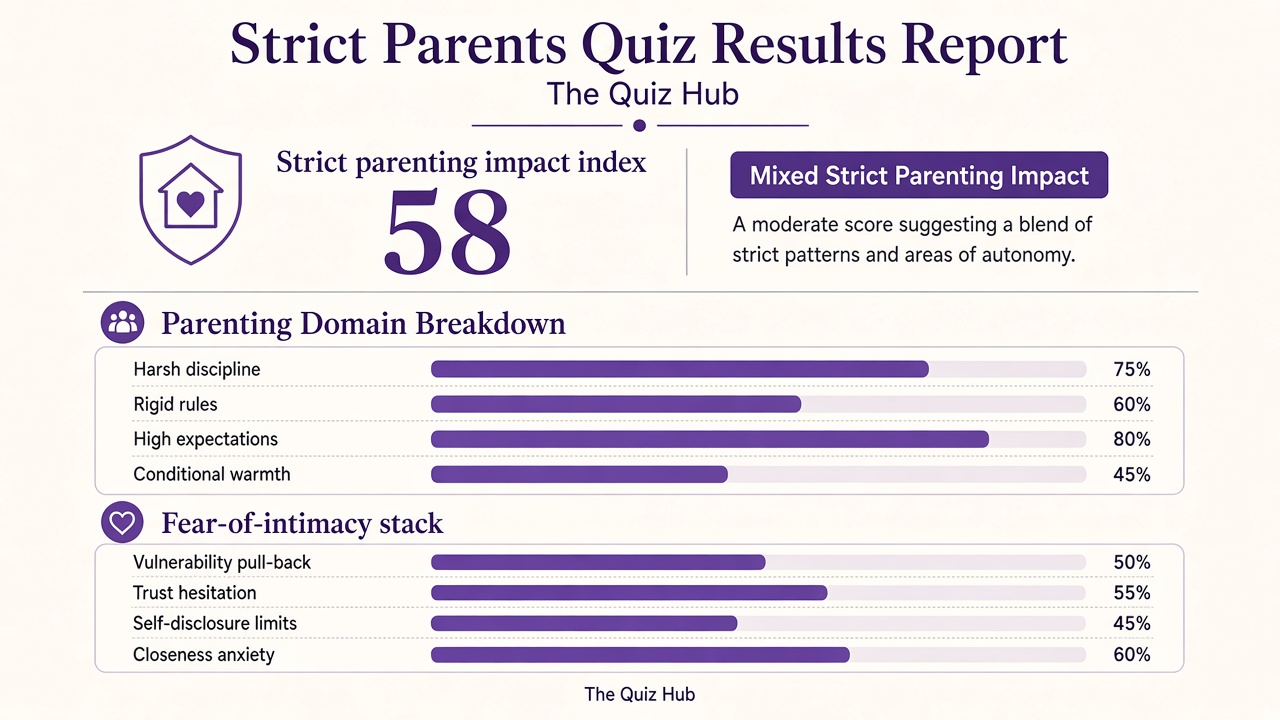
What your report looks like
What this quiz can and cannot tell you
Can tell you
- How often favorite-child patterns showed up in this self-report screener
- A favorite-child signal index with four domain bars plus fear-of-intimacy stack
- A starting point before sibling or family conversations
Cannot tell you
- Objective proof of which child parents loved most
- Legal or inheritance outcomes
- Permanent family role labels
Why people search favorite child quizzes
People search am I the favorite child when inheritance talks, holiday seating, or sibling fights replay old double standards. The Quiz Hub built this as an original frequency screener with a parallel fear-of-intimacy stack, inspired by family systems ideas from Bowen (1978), not a published golden-child scale.
Sample items ask how often parents praised you more, bent rules in your favor, gave you first pick on perks, or rallied relatives to your side.
| Test | Focus |
|---|---|
| Am I the family scapegoat quiz | Blame and exclusion patterns instead of golden-child perks |
| Are my parents strict quiz | Harsh discipline across children rather than favoritism |
| Am I entitled quiz | Fairness and rule-exception thinking in adulthood |
Am I The Favorite Child Quiz FAQ
What is a golden child or favorite child?
In family systems talk, a golden or favorite child receives extra praise, perks, or protection compared with siblings. This quiz measures how often you report those patterns. It is not proof of objective favoritism.
What does this quiz measure?
Twenty-two frequency items on parental favoritism, sibling double standards, golden-child perks, and family alignment, plus a fear-of-intimacy stack chart. You receive a favorite-child signal index from 0 to 100.
Can siblings get different scores on the same family?
Yes. Memory, birth order, and current contact shape self-report. This quiz describes your reported experience, not every sibling's view.
How is this different from the scapegoat quiz?
The scapegoat quiz screens blame, exclusion, and reputation damage. This quiz focuses on perks, double standards, and family alignment in your favor.
Does a high score mean I am a bad person?
No. Higher scores mean you report more favorite-child treatment patterns on this screener. Many golden-child habits are learned from family systems, not moral failure.
Who reviewed this content?
Dr. Elena Vasquez, PhD, reviewed the test framing and result explanations. See our editorial policy for review standards.
Reviewed by