
What this spoiled trait quiz measures
This am I spoiled quiz estimates how strongly you agree with statements about comfort expectations, low frustration tolerance, parental dependence, and gratitude gaps. Twenty-two original agreement items group into four domains inspired by developmental psychology research on indulgence and self-regulation from Diana Baumrind on parenting styles and Jean Twenge on entitlement trends in young adults. Each item also maps to a fear-of-intimacy stack layer. Your spoiled trait index averages these patterns into a 0 to 100 score where higher numbers mean more spoiled signals on this screener.
Comfort expectations
Expecting others to handle chores, errands, and logistics you could do yourself
Low frustration tolerance
Melting down when plans change, pouting after hearing no, and needing instant fixes
Parental dependence
Calling parents for money or rescue, avoiding adult tasks, and leaning on family for daily upkeep
Gratitude gaps
Taking gifts for granted, forgetting thank-yous, and feeling owed comfort without reciprocity
How it works
Three steps from first question to your spoiled trait report with domain bars and fear-of-intimacy stack.
Answer 22 agreement items
Rate how much you agree with each statement about comfort and independence habits, from Strongly disagree to Strongly agree. You click Next after each answer; nothing auto-advances.
Items map to spoiled domains and intimacy stack
Your answers accumulate percentages for comfort expectations, frustration tolerance, parental dependence, and gratitude gaps, plus four fear-of-intimacy stack layers.
View band and dual charts
Results show Lower, Mixed, or Higher Spoiled Trait Signals with domain bars and a fear-of-intimacy stack chart. Higher index means stronger self-reported spoiled patterns on this screener.
Take the am I spoiled quiz
Rate 22 statements about comfort, frustration tolerance, dependence, and gratitude. Your answers produce a spoiled trait index from 0 to 100, a fear-of-intimacy stack index, four domain scores, and a band label for self-reflection.
Opens in a focused modal. No account required. Results stay on screen.
What your spoiled trait result means
Your spoiled trait index is the normalized total across all 22 items on a 0 to 100 scale. The fear-of-intimacy stack index uses inverted scoring on the same answers so higher stack scores mean more closeness-guarding patterns on these items.
| Band | Index range | Typical reading |
|---|---|---|
| Lower Spoiled Trait Signals | 0 to 35 | Fewer comfort expectations, dependence, and gratitude gap signals |
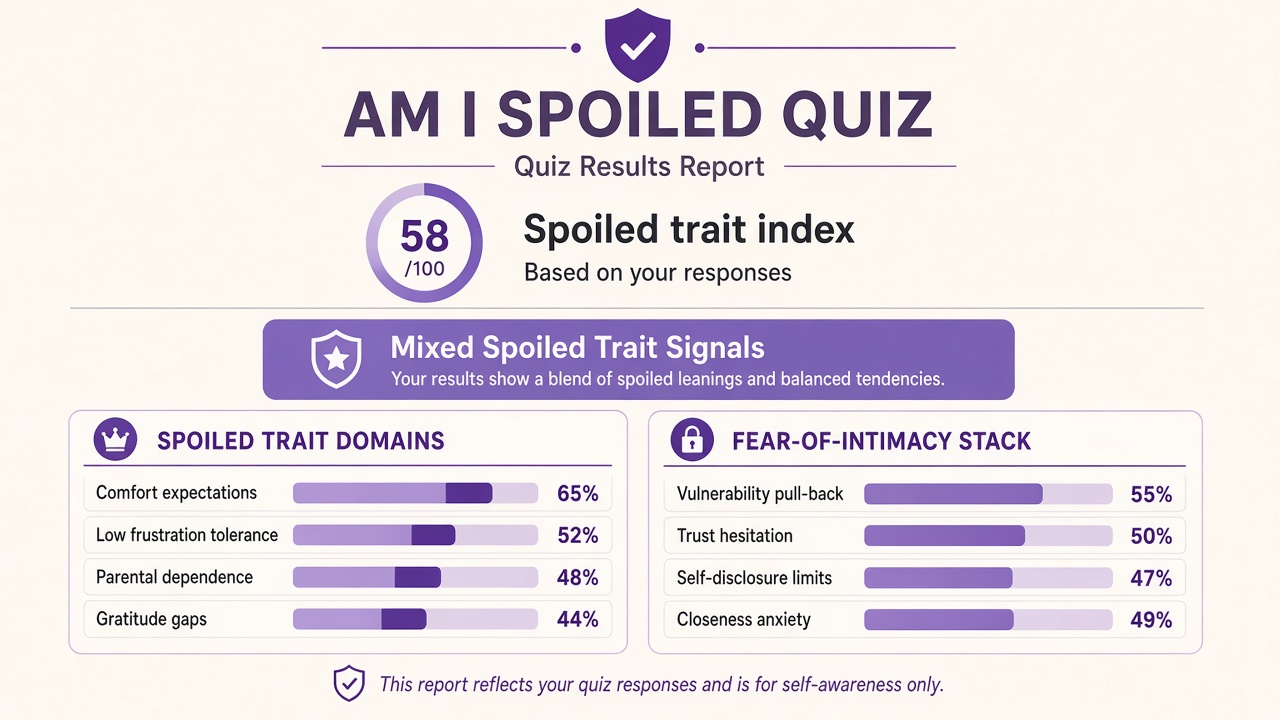
| Mixed Spoiled Trait Signals | 36 to 65 | Blend of self-reliance and comfort habits; domain chart shows strongest pattern |
| Higher Spoiled Trait Signals | 66 to 100 | Frequent comfort expectations, low frustration tolerance, or gratitude gaps on this screener |
What your spoiled trait report looks like
After all 22 items, you get a spoiled trait index from 0 to 100, a band label, four domain bars, and a fear-of-intimacy stack chart with vulnerability pull-back, trust hesitation, self-disclosure limits, and closeness anxiety layers.
What this quiz can and cannot tell you
Can tell you
- How strongly comfort expectations, frustration tolerance, dependence, and gratitude gaps showed up in your self-report
- A spoiled trait index and fear-of-intimacy stack index with domain bars
- Which spoiled domain feels strongest in your current habits
- A starting point for feedback conversations with roommates, partners, or family
Cannot tell you
- Whether every person finds you spoiled without their side of the story
- Whether you had a privileged childhood or simply learned different habits
- Whether spoiled habits are harmful or harmless without your own context
- Whether you should change your personality to fit less cushioned environments
Indulgence, self-regulation, and the fear-of-intimacy stack
Psychologist Diana Baumrind studied how indulgent parenting shapes frustration tolerance and gratitude in adulthood. Researcher Jean Twenge tracked rising entitlement beliefs among young adults entering a economy with uneven safety nets. Neither body of work labels individuals spoiled in a moral sense, but both note that comfort without reciprocity training can leave people unprepared for ordinary limits.
The Quiz Hub built this am I spoiled quiz as an original agreement screener plus FOIS-style intimacy avoidance layers from Descutner and Thelen (1991). Our am I entitled quiz screens special treatment and blame shifting rather than comfort habits. The am I high maintenance quiz focuses on daily upkeep needs in relationships.
| The Quiz Hub test | What it adds |
|---|---|
| Am I entitled quiz | Special treatment and blame shifting, not comfort or parental rescue habits |
| Am I high maintenance quiz | Daily upkeep and reassurance needs, not gratitude gaps or dependence |
| Am I petty quiz | Grudge and scorekeeping habits, not spoiled comfort expectations |
| Fear of intimacy quiz | General intimacy avoidance without spoiled trait domains |
| This quiz | Spoiled trait index plus fear-of-intimacy stack for comfort, frustration tolerance, dependence, and gratitude gaps |
Sample items include whether you expect roommates to pick up slack you could handle, or whether you forget thank-yous because help felt expected. High comfort expectations with high vulnerability pull-back on the stack often land in Mixed bands when spoiled habits guard emotional openness. Read our editorial policy or browse the personality and psychology tests hub.
Am I Spoiled Quiz FAQ
What does the am I spoiled quiz measure?
Twenty-two original agreement items ask about comfort expectations, low frustration tolerance, parental dependence, and gratitude gaps. Each item also maps to a fear-of-intimacy stack layer. You receive a spoiled trait index from 0 to 100 where higher scores mean more spoiled signals on this screener.
Does a higher spoiled trait index mean I am a bad person?
No. On this screener, a higher index means you endorsed more comfort, dependence, or gratitude gap items. Many adults land here when upbringing, stress, or uneven support shaped their habits. This quiz cannot label your moral worth.
What is the fear-of-intimacy stack on this quiz?
The fear-of-intimacy stack is a second results chart inspired by FOIS-style intimacy avoidance themes from Descutner and Thelen (1991), adapted to spoiled trait framing. Higher stack scores may reflect using comfort or dependence to avoid emotional vulnerability.
How is this different from the am I entitled quiz?
The am I entitled quiz uses frequency items about special treatment, blame shifting, and one-sided favors inspired by psychological entitlement research. This spoiled quiz focuses on comfort expectations, frustration tolerance, parental rescue habits, and gratitude gaps.
Can this quiz tell me if my parents spoiled me?
No. The spoiled trait index describes self-reported habits on this abbreviated screener. Upbringing is one factor among many. Only honest conversation with family can clarify how indulgence shaped your adult skills.
Who reviewed this content?
Dr. James Whitfield, reviewed the test framing and result explanations. See our editorial policy for review standards.
Reviewed by
