What this high-maintenance trait quiz measures
This am I high maintenance quiz estimates how much demanding interpersonal habits show up in your self-report. Twenty-two original agree-disagree items group into four domains drawn from relationship psychology themes on interpersonal demands and reassurance seeking in work by Susan Sprecher and Pamela Regan on relationship maintenance, plus clinical writing on emotional reactivity from Marsha Linehan on dialectical behavior therapy skills: attention reassurance, standards expectations, emotional reactivity, and accommodation demands. Each item also maps to a fear-of-intimacy stack layer so you can see whether vulnerability pull-back, trust hesitation, self-disclosure limits, or closeness anxiety rides alongside high-maintenance signals. Your high-maintenance trait index averages these patterns into a 0 to 100 score where higher numbers mean more endorsement.
Attention reassurance
Frequent check-ins, reply anxiety, reassurance requests, and hurt when small details get forgotten.
Standards expectations
Strong opinions on quality, speaking up about inconveniences, brand or routine preferences, and plan-change stress.
Emotional reactivity
Mood swings after slights, dramatic upset labels, long conflict processing, and taking criticism personally.
Accommodation demands
Expecting schedule adjustments, disappointment when needs are not anticipated, and wanting special group treatment.
How it works
Three steps from first question to your high-maintenance trait report with fear-of-intimacy stack. Click Start Quiz to open the interactive quiz in a full-screen modal.
Answer 22 agree-disagree items
Rate how much you agree with each statement, from Strongly disagree to Strongly agree. You click Next after each answer; nothing auto-advances.
Items map to maintenance domains and intimacy stack
Your answers accumulate percentages for attention reassurance, standards expectations, emotional reactivity, and accommodation demands, plus four fear-of-intimacy stack layers.
View band, domain bars, and stack chart
Results show Lower, Mixed, or Higher High-Maintenance Signals with domain bars, stack layers, and reflection prompts.
Take the am I high maintenance quiz
Rate 22 statements about reassurance needs, picky standards, mood reactivity, and accommodation demands. Your answers produce a high-maintenance trait index from 0 to 100, four domain scores, a fear-of-intimacy stack chart, and a band label for reflection.
Opens in a focused modal. No account required. Results stay on screen.
What your high-maintenance trait result means
Your high-maintenance trait index is the normalized total across all 22 items on a 0 to 100 scale. Higher scores mean more endorsement of attention reassurance, standards expectations, emotional reactivity, and accommodation demand items on this screener. Domain bars show agreement rates so you can see whether reassurance, standards, mood sensitivity, or expecting adjustment drives your result most. The fear-of-intimacy stack chart shows parallel layers for vulnerability pull-back, trust hesitation, self-disclosure limits, and closeness anxiety when demanding habits include guarded closeness.
| Band | Index range | Typical reading |
|---|---|---|
| Lower High-Maintenance Signals | 0 to 35 | Fewer demanding habits; secure attachment or low-drama style can score here |
| Mixed High-Maintenance Signals | 36 to 65 | Blend of real needs and patterns others may find taxing; domain and stack charts show where habits feel strongest |
| Higher High-Maintenance Signals | 66 to 100 | Frequent reassurance needs, picky standards, mood reactivity, or accommodation demands on this screener |
What your high-maintenance report looks like
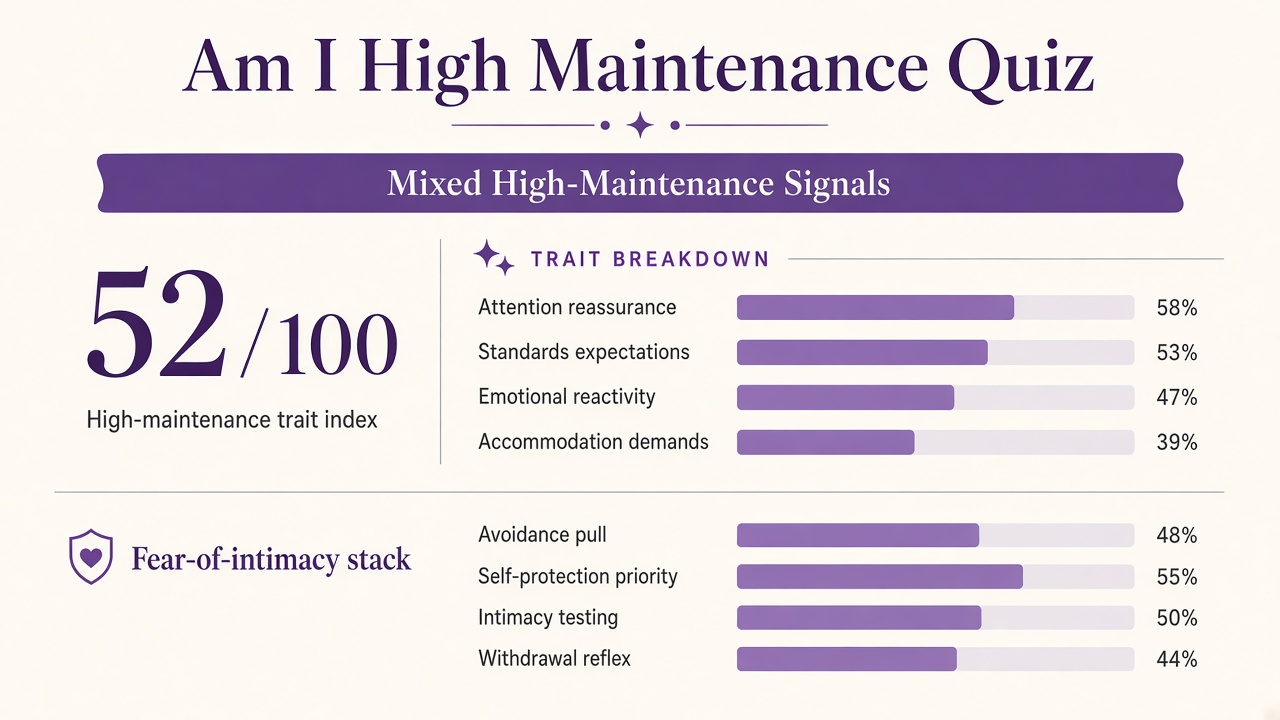
After all 22 items, you get a high-maintenance trait index from 0 to 100, a band label, four domain bars for attention reassurance, standards expectations, emotional reactivity, and accommodation demands, plus a fear-of-intimacy stack chart with vulnerability, trust, disclosure, and closeness anxiety layers.
What this quiz can and cannot tell you
Can tell you
- How much high-maintenance trait patterns showed up in this self-report screener
- A high-maintenance trait index and four domain bars for reassurance, standards, reactivity, and accommodation
- A fear-of-intimacy stack showing which closeness-guarding layer feels strongest
- A starting point for honest conversation with partners or therapists about needs and limits
Cannot tell you
- Whether every friend or partner finds you high maintenance without their side of the story
- Whether you have borderline personality disorder or any clinical diagnosis
- Whether your standards protect real values or mainly manage anxiety
- What specific changes others want without honest conversation and trusted guidance
High-maintenance labels, relationship demands, and intimacy guarding
People search am I high maintenance when partners joke about their standards, when friends sigh at plan changes, or when they notice they need more reassurance than peers. Relationship researchers Susan Sprecher and Pamela Regan studied how couples maintain bonds through attention, affection, and responsiveness, showing that needs vary widely without one correct amount. Marsha Linehan's dialectical behavior therapy work on emotional regulation highlights how mood reactivity and conflict recovery time shape how demanding someone feels in close relationships, even when intentions are loving.
The Quiz Hub built this am I high maintenance quiz as an original self-report screener inspired by those relationship demand themes plus FOIS-style intimacy avoidance layers from Descutner and Thelen (1991), not a reproduction of any published clinical instrument. Readers often compare it to sibling tools on this site. Our am I entitled quiz screens fairness beliefs and special treatment expectations rather than daily upkeep needs. The am I asking for too much in my relationship quiz focuses on partner-specific request patterns. The difficult person test maps broader antagonism and callousness traits from personality research.
| The Quiz Hub test | What it adds |
|---|---|
| Am I entitled quiz | Special treatment and blame shifting domains, not reassurance or picky standards habits |
| Am I arrogant quiz | Dominance display and status seeking, not mood reactivity or accommodation demands |
| Am I asking for too much quiz | Relationship-specific request items without fear-of-intimacy stack chart |
| Difficult person test | Antagonism and callousness traits, not reassurance or standards domains |
| Fear of intimacy quiz | General intimacy avoidance across vulnerability and trust, not high-maintenance trait domains |
| This high maintenance quiz | High-maintenance trait index plus fear-of-intimacy stack for reassurance, standards, reactivity, and accommodation |
Sample item types include agree-disagree ratings such as whether you feel unsettled when a partner takes hours to reply, or whether small slights can ruin your mood for hours. High attention reassurance with high closeness anxiety on the stack often lands in Mixed High-Maintenance Signals bands when you need closeness but fear being too much. Strong standards expectations with lower accommodation demands can split domain scores when you are picky about quality but rarely ask others to change plans. Read how we review quizzes in our editorial policy or browse more tools on our personality psychology hub.
Am I high maintenance quiz FAQ
What does the am I high maintenance quiz measure?
Twenty-two original agree-disagree items ask how much you endorse attention reassurance needs, standards expectations, emotional reactivity, and accommodation demands. Each item also maps to a fear-of-intimacy stack layer: vulnerability pull-back, trust hesitation, self-disclosure limits, and closeness anxiety. You receive a high-maintenance trait index from 0 to 100 where higher scores mean more endorsement on this screener, plus a parallel stack index.
Does a higher high-maintenance trait index mean I am a bad partner?
No. On this screener, a higher index means you endorsed more reassurance seeking, picky standards, mood sensitivity, or expecting others to adjust around you. Many adults land here when anxiety, past betrayal, or real needs shape how they ask for care. This quiz cannot diagnose personality disorder or predict whether a relationship should end.
What is the fear-of-intimacy stack on this quiz?
The fear-of-intimacy stack is a second results chart inspired by FOIS-style intimacy avoidance themes from Descutner and Thelen (1991), adapted to high-maintenance framing. Each of the 22 items maps to one of four stack layers showing how closeness guarding may pair with demanding habits: hiding vulnerability, testing trust, limiting disclosure, or worrying about being too close. Higher stack scores mean more avoidance patterns on these items.
How is this different from the am I entitled quiz?
The am I entitled quiz uses a past-few-months frequency frame about special treatment, blame shifting, empathy gaps, and one-sided favors inspired by Campbell Psychological Entitlement Scale themes. This high maintenance quiz uses agree-disagree items about reassurance needs, picky standards, emotional reactivity, and expecting accommodation rather than fairness beliefs alone.
How is this different from the am I asking for too much in my relationship quiz?
The am I asking for too much quiz focuses on relationship-specific request patterns and partner perspective items. This high maintenance quiz measures broader trait-style habits across attention, standards, mood recovery, and accommodation demands with a fear-of-intimacy stack chart the relationship quiz does not include.
Can this quiz tell me if my partner thinks I am high maintenance?
No. The high-maintenance trait index describes self-reported patterns on this abbreviated screener. Cultural context, attachment history, and current stress all shape how needs feel. Only people in your life can tell you how your standards and reassurance requests land, ideally through honest conversation.
Who reviewed this content?
Dr. James Whitfield, PhD, reviewed the test framing and result explanations. See our editorial policy for review standards.
Reviewed by