What this am i nice quiz measures
This am I nice quiz estimates how often warm, accommodating, or conflict-avoidant patterns show up in how you report treating others. Twenty-two original agree-disagree items group into four domains inspired by agreeableness and prosocial research from Costa and McCrae on Big Five agreeableness and Alice Isen on mood and helping behavior: warmth and generosity, conflict avoidance, people pleasing, and boundary softness. Each item also maps to a fear-of-intimacy stack layer. Your niceness tendency index averages these patterns into a 0 to 100 score where higher numbers mean more endorsement on this screener.
Warmth and generosity
Welcoming newcomers, offering help unprompted, remembering details, sharing freely, and softening harsh tone.
Conflict avoidance
Changing opinions to keep mood light, swallowing irritation, agreeing to disliked plans, laughing off hurtful jokes.
People pleasing
Checking group happiness first, extra tasks to avoid seeming selfish, quick apologies, mirroring moods, hiding bad days.
Boundary softness
Lending time or money past comfort, late-night replies, yes to resented favors, letting lateness slide.
How it works
Three steps from first question to your niceness tendency index report with fear-of-intimacy stack. Click Start Quiz to open the interactive quiz in a full-screen modal.
Answer 22 agree-disagree items
Rate how much you agree with each statement, from Strongly disagree to Strongly agree. You click Next after each answer; nothing auto-advances.
Items map to domains and intimacy stack
Your answers accumulate percentages for warmth and generosity, conflict avoidance, people pleasing, boundary softness, plus four fear-of-intimacy stack layers.
View band and dual charts
Results show Lower Niceness Tendency, Mixed Niceness Tendency, or Higher Niceness Tendency with domain bars and a fear-of-intimacy stack chart.
Take the am i nice quiz
Rate 22 statements about niceness tendency patterns. Your answers produce a niceness tendency index from 0 to 100, a fear-of-intimacy stack index, four domain scores, and a band label for reflection or therapy conversation.
Opens in a focused modal. No account required. Results stay on screen.
What your niceness tendency index result means
Your niceness tendency index is the normalized total across all 22 items on a 0 to 100 scale, with reverse scoring on protective items. The fear-of-intimacy stack index uses the same answers mapped to vulnerability, trust, disclosure, and closeness anxiety layers where higher stack scores mean more avoidance patterns. Domain bars show endorsement rates so you can see which domain drives your result most.
| Band | Index range | Typical reading |
|---|---|---|
| Lower Niceness Tendency | 0 to 35 | Lower endorsement on this screener; context and stress can still shift individual items |
| Mixed Niceness Tendency | 36 to 65 | Blend of patterns; domain and stack charts show where closeness guarding appears |
| Higher Niceness Tendency | 66 to 100 | Frequent endorsement on this screener; worth reflecting on impact in close ties |
What your am i nice quiz report looks like
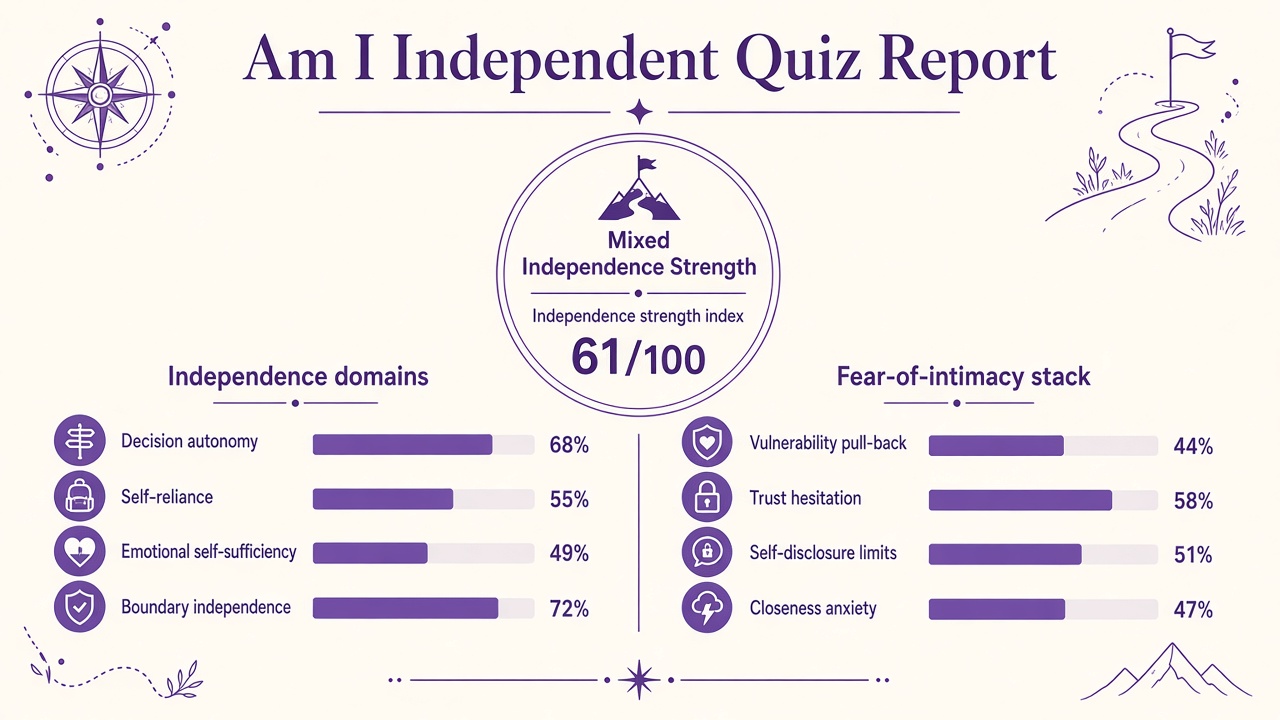
After all 22 items, you get a niceness tendency index from 0 to 100, a band label, four domain bars, and a fear-of-intimacy stack chart with vulnerability pull-back, trust hesitation, self-disclosure limits, and closeness anxiety layers.
What this quiz can and cannot tell you
Can tell you
- How much warmth and generosity, conflict avoidance, people pleasing, boundary softness showed up in your self-report
- A niceness tendency index and fear-of-intimacy stack index with domain bars
- Which domain or intimacy stack layer feels strongest in your current patterns
- A starting point for therapy conversation about self-presentation and closeness
Cannot tell you
- Whether you have a personality disorder without clinical evaluation
- How every person experiences you in real life
- Whether cultural norms or trauma history explain your scores without professional context
- What specific behavior changes others want without honest conversation
Niceness, agreeableness, and hidden resentment
Psychologists drawing on agreeableness and prosocial behavior research note that self-report patterns on short screeners capture tendencies people notice in themselves, not fixed labels assigned by others. Research from Costa and McCrae on Big Five agreeableness and Alice Isen on positive affect and helping helps explain why adults search for quizzes like this one when they want language for habits that feel automatic in conflict, privacy, or social settings.
The Quiz Hub built this am i nice quiz as an original self-report screener inspired by those themes plus FOIS-style intimacy avoidance layers from Descutner and Thelen (1991), not a reproduction of any single published scale. Readers often compare it to sibling tools on this site.
| The Quiz Hub test | What it adds |
|---|---|
| Am I mean quiz | Hostile tone and retaliation domains, not warmth or people pleasing |
| Am I a pushover quiz | Boundary weakness focus without four niceness domain bars |
| Am I entitled quiz | Special treatment expectations, not generous warmth or conflict avoidance |
| Am I independent quiz | Autonomy and self-reliance domains, not accommodation patterns |
| Fear of intimacy quiz | FOIS-inspired intimacy avoidance only, without niceness domain bars |
| This am i nice quiz | niceness tendency index plus fear-of-intimacy stack for warmth and generosity, conflict avoidance, people pleasing, boundary softness |
Sample item types include agree-disagree ratings such as whether you apologize quickly even when you are not sure what you did wrong, or whether you say yes to favors you resent because refusing feels harsh. High scores on one domain with high intimacy stack layers often land in Mixed bands. Read how we review quizzes in our editorial policy or browse more tools on our personality psychology hub.
Am I Nice Quiz FAQ
What does the am i nice quiz measure?
22 original agree-disagree items ask how much you endorse warmth and generosity, conflict avoidance, people pleasing, boundary softness patterns in daily life and close relationships. Each item also maps to a fear-of-intimacy stack layer. You receive a niceness tendency index from 0 to 100 where higher scores mean more endorsement on this screener. Self-reflection tool, not a clinical diagnosis.
What is the fear-of-intimacy stack on this quiz?
The fear-of-intimacy stack is a second results chart inspired by FOIS-style intimacy avoidance themes from Descutner and Thelen (1991), adapted to am i nice framing. Each item maps to one of four stack layers: vulnerability pull-back, trust hesitation, self-disclosure limits, and closeness anxiety.
How is this different from the fear of intimacy quiz?
The fear of intimacy quiz uses frequency items about general intimacy avoidance across vulnerability and trust without four niceness domains. This am i nice quiz uses agree-disagree items focused on warmth and generosity and related domains with a parallel fear-of-intimacy stack chart in one report.
Can this quiz diagnose a personality disorder?
No. The niceness tendency index describes self-reported patterns on this abbreviated screener. Only a licensed clinician can evaluate personality or relational patterns through structured interviews. Online quizzes cannot confirm or deny a diagnosis.
How long does the quiz take?
Most people finish in about 5 minutes. There are 22 items on a five-point agree-disagree scale. You can pause and return in the same browser session thanks to autosave.
Who reviewed this content?
Dr. James Whitfield, PhD, reviewed the test framing and result explanations. See our editorial policy for review standards.
Reviewed by