What this am I open minded quiz measures
This am I open minded quiz estimates how much your self-report aligns with openness habits psychologists link to intellectual humility and belief revision. Twenty-two original agree-or-disagree items group into four domains: intellectual curiosity, perspective flexibility, challenge comfort, and label resistance. Each item also maps to a fear-of-intimacy stack layer so you can see whether vulnerability pull-back, trust hesitation, self-disclosure limits, or closeness anxiety sits underneath debate comfort. Your open-mindedness index averages these signals into a 0 to 100 score where higher numbers mean stronger openness endorsement on this screener.
Intellectual curiosity
Seeking ideas, media, and conversations that stretch beyond current beliefs.
Perspective flexibility
Updating opinions and understanding why others see issues differently.
Challenge comfort
Staying engaged when beliefs or behavior receive respectful pushback.
Label resistance
Avoiding rigid good-or-bad sorting of people and complex issues.
How it works
Three steps from first question to your open-mindedness report with fear-of-intimacy stack. Click Start Quiz to open the interactive quiz in a full-screen modal.
Answer 22 agree-or-disagree items
Rate how much you agree with each openness statement, from Strongly disagree to Strongly agree. You click Next after each answer; nothing auto-advances.
Items map to openness domains and intimacy stack
Your answers accumulate percentages for intellectual curiosity, perspective flexibility, challenge comfort, and label resistance, plus four fear-of-intimacy stack layers.
View band, domain bars, and stack chart
Results show Lower, Mixed, or Higher Open-Mindedness with domain bars, stack layers, and reflection prompts.
Take the am I open minded quiz
Rate 22 statements about curiosity, belief updates, and debate habits. Your answers produce an open-mindedness index from 0 to 100, four domain scores, a fear-of-intimacy stack chart, and a band label for reflection.
Opens in a focused modal. No account required. Results stay on screen.
What your open-mindedness result means
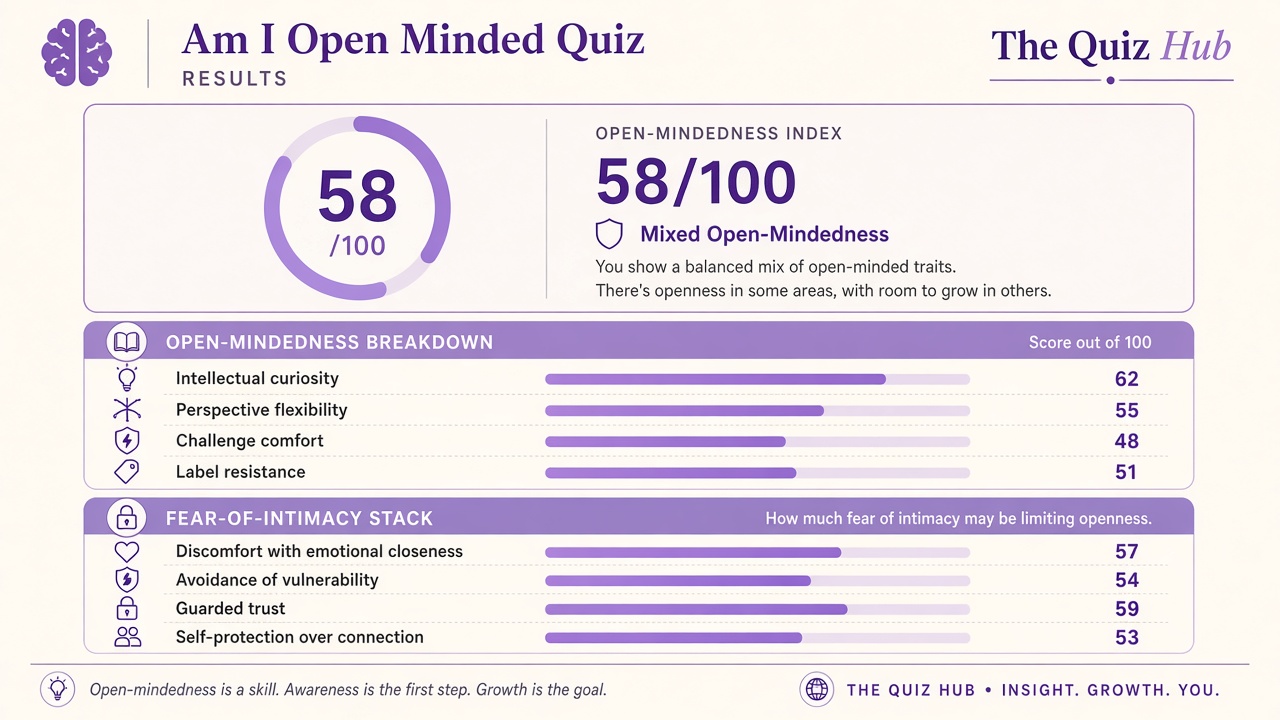
Your open-mindedness index is the normalized total across all 22 items on a 0 to 100 scale. Higher scores mean stronger agreement with curiosity, perspective flexibility, challenge comfort, and label resistance items on this screener. Domain bars show endorsement rates so you can see which pattern drives your result most. The fear-of-intimacy stack chart shows parallel layers that can complicate honest debate when closeness feels risky even if abstract ideas feel easy to explore.
| Band | Index range | Typical reading |
|---|---|---|
| Lower Open-Mindedness | 0 to 35 | Limited openness signals, strong preference for familiar beliefs, or protective certainty on this screener |
| Mixed Open-Mindedness | 36 to 65 | Blend of curiosity and defensiveness; openness may vary by topic or relationship |
| Higher Open-Mindedness | 66 to 100 | Strong curiosity, perspective flexibility, challenge comfort, or label resistance on this screener |
What your open-mindedness report looks like
After all 22 items, you get an open-mindedness index from 0 to 100, a band label, four domain bars, plus a fear-of-intimacy stack chart with vulnerability, trust, disclosure, and closeness anxiety layers.
What this quiz can and cannot tell you
Can tell you
- How much openness signals showed up in your self-report on this screener
- An open-mindedness index and four domain bars for curiosity, perspective flexibility, challenge comfort, and label resistance
- A fear-of-intimacy stack showing which closeness-avoidance layer may complicate honest debate
- A starting point for reflection on which topics trigger defensiveness versus genuine curiosity
Cannot tell you
- Whether you are morally better or worse than others based on a quiz score alone
- Your IQ, reasoning speed, or formal cognitive ability
- Whether you will change a specific belief after one conversation
- What therapy or coaching you need without licensed professional guidance
Open-mindedness, intellectual humility, and debate habits
Search interest in am I open minded quizzes often spikes after heated arguments online or at work when someone wonders whether they listen fairly or only perform flexibility. Psychologists study related habits under intellectual humility, which emphasizes recognizing limits in one's knowledge and staying open to revision when evidence shifts. That framing differs from scoring high on abstract curiosity while shutting down when personal identity feels attacked.
The Quiz Hub built this am I open minded quiz as an original self-report screener inspired by openness and humility themes plus FOIS-style intimacy avoidance layers from Karen M. Descutner and Mark H. Thelen (1991), not a reproduction of any single published instrument. Readers often compare it to sibling tools on this site. Our Big Five personality test reports broad Openness to Experience percentiles. The am I judgemental quiz screens bias and snap-judgment habits rather than curiosity domains. The cognitive reflection test measures logic-trap performance, not willingness to update beliefs.
| The Quiz Hub test | What it adds |
|---|---|
| Big Five personality test | OCEAN trait percentiles, not focused openness domain bars with intimacy stack |
| Am I judgemental quiz | Bias and criticism habits, not intellectual curiosity and perspective flexibility |
| Am I nonchalant quiz | Detached coolness and low-reactivity style, not belief-update habits |
| Cognitive reflection test | Logic puzzle accuracy, not agree-disagree openness items |
| Fear of intimacy quiz | General closeness avoidance frequency, not openness domain items |
| This am I open minded quiz | Open-mindedness index plus fear-of-intimacy stack for curiosity, perspective flexibility, challenge comfort, and label resistance |
Sample item types include agreement ratings such as whether you seek media that challenges your views, or whether you can name why a friend disagrees without dismissing them. High challenge comfort with high closeness anxiety on the stack often lands in Mixed Open-Mindedness because abstract debate feels easier than vulnerable disclosure. Past social pressure to pick one side on every issue can shift scores without meaning your pattern is fixed. Read how we review quizzes in our editorial policy or browse more tools on our personality and psychology hub.
Am I open minded quiz FAQ
What does open-mindedness mean on this quiz?
Open-mindedness here means willingness to seek new ideas, update opinions with evidence, tolerate respectful challenge, and resist oversimplified labels. Psychologists often study related traits under openness and intellectual humility. This am I open minded quiz measures self-reported habits on those themes. It is not an IQ score or a moral grade on your character.
What does this am I open minded quiz measure?
Twenty-two original agree-or-disagree items ask how much you seek challenging ideas, revise beliefs, stay engaged during pushback, and avoid rigid sorting of people and issues. Scores map to four domains plus a parallel fear-of-intimacy stack with vulnerability pull-back, trust hesitation, self-disclosure limits, and closeness anxiety layers. You receive an open-mindedness index from 0 to 100 where higher scores mean stronger openness signals on this screener, plus a band from Lower through Higher Open-Mindedness.
How is this different from the Big Five personality test?
The Big Five personality test reports a broad Openness to Experience percentile across many facets. This quiz focuses on intellectual curiosity, perspective flexibility, challenge comfort, and label resistance with a fear-of-intimacy stack chart. Both use self-report items, but this screener answers a narrower openness question with domain bars tuned to debate and belief-update habits.
What is the fear-of-intimacy stack on this quiz?
The fear-of-intimacy stack is a second results chart inspired by FOIS-style intimacy avoidance themes from Karen M. Descutner and Mark H. Thelen (1991), adapted to open-mindedness framing. Each of the 22 items also maps to one of four stack layers. The stack index summarizes how often closeness anxiety may sit underneath abstract debate comfort.
Can this quiz tell me if I am truly open minded?
No. The open-mindedness index describes self-reported patterns on this abbreviated screener. People can score high on curiosity items while staying defensive in personal relationships, or score low while holding well-reasoned convictions. Online quizzes cannot rank your virtue, predict conflict outcomes, or replace honest feedback from people who know you.
Who reviewed this content?
Dr. James Whitfield, PhD, reviewed the test framing and result explanations. See our editorial policy for review standards.
Reviewed by