What this am I homophobic quiz measures
This am I homophobic quiz estimates how often anti-LGBTQ+ attitude and behavior patterns show up in your self-report. Twenty-two original agree-disagree items group into four domains drawn from sexual prejudice research by Gregory Herek (2000) and modern bias education themes: negative beliefs about homosexuality, discomfort with queer visibility, hostile expression habits, and discrimination minimization. Each item also maps to a fear-of-intimacy stack layer so you can see whether vulnerability pull-back, trust hesitation, self-disclosure limits, or closeness anxiety rides alongside prejudice habits. Your homophobia tendency index averages these patterns into a 0 to 100 score where higher numbers mean more frequent endorsement.
Negative beliefs
Moral condemnation, phase framing, choice beliefs, and resistance to normalizing gay families or equal protections.
Visibility discomfort
Public affection discomfort, media avoidance, pride skepticism, rainbow business avoidance, and unease in diverse groups.
Hostile expression
Laughing at anti-gay jokes, slur use, mocking mannerisms, and failing to speak up or apologize.
Discrimination minimization
Downplaying discrimination, opposing service or hiring protections, and dismissing bullying or violence risks.
How it works
Three steps from first question to your homophobia tendency report with fear-of-intimacy stack. Click Start Quiz to open the interactive quiz in a full-screen modal.
Answer 22 agree-disagree items
Rate each statement from Strongly disagree to Strongly agree. You click Next after each answer; nothing auto-advances.
Items map to prejudice domains and intimacy stack
Your answers accumulate percentages for negative beliefs, visibility discomfort, hostile expression, and discrimination minimization, plus four fear-of-intimacy stack layers.
View band, domain bars, and stack chart
Results show Lower, Mixed, or Higher Homophobic Tendency Signals with domain bars, stack layers, and reflection prompts.
Take the am I homophobic quiz
Rate 22 statements about beliefs, visibility discomfort, hostile language, and discrimination minimization. Your answers produce a homophobia tendency index from 0 to 100, four domain scores, a fear-of-intimacy stack chart, and a band label for reflection.
Opens in a focused modal. No account required. Results stay on screen.
What your homophobia tendency result means
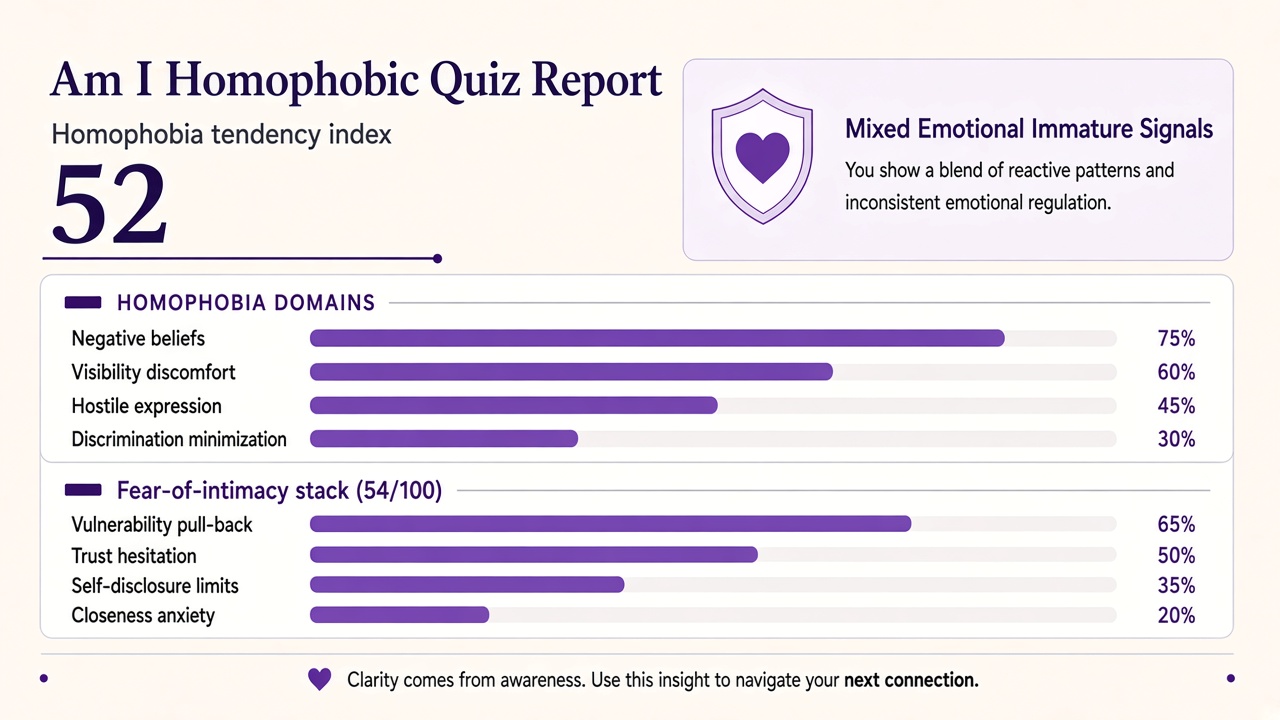
Your homophobia tendency index is the normalized total across all 22 items on a 0 to 100 scale. Higher scores mean more frequent endorsement of negative beliefs, visibility discomfort, hostile expression, and discrimination minimization items on this screener. Domain bars show endorsement rates so you can see whether moral condemnation, public discomfort, hostile jokes, or downplaying harm drives your result most. The fear-of-intimacy stack chart shows parallel layers for vulnerability pull-back, trust hesitation, self-disclosure limits, and closeness anxiety when prejudice habits include guarded closeness.
| Band | Index range | Typical reading |
|---|---|---|
| Lower Homophobic Tendency Signals | 0 to 35 | Fewer anti-LGBTQ+ attitude signals; upbringing or faith questions can still score here while you grow |
| Mixed Homophobic Tendency Signals | 36 to 65 | Blend of inclusive habits and recurring discomfort, jokes, or minimization; domain and stack charts show where you struggle most |
| Higher Homophobic Tendency Signals | 66 to 100 | Frequent moral condemnation, visibility discomfort, hostile language, or discrimination minimization; check stack if closeness with LGBTQ+ people feels threatening |
What your homophobia tendency report looks like
After all 22 items, you get a homophobia tendency index from 0 to 100, a band label, four domain bars for negative beliefs, visibility discomfort, hostile expression, and discrimination minimization, plus a fear-of-intimacy stack chart with vulnerability, trust, disclosure, and closeness anxiety layers.
What this quiz can and cannot tell you
Can tell you
- How often anti-LGBTQ+ attitude and behavior patterns showed up in this self-report screener
- A homophobia tendency index and four domain bars for beliefs, visibility discomfort, hostile expression, and discrimination minimization
- A fear-of-intimacy stack showing which closeness-guarding layer feels strongest alongside prejudice habits
- A starting point for bias education, faith reflection, or comparing with sibling tests
Cannot tell you
- Whether you are permanently homophobic or a bad person
- Whether your views are rooted in religion, culture, or trauma without professional context
- Whether LGBTQ+ people in your life agree with your self-view
- What accountability or repair you owe without honest conversation with those affected
Sexual prejudice, visibility discomfort, and intimacy guarding
People search am I homophobic when a joke, vote, or family argument leaves them wondering whether their reactions toward LGBTQ+ people cross into prejudice. Psychologist Gregory Herek defines sexual prejudice as negative attitudes toward people because of their sexual orientation, whether those attitudes show up as beliefs, discomfort, jokes, or policy positions. GLAAD and PFLAG education materials often separate intent from impact: you can hurt someone without meaning to, and you can also change habits once you see the harm.
The Quiz Hub built this am I homophobic quiz as an original self-report screener inspired by Herek themes plus FOIS-style intimacy avoidance layers, not a reproduction of any single published prejudice scale. Readers often compare it to sibling tools on this site. Our am I gay test screens attraction and identity curiosity for the person taking the test, not attitudes toward others. The am I a fascist quiz maps authoritarian ideology leanings rather than LGBTQ+ prejudice domains. The fear of intimacy quiz measures general vulnerability pull-back across closeness, not hostile expression or discrimination minimization.
| The Quiz Hub test | What it adds |
|---|---|
| Am I gay test | Attraction and identity curiosity screener for the test-taker, not prejudice toward LGBTQ+ people |
| Am I fruity quiz | Queer-coded expressive energy and affection comfort, not moral condemnation or hostile language |
| Am I a fascist quiz | Authoritarian ideology leanings across conventionalism and anti-pluralism, not sexual prejudice domains |
| Am I cynical quiz | General motive skepticism and trust erosion, not LGBTQ+ specific belief or behavior items |
| Fear of intimacy quiz | General intimacy avoidance across vulnerability and trust, not homophobia tendency domains |
| This am I homophobic quiz | Homophobia tendency index plus fear-of-intimacy stack for negative beliefs, visibility discomfort, hostile expression, and discrimination minimization |
Sample item types include agree-disagree ratings such as whether you laugh along with jokes that target gay people, or whether media today exaggerates LGBTQ+ discrimination. High negative beliefs with high trust hesitation on the stack often lands in Mixed or Higher Homophobic Tendency Signals bands. Strong inclusive habits with selective visibility discomfort can score in Lower Homophobic Tendency Signals even when you still want to update childhood language. Read how we review quizzes in our editorial policy or browse more tools on our personality psychology hub.
Am I homophobic quiz FAQ
What does homophobic mean in everyday language?
Researchers such as Gregory Herek use sexual prejudice to describe negative attitudes, discomfort, or hostile behavior toward lesbian, gay, bisexual, or queer people. Homophobic often points to those patterns in speech, beliefs, or actions, not a fixed identity label. This am I homophobic quiz measures self-reported tendency signals on those themes plus a parallel fear-of-intimacy stack.
What does this am I homophobic quiz measure?
Twenty-two original agree-disagree items ask about moral condemnation, public discomfort with LGBTQ+ visibility, hostile jokes or slurs, and minimizing discrimination. Scores map to four homophobia tendency domains plus a parallel fear-of-intimacy stack with vulnerability pull-back, trust hesitation, self-disclosure limits, and closeness anxiety layers. You receive a homophobia tendency index from 0 to 100 where higher scores mean more anti-LGBTQ+ attitude or behavior signals on this screener, plus a stack index for intimacy guarding patterns.
What is the fear-of-intimacy stack on this quiz?
The fear-of-intimacy stack is a second results chart inspired by FOIS-style intimacy avoidance themes from Descutner and Thelen (1991), adapted to sexual prejudice framing. Each of the 22 items also maps to one of four stack layers: vulnerability pull-back, trust hesitation, self-disclosure limits, and closeness anxiety. The stack index summarizes how often guarded closeness rides alongside negative beliefs or visibility discomfort.
How is this different from the am I gay test?
The am I gay test screens attraction and identity curiosity patterns for the person taking the test. This am I homophobic quiz measures attitudes and behaviors toward LGBTQ+ people and visibility, not your own orientation. They answer different search intents and should not be treated as opposites of the same score.
Can this quiz tell me if I am homophobic forever?
No. Bias habits can change with relationships, education, faith reflection, and accountability. This screener describes pattern signals you notice right now, not a permanent character verdict or diagnosis. Treat results as a starting point for honest reflection, not proof of who you are.
Who reviewed this content?
Dr. James Whitfield, PhD, reviewed the test framing and result explanations. See our editorial policy for review standards.
Reviewed by