What this am I infertile quiz measures
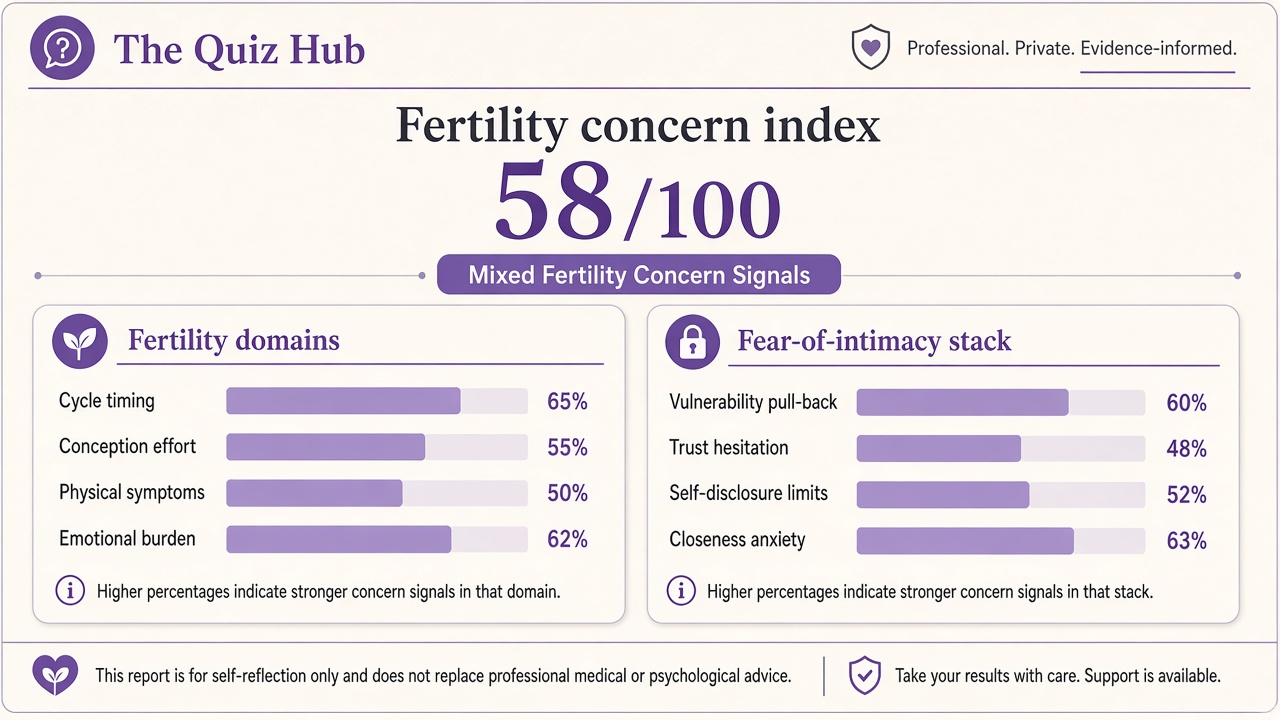
This am I infertile quiz estimates how often fertility worry patterns showed up for you in the past three months. Twenty-two original frequency items group into four domains drawn from ASRM infertility evaluation themes: cycle timing, conception effort, physical symptoms, and emotional burden. Your fertility concern index averages these patterns into a 0 to 100 score with plain-language bands. A parallel fear-of-intimacy stack shows how hiding worry from partners or closeness strain may layer with trying stress. It reflects your self-report, not a clinician's evaluation.
Cycle timing
Irregular cycles, missing ovulation signs, negative predictor kits, and unreliable temperature shifts.
Conception effort
Timed intercourse stress, months without pregnancy, age pressure, and social comparison while trying.
Physical symptoms
Pelvic pain worry, hormone symptom fear, past procedure concerns, and sperm quality anxiety without testing.
Emotional burden
Hiding worry from partners, delaying clinic visits, negative test grief, and solo online research spirals.
How it works
Three steps from first question to your fertility report. Click Start Quiz to open the interactive quiz in a full-screen modal.
Answer 22 frequency items
Rate how often each fertility worry pattern showed up in the past three months, from Never to Very often. You click Next after each answer; nothing auto-advances.
Items map to four fertility domains
Your answers accumulate percentages for cycle timing, conception effort, physical symptoms, and emotional burden, plus a fear-of-intimacy stack index.
View band and domain bars
Results show Lower, Mixed, or Higher Fertility Concern Signals with fertility domain bars and intimacy stack layers. Elevated bands include reproductive health referral guidance.
Take the am I infertile quiz
Rate 22 statements about fertility worry from the past three months. Your answers produce a fertility concern index from 0 to 100, four fertility domain scores, a fear-of-intimacy stack chart, and a band label for reflection or a clinic visit.
Opens in a focused modal. No account required. Results stay on screen.
What your result means
Your fertility concern index is the normalized total across all 22 items on a 0 to 100 scale, with reverse scoring on protective items so higher scores mean more fertility worry signals overall. Domain bars show endorsement rates so you can see whether cycle timing, trying strain, physical symptom fear, or emotional load drives your result most. The fear-of-intimacy stack chart shows how partner hiding or closeness strain layers alongside fertility fear.
| Band | Index range | Typical reading |
|---|---|---|
| Lower Fertility Concern Signals | 0 to 35 | Fewer fertility worry patterns on this screener; brief cycle shifts may still appear |
| Mixed Fertility Concern Signals | 36 to 65 | Blend of cycle worry, trying strain, and emotional load; worth tracking and discussing if persistent |
| Higher Fertility Concern Signals | 66 to 100 | Frequent irregular cycle worry, prolonged trying, or intense grief; reproductive evaluation may help |
What your am I infertile report looks like
After all 22 items, you get a fertility concern index from 0 to 100, a band label, four fertility domain bars, and a fear-of-intimacy stack chart with vulnerability pull-back, trust hesitation, self-disclosure limits, and closeness anxiety layers. Percentages reflect how often fertility worry showed up in your answers, not a clinical verdict about your reproductive health.
What this quiz can and cannot tell you
Can tell you
- How often fertility worry patterns showed up for you in the past three months
- A fertility concern index and four domain bars for cycle timing, trying strain, physical symptoms, and emotional burden
- A fear-of-intimacy stack chart showing how partner hiding or closeness strain layers with fertility fear
- A starting point for a reproductive health visit or retaking after a clinic appointment
Cannot tell you
- Whether you are infertile or how severe a fertility problem may be
- Whether you have PCOS, endometriosis, tubal blockage, or any medical diagnosis
- Whether you or your partner need IVF, medication, or surgery without clinician assessment
- What treatment you need without history, exam, labs, imaging, or semen analysis when relevant
Fertility worry, ASRM guidance, and when to see a doctor
The American Society for Reproductive Medicine (ASRM) defines infertility as failure to achieve pregnancy after twelve months of regular unprotected intercourse, or six months when the female partner is over 35. Clinical evaluation typically includes cycle history, ovulation assessment, hormone labs, imaging, and semen analysis when a male partner is involved. In everyday language, am I infertile searches often map to those patterns: irregular cycles, months of negative tests, pelvic pain worry, and grief after each cycle ends without pregnancy.
The Quiz Hub built this am I infertile quiz as an original self-report screener inspired by ASRM evaluation themes, not a reproduction of any published clinical instrument. Readers often compare it to sibling tools on this site. Our am I ready for a baby quiz maps partner alignment and parenting motivation without symptom frequency items. The depression test screens low mood and anhedonia rather than ovulation signs or trying timelines. The am I a hypochondriac quiz measures health anxiety and reassurance loops rather than cycle timing frequency.
| The Quiz Hub test | What it adds |
|---|---|
| Am I ready for a baby quiz | Parenthood readiness domains without cycle worry or trying strain items |
| How many kids will I have quiz | Parenting orientation bands for reflection, not fertility symptom frequency |
| Am I heartbroken quiz | Acute grief and loss distress without ovulation or trying timeline items |
| Fear of intimacy quiz | FOIS-inspired intimacy avoidance only, without fertility domain bars |
| Am I a hypochondriac quiz | Health anxiety and reassurance seeking patterns, not cycle timing frequency |
| This am I infertile quiz | Four-domain fertility concern index plus fear-of-intimacy stack for worry frequency |
Sample item types include frequency ratings such as whether you tried to conceive for six months or more without a positive pregnancy test, or whether you postponed a reproductive health appointment because you feared bad news. High cycle timing worry with high emotional burden often lands in Mixed or Higher Fertility Concern Signals. Stress, thyroid shifts, and recent miscarriage grief can spike scores temporarily without meaning you need emergency care. Read how we review quizzes in our editorial policy or browse more tools on our mental health and clinical hub.
Am I infertile quiz FAQ
What are signs you might have fertility concerns?
Common fertility concern signs include irregular or absent ovulation patterns, months of trying without pregnancy, pelvic pain or heavy periods, hormone symptom worry, and intense grief after negative tests. Stress, thyroid shifts, and recent illness can also disrupt cycles temporarily. This am I infertile quiz measures how often those worry patterns showed up for you in the past three months. It is not a medical diagnosis.
What does this am I infertile quiz measure?
Twenty-two original frequency items ask how often you experienced cycle timing worry, conception effort strain, physical symptom fear, and emotional burden inspired by ASRM infertility evaluation themes. You receive a fertility concern index from 0 to 100, four domain bars, and a parallel fear-of-intimacy stack chart. Only clinical assessment with history, exam, and testing can evaluate infertility.
What is the fear-of-intimacy stack on this quiz?
The fear-of-intimacy stack is a second results chart inspired by FOIS-style intimacy avoidance themes, adapted to fertility worry framing. Each of the 22 items also maps to one of four stack layers. The stack index summarizes how often hiding worry from partners, trust hesitation, or closeness strain appears alongside fertility fear.
How is this different from the am I ready for a baby quiz?
The am I ready for a baby quiz screens partner alignment, emotional readiness, practical foundation, and parenting motivation without symptom frequency items. This am I infertile quiz focuses on cycle worry, months trying, physical symptom fear, and emotional load while attempting to conceive. It uses a three-month frequency frame with domain bars and a fear-of-intimacy stack.
Can this quiz diagnose infertility?
No. The fertility concern index describes self-reported worry frequency on this abbreviated screener. Only a licensed clinician can evaluate infertility through history, physical exam, hormone labs, imaging, and semen analysis when relevant. Online quizzes cannot confirm or rule out infertility or any medical condition.
Who reviewed this content?
Dr. Elena Vasquez, PhD, reviewed the test framing and result explanations. See our editorial policy for review standards.
Reviewed by