What this am I genderfluid quiz measures
This am I genderfluid quiz estimates how much your self-report aligns with shifting-gender clarity signals. Twenty-two original agree-or-disagree items group into four domains inspired by genderfluid community language and everyday questioning talk: gender shift over time, binary category mismatch, expression variability, and genderfluid label curiosity. Each item also maps to a fear-of-intimacy stack layer so you can see whether vulnerability pull-back, trust hesitation, self-disclosure limits, or closeness anxiety sits underneath gender exploration. Your genderfluid identity clarity index averages these signals into a 0 to 100 score where higher numbers mean stronger shifting-gender endorsement.
Gender shift over time
Inner gender sense moving across days, weeks, months, or life seasons rather than staying fixed.
Binary category mismatch
Restlessness with man-or-woman boxes, settled gender assumptions, and one-time gender decisions.
Expression variability
Outward presentation, style, and voice shifting to match whichever gender side feels active.
Label curiosity
Wondering whether genderfluid fits, trying on genderflux or agender labels, and comparing with others.
How it works
Three steps from first question to your genderfluid clarity report with fear-of-intimacy stack. Click Start Quiz to open the interactive quiz in a full-screen modal.
Answer 22 agree-or-disagree items
Rate how much you agree with each gender pattern statement, from Strongly disagree to Strongly agree. You click Next after each answer; nothing auto-advances.
Items map to clarity domains and intimacy stack
Your answers accumulate percentages for gender shift over time, binary category mismatch, expression variability, and label curiosity, plus four fear-of-intimacy stack layers.
View band, domain bars, and stack chart
Results show Lower, Mixed, or Higher Genderfluid Clarity with domain bars, stack layers, and reflection prompts.
Take the am I genderfluid quiz
Rate 22 statements about how your gender feels across time. Your answers produce a genderfluid identity clarity index from 0 to 100, four domain scores, a fear-of-intimacy stack chart, and a band label for reflection.
Opens in a focused modal. No account required. Results stay on screen.
What your genderfluid clarity result means
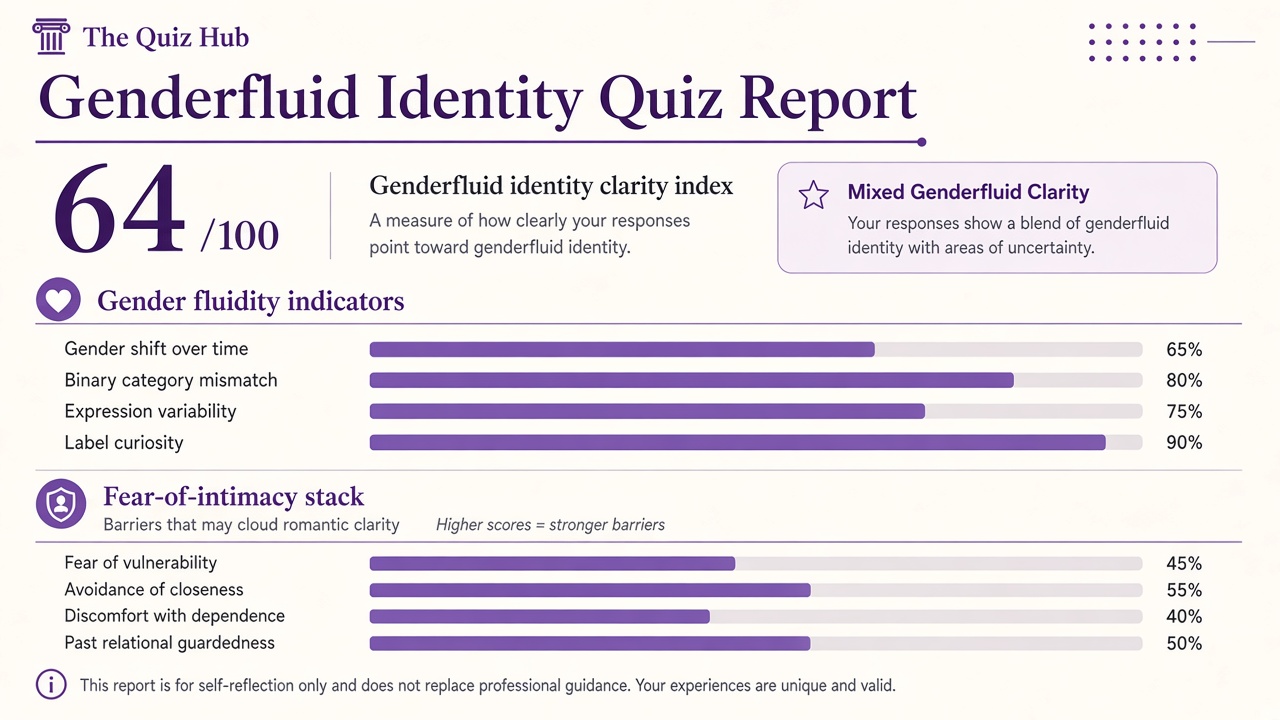
Your genderfluid identity clarity index is the normalized total across all 22 items on a 0 to 100 scale. Higher scores mean stronger agreement with gender shift over time, binary category mismatch, expression variability, and label curiosity items on this screener. Domain bars show endorsement rates so you can see whether shift, mismatch, expression, or curiosity drives your result most. The fear-of-intimacy stack chart shows parallel layers for vulnerability pull-back, trust hesitation, self-disclosure limits, and closeness anxiety that can complicate naming shifting gender patterns even when feelings feel strong.
| Band | Index range | Typical reading |
|---|---|---|
| Lower Genderfluid Clarity | 0 to 35 | Limited shifting-gender signals, stable gender sense, or strong hesitation on naming fluidity |
| Mixed Genderfluid Clarity | 36 to 65 | Blend of shifting-gender signals and hesitation; one domain may lag behind the rest |
| Higher Genderfluid Clarity | 66 to 100 | Strong gender shift, binary mismatch, expression variability, or label curiosity signals on this screener |
What your genderfluid report looks like
After all 22 items, you get a genderfluid identity clarity index from 0 to 100, a band label, four domain bars for gender shift over time, binary category mismatch, expression variability, and label curiosity, plus a fear-of-intimacy stack chart with vulnerability, trust, disclosure, and closeness anxiety layers.
What this quiz can and cannot tell you
Can tell you
- How much shifting-gender clarity signals showed up in your self-report on this screener
- A genderfluid identity clarity index and four domain bars for shift, binary mismatch, expression, and label curiosity
- A fear-of-intimacy stack showing which closeness-avoidance layer may complicate naming gender fluidity
- A starting point for honest reflection on labels, pronouns, disclosure timing, and expression choices
Cannot tell you
- Whether you are officially genderfluid, cisgender, non-binary, bigender, or any other label based on a quiz score alone
- How your gender will feel next month, next year, or after major life changes
- Whether a relationship will accept your gender shifts from index numbers
- What therapy or gender-affirming care you need without licensed professional guidance
Genderfluid identity, binary boxes, and intimacy fear
Search interest in am I genderfluid quizzes often spikes when someone notices their inner gender sense moving across weeks while the world still treats gender as fixed. Genderfluid identity, widely used in trans and non-binary communities, names change-over-time patterns rather than one static label. Writers such as Riki Wilchins and Julia Serano have helped popularize language for gender variance without telling anyone which label they must use. That framing does not decide your pronouns, but it explains why genderfluid curiosity can feel real even when you still use the gender you were assigned at birth.
The Quiz Hub built this am I genderfluid quiz as an original self-report screener inspired by genderfluid community themes plus FOIS-style intimacy avoidance layers from Karen M. Descutner and Mark H. Thelen (1991), not a reproduction of any single published instrument. Readers often compare it to sibling tools on this site. Our am I bigender quiz screens dual-gender resonance where masculine and feminine sides may feel present together. The non-binary test focuses on broader non-binary and genderfluid reflection framing. The gender identity test maps exploration and dysphoria themes across six domains.
| The Quiz Hub test | What it adds |
|---|---|
| Am I bigender quiz | Dual-gender resonance and simultaneous masculine-feminine sides, not change-over-time fluidity items |
| Non-binary test | Broader non-binary reflection across six domains, not a focused genderfluid clarity index |
| Gender identity test | Wide gender exploration map with dysphoria themes, not genderfluid-specific shift items |
| Am I trans quiz | Trans identity reflection framing, not shifting-gender clarity domains with intimacy stack |
| Fear of intimacy quiz | General intimacy avoidance frequency, not genderfluid domain items |
| This am I genderfluid quiz | Genderfluid identity clarity index plus fear-of-intimacy stack for shift, binary mismatch, expression, and label curiosity |
Sample item types include agreement ratings such as whether you wake up feeling like a different gender than the week before, or whether forms that force man-or-woman answers feel boxing. High gender shift scores with high trust hesitation on the stack often land in Mixed Genderfluid Clarity because clarity and fear pull in opposite directions. Past bullying, family messaging, or genuine gender stability can shift scores without meaning your pattern is wrong. Read how we review quizzes in our editorial policy or browse more tools on our relationships and dating hub.
Am I genderfluid quiz FAQ
What does genderfluid mean?
Genderfluid describes a gender identity that shifts across time rather than staying fixed in one place. Someone may feel more masculine one week, more feminine another, or move through neutral and androgynous states. The term is used widely in LGBTQ communities and discussed in gender studies work by scholars such as Riki Wilchins and Julia Serano. This am I genderfluid quiz measures how much shifting-gender signals show up in your self-report. It is not a label on your gender identity or proof you must use any specific pronouns.
What does this am I genderfluid quiz measure?
Twenty-two original agree-or-disagree items ask how much you notice gender shift over time, feel boxed in by man-or-woman categories, change expression to match inner shifts, and wonder whether genderfluid labels fit. Scores map to four clarity domains plus a parallel fear-of-intimacy stack with vulnerability pull-back, trust hesitation, self-disclosure limits, and closeness anxiety layers. You receive a genderfluid identity clarity index from 0 to 100 where higher scores mean stronger shifting-gender signals on this screener, plus a band from Lower through Higher Genderfluid Clarity.
What is the fear-of-intimacy stack on this quiz?
The fear-of-intimacy stack is a second results chart inspired by FOIS-style intimacy avoidance themes from Karen M. Descutner and Mark H. Thelen (1991), adapted to genderfluid self-reflection. Each of the 22 items also maps to one of four stack layers: vulnerability pull-back, trust hesitation, self-disclosure limits, and closeness anxiety. The stack index summarizes how often intimacy fear may sit underneath gender clarity, such as knowing your gender shifts but bracing for rejection when you share that truth.
How is this different from the am I bigender quiz?
The am I bigender quiz screens dual-gender resonance, where masculine and feminine sides may feel present together. This am I genderfluid quiz focuses on change over time: gender sense moving across days, weeks, or seasons, plus discomfort with fixed binary boxes. Bigender and genderfluid can overlap in lived experience, but the question banks target different patterns. This test also adds a fear-of-intimacy stack layer that the bigender quiz shares structurally but with genderfluid-specific stems.
Can this quiz tell me if I am genderfluid?
No. The genderfluid identity clarity index describes self-reported gender patterns on this abbreviated screener. Only you, honest reflection, and optionally a gender-affirming therapist can explore what labels fit. Online quizzes cannot confirm gender identity, predict how you will feel next month, or replace coming-out decisions you make on your own timeline.
Who reviewed this content?
Dr. James Whitfield, PhD, reviewed the test framing and result explanations. See our editorial policy for review standards.
Reviewed by