What this am I better off single quiz measures
This am I better off single quiz estimates how often solo life feels more peaceful or partnership feels more appealing in your current season. Twenty original frequency items group into four single-fit domains: solo peace, autonomy priority, partnership strain, and coupling desire. Each item also maps to a parallel fear-of-intimacy stack layer so you can see whether closeness anxiety shapes your single-life preference. Your single-vs-relationship fit index averages these patterns into a 0 to 100 score with plain-language bands. It reflects your self-report, not a verdict about your relationship.
Solo peace
Feeling more yourself alone, sleeping better without scrutiny, and preferring private inner life.
Autonomy priority
Guarding alone time, resisting surveillance logistics, and tension around constant check-ins.
Partnership strain
Dreading emotional labor, assuming conflict proves coupling fails, and exit fantasies during disagreements.
Coupling desire
Looking forward to shared home life, missing a default partner, and curiosity about deepening commitment.
How it works
Three steps from first question to your single-vs-relationship fit report. Click Start Quiz to open the interactive quiz in a full-screen modal.
Answer 20 frequency items
Rate how often each solo-versus-partnership pattern shows up, from Never to Almost always. You click Next after each answer; nothing auto-advances.
Items map to four fit domains plus intimacy stack
Your answers accumulate percentages for solo peace, autonomy priority, partnership strain, and coupling desire, plus a fear-of-intimacy stack index with four layer bars.
View band and domain bars
Results show Lower, Mixed, or Higher Single Preference with fit domain bars, intimacy stack bars, and reflection prompts. Higher bands include crisis resources.
Take the am I better off single quiz
Rate 20 statements about how single life and partnership feel in your current season. Your answers produce a single-vs-relationship fit index from 0 to 100, four fit domain scores, a fear-of-intimacy stack chart, and a band label for reflection.
Opens in a focused modal. No account required. Results stay on screen.
What your result means
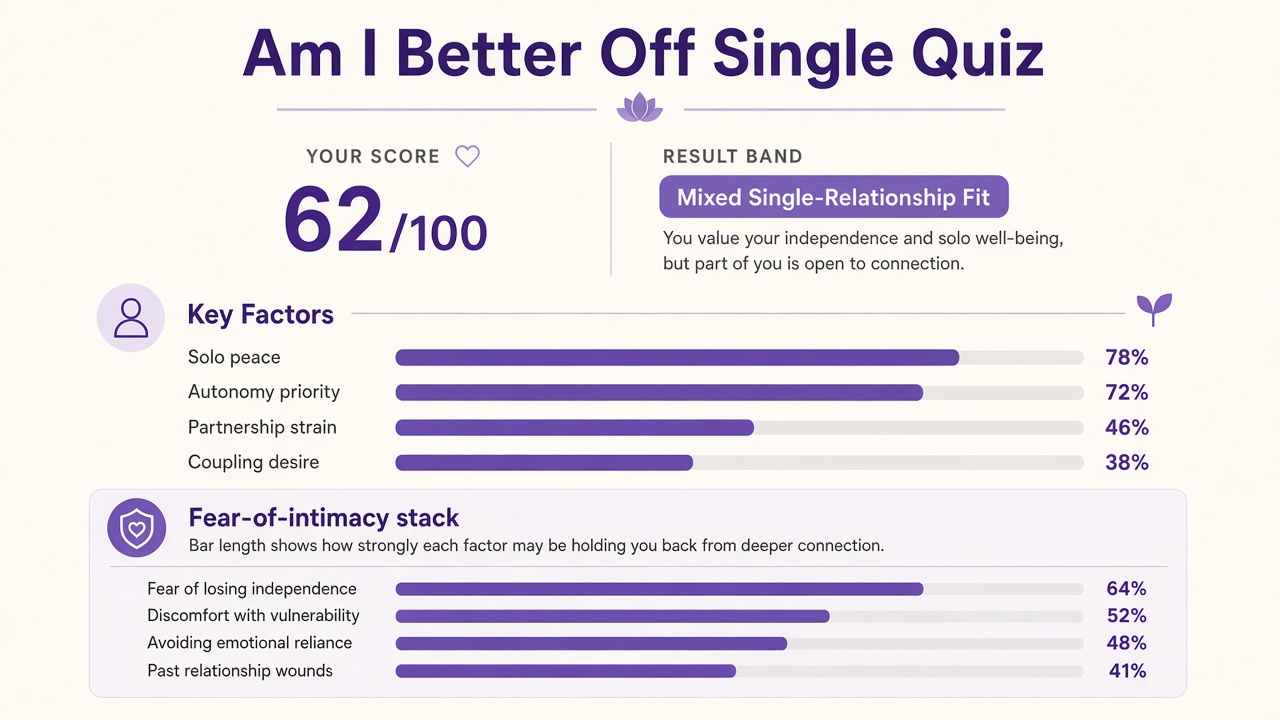
Your single-vs-relationship fit index is the normalized total across all 20 items on a 0 to 100 scale, with reverse scoring on coupling desire items so higher scores mean stronger single-life preference overall. Domain bars show endorsement rates so you can see whether solo peace, autonomy guarding, partnership strain, or low coupling desire drives your result most. The fear-of-intimacy stack chart runs in parallel so you can separate intentional solitude from closeness anxiety.
| Band | Index range | Typical reading |
|---|---|---|
| Lower Single Preference | 0 to 35 | Partnership may suit you as well as or better than staying single; normal alone-time enjoyment may still appear |
| Mixed Single-Relationship Fit | 36 to 65 | Blend of solo peace and partnership pull; worth tracking if a specific relationship feels mismatched |
| Higher Single Preference | 66 to 100 | Frequent solo peace, autonomy priority, or partnership strain; reflection or professional support may help |
What your am I better off single report looks like
After all 20 items, you get a single-vs-relationship fit index from 0 to 100, a band label, four single-fit domain bars, and a fear-of-intimacy stack chart with vulnerability pull-back, trust hesitation, self-disclosure limits, and closeness anxiety layers. Percentages reflect how solo life and partnership feel right now, not a permanent life directive.
What this quiz can and cannot tell you
Can tell you
- How often solo peace, autonomy priority, or partnership strain patterns showed up for you
- A single-vs-relationship fit index and four domain bars plus a fear-of-intimacy stack chart
- Which fit domain or intimacy layer feels strongest in your current season
- A starting point for therapy conversation or retaking after a relationship change
Cannot tell you
- Whether you should break up, stay single, or start dating someone new
- Whether your partner is right or wrong for you without your own judgment and context
- Whether you have attachment avoidance or any clinical diagnosis
- What life structure you need without honest reflection and, when needed, licensed support
Solo peace, autonomy, and the fear-of-intimacy stack
Relationship researchers such as Amir Levine and Rachel Heller (2010) describe how attachment patterns shape whether closeness feels nourishing or costly. Psychologist Bella DePaulo has written extensively on single life as a valid, often fulfilling path rather than a waiting room for partnership. Many people asking "am I better off single" are weighing two honest truths: they enjoy autonomy and quiet, and they still wonder whether partnership could work with the right person or after more healing.
The Quiz Hub built this am I better off single quiz as an original self-report screener, not a BuzzFeed-style listicle with no scoring backbone. Each item uses a frequency frame ("how often do you...") matched to solo-versus-couple comparison. A parallel fear-of-intimacy stack tags every question with vulnerability pull-back, trust hesitation, self-disclosure limits, or closeness anxiety layers so high single-fit scores are easier to interpret. Readers often compare it to sibling tools on this site.
| The Quiz Hub test | What it adds |
|---|---|
| Fear of intimacy quiz | FOIS-inspired intimacy avoidance index in active relationships, not single-versus-couple preference |
| Do I have commitment issues quiz | Label avoidance and exit strategy patterns, not whether solo life feels more peaceful |
| Am I emotionally unavailable quiz | Consistency gaps and exit fantasies with a partner, not solo-life fit framing |
| Am I afraid of love quiz | Love-avoidance index on hurt anticipation and vulnerability blocks, not autonomy priority |
| Compatibility test | Values and lifestyle overlap bars, not single-life preference frequency |
| This am I better off single quiz | Single-vs-relationship fit index with four fit domains and fear-of-intimacy stack chart |
Sample item types include frequency ratings such as whether you feel more like yourself on quiet evenings without a partner's expectations, or whether you look forward to building a home life with someone you trust. High solo peace with high fear-of-intimacy stack scores often lands in Mixed or Higher Single Preference bands even when coupling desire items stay moderate. Recent breakup recovery, intentional solo living, and mismatched partnerships can all spike scores temporarily. Read how we review quizzes in our editorial policy or browse more tools on our relationships and dating hub.
Am I better off single quiz FAQ
What does "better off single" mean on this quiz?
Better off single here means your current answers lean toward solo peace, autonomy priority, or partnership strain more than toward active coupling desire. It does not mean you should break up, stay single forever, or that relationships are bad. This am I better off single quiz maps self-reported patterns to a single-vs-relationship fit index from 0 to 100 for reflection, not a life directive.
What does this am I better off single quiz measure?
Twenty original frequency items ask how often solo peace, autonomy priority, partnership strain, and coupling desire patterns show up when you compare single life to partnership. Each item also feeds a parallel fear-of-intimacy stack with vulnerability pull-back, trust hesitation, self-disclosure limits, and closeness anxiety layers. You receive a single-vs-relationship fit index from 0 to 100 and a band from Lower through Higher Single Preference.
How is this different from the fear of intimacy quiz?
The fear of intimacy quiz screens closeness-limiting habits in active relationships: vulnerability avoidance, trust hesitation, and self-disclosure limits. This am I better off single quiz asks whether solo life feels more peaceful or partnership feels more appealing right now, with the fear-of-intimacy stack as a secondary chart. It uses a single-versus-couple frequency frame rather than emotional closeness items alone.
Can this quiz tell me to break up or stay single?
No. The single-vs-relationship fit index describes self-reported patterns on this abbreviated screener. Only you can weigh relationship context, safety, values, and goals. Online quizzes cannot confirm whether you should leave a partner or avoid dating entirely.
What should I do if I get a higher single preference band?
Consider whether solo peace feels chosen or protective after hurt. Pair results with our fear of intimacy quiz or attachment style test if closeness anxiety drives the score. Talk with a licensed therapist if distress or avoidance blocks the life structure you want. If you feel unsafe or in crisis, call or text 988 (US) or your local crisis line.
Who reviewed this content?
Dr. Priya Sharma, PhD, reviewed the test framing and result explanations. See our editorial policy for review standards.
Reviewed by