What this am I addicted to video games quiz measures
This am I addicted to video games quiz estimates how often gaming dependency patterns show up in your routine. Twenty-two original frequency items group into four domains drawn from gaming disorder and behavioral addiction research: compulsive play, withdrawal distress, life impact, and play balance. Each item also maps to a fear-of-intimacy stack layer so you can see whether retreating into games connects to vulnerability pull-back, trust hesitation, self-disclosure limits, or closeness anxiety. Your gaming dependency index averages these patterns into a 0 to 100 score with plain-language bands.
Compulsive play
Opening games without a plan, intrusive play thoughts, losing track of time, and continuing past planned stop times.
Withdrawal distress
Restlessness when offline, using games to soothe mood, and feeling uneasy during unstructured time.
Life impact
Sleep loss, focus problems, guilt, skipped plans, hiding play time, and hearing you are never present.
Play balance
Taking days off, enjoying offline hobbies, honoring commitments, and keeping gaming-free evenings.
How it works
Three steps from first question to your gaming dependency report with fear-of-intimacy stack. Click Start Quiz to open the interactive quiz in a full-screen modal.
Answer 22 frequency items
Rate how often each gaming pattern showed up over the past two weeks, from Never to Very often. You click Next after each answer; nothing auto-advances.
Items map to gaming domains and intimacy stack
Your answers accumulate percentages for compulsive play, withdrawal distress, life impact, and play balance, plus four fear-of-intimacy stack layers.
View band and dual charts
Results show Lower, Mixed, or Higher Dependency Signals with domain bars, a fear-of-intimacy stack chart, and reflection prompts. Higher bands include crisis resources.
Take the am I addicted to video games quiz
Rate 22 statements about compulsive play, withdrawal distress, life impact, and play balance over the past two weeks. Your answers produce a gaming dependency index from 0 to 100, a fear-of-intimacy stack chart, and a band label for reflection or therapy conversation.
Opens in a focused modal. No account required. Results stay on screen.
What your result means
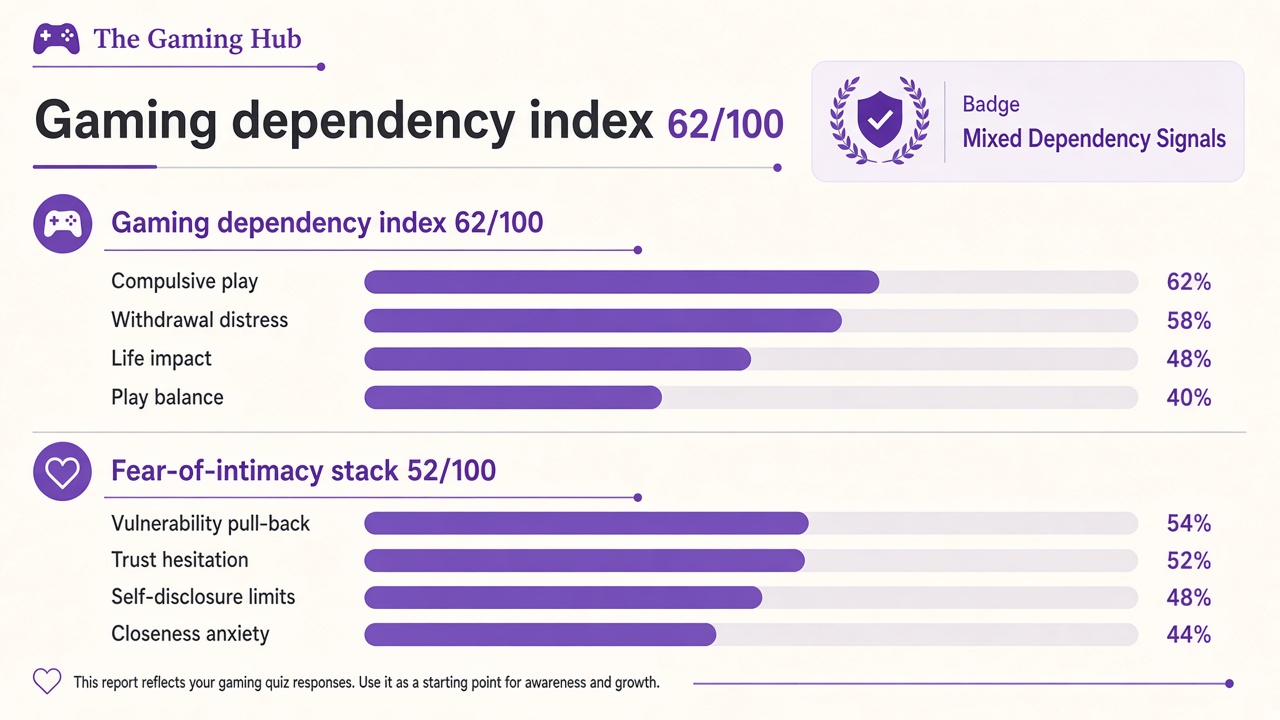
Your gaming dependency index is the normalized total across all 22 items on a 0 to 100 scale, with reverse scoring on play balance items so higher scores mean more dependency concern overall. Domain bars show endorsement rates so you can see whether compulsive play, offline restlessness, life impact, or weak play balance drives your result most. The fear-of-intimacy stack chart shows parallel layers for vulnerability pull-back, trust hesitation, self-disclosure limits, and closeness anxiety alongside gaming habits.
| Band | Index range | Typical reading |
|---|---|---|
| Lower Dependency Signals | 0 to 35 | Fewer compulsive play signals on this screener; new releases can still spike scores |
| Mixed Dependency Signals | 36 to 65 | Blend of enjoyable gaming and hard-to-control habits; worth tracking if sleep or closeness erodes |
| Higher Dependency Signals | 66 to 100 | Frequent compulsive play, poor play balance, or games used to avoid feelings; professional support may help |
What your video game addiction quiz report looks like
After all 22 items, you get a gaming dependency index from 0 to 100, a band label, four gaming domain bars, and a fear-of-intimacy stack chart with vulnerability pull-back, trust hesitation, self-disclosure limits, and closeness anxiety layers. Percentages reflect play habits you notice, not a clinical verdict about gaming disorder.
What this quiz can and cannot tell you
Can tell you
- How often gaming dependency patterns showed up for you on this screener
- A gaming dependency index and four domain bars for compulsive play, withdrawal distress, life impact, and play balance
- A fear-of-intimacy stack showing which closeness-avoidance layer feels strongest alongside gaming
- A starting point for therapy conversation or retaking after a screen-time reset
Cannot tell you
- Whether you have gaming disorder or any clinical diagnosis
- Whether your school or employer should grant accommodations without formal evaluation
- Whether your rank or achievements prove you are healthy without medical review
- What treatment you need without a licensed clinician's evaluation
Gaming disorder research, digital balance, and the intimacy stack
The World Health Organization included gaming disorder in the ICD-11 in 2018, defining impaired control, increasing priority to gaming, and continuation despite harm. Cecilie Schou Andreassen and colleagues published the Game Addiction Scale in 2012, adapting addiction criteria to video game play. Joël Billieux and researchers at the University of Luxembourg later debated whether gaming disorder criteria capture genuine pathology or heavy engagement, which is why honest self-report screeners emphasize life impact and play balance rather than hours alone.
The Quiz Hub built this am I addicted to video games quiz as an original self-report screener inspired by those themes, not a reproduction of the Game Addiction Scale or any published instrument. Readers often compare it to sibling tools on this site. Our am I addicted to social media quiz screens compulsive scrolling and feed withdrawal with BSMAS-inspired domains. The do I have ADHD quiz maps attention and impulse patterns that can overlap with gaming but uses a different symptom frame. The fear of intimacy quiz maps vulnerability avoidance without a gaming lens.
| The Quiz Hub test | What it adds |
|---|---|
| Am I addicted to social media quiz | Compulsive scrolling and feed withdrawal, not session-based gaming compulsion |
| Do I have ADHD quiz | Attention, hyperactivity, and impulse domains without gaming-specific life impact items |
| Am I lonely quiz | Social isolation and belonging distress, not compulsive play frequency |
| Fear of intimacy quiz | FOIS-inspired avoidance index without gaming dependency domains |
| Am I a workaholic quiz | Compulsive overwork and boundary collapse, not play session compulsion |
| This video games quiz | Gaming dependency index plus fear-of-intimacy stack for compulsive play and play balance |
Sample item types include frequency ratings such as whether you kept playing after telling yourself you would stop at one more round, or whether you used gaming to calm stress when difficult feelings were waiting offline. High compulsive play with high closeness anxiety often lands in Mixed or Higher Dependency Signals. New game launches, competitive seasons, and friend group co-op raids can spike scores temporarily. Read how we review quizzes in our editorial policy or browse more screeners on our mental health and clinical hub.
Am I addicted to video games quiz FAQ
What is gaming disorder?
Gaming disorder describes impaired control over gaming, increasing priority given to games over other activities, and continuation despite negative consequences. The World Health Organization included gaming disorder in the ICD-11 in 2018. Researchers such as Cecilie Schou Andreassen and colleagues adapted addiction criteria to games through scales like the Game Addiction Scale. Gaming disorder overlaps with depression and ADHD but focuses on compulsive play rather than mood alone. This am I addicted to video games quiz measures how often those patterns show up over two weeks. It is not a clinical diagnosis.
What does this am I addicted to video games quiz measure?
Twenty-two original frequency items ask how often you notice compulsive play, withdrawal distress, life impact, and limited play balance. Each item also maps to a fear-of-intimacy stack layer: vulnerability pull-back, trust hesitation, self-disclosure limits, and closeness anxiety. You receive a gaming dependency index from 0 to 100 and a band from Lower through Higher Dependency Signals.
What is the fear-of-intimacy stack on this quiz?
The fear-of-intimacy stack is a second results chart inspired by FOIS-style intimacy avoidance themes, adapted to gaming framing. Each of the 22 items maps to one of four stack layers showing how retreating into games may connect to closeness anxiety: hiding vulnerability, testing trust through online safety, limiting personal disclosure, or panicking when bonds need time. The stack index summarizes those layers alongside the gaming dependency index.
How is this different from the am I addicted to social media quiz?
The am I addicted to social media quiz screens compulsive scrolling, notification checking, and feed withdrawal over two weeks with BSMAS-inspired domains. This am I addicted to video games quiz focuses on compulsive play sessions, offline restlessness, sleep and focus loss from gaming, and weak play balance without social feed items. Both use frequency scales but measure different digital habits. Many people score high on one quiz and moderate on the other.
Can this quiz diagnose gaming disorder?
No. The gaming dependency index describes self-reported play patterns on this abbreviated screener. Only a licensed clinician can evaluate gaming disorder, mood disorders, or ADHD through structured interviews. Online quizzes cannot confirm or deny a diagnosis or certify fitness for school or work.
Who reviewed this content?
Dr. Elena Vasquez, PhD, reviewed the test framing and result explanations. See our editorial policy for review standards.
Reviewed by