What this worm reassurance quiz measures
This would you still love me worm quiz estimates how your partner responds when you ask absurd hypotheticals: would they still love you as a worm, a frog, or some other silly transformation? Twenty-two original frequency items group into four domains about warm engagement, reassurance without dismissiveness, playful reciprocation versus irritation, and emotional safety when jokes feel vulnerable. Your reassurance and playfulness index averages these patterns into a 0 to 100 score with plain-language bands.
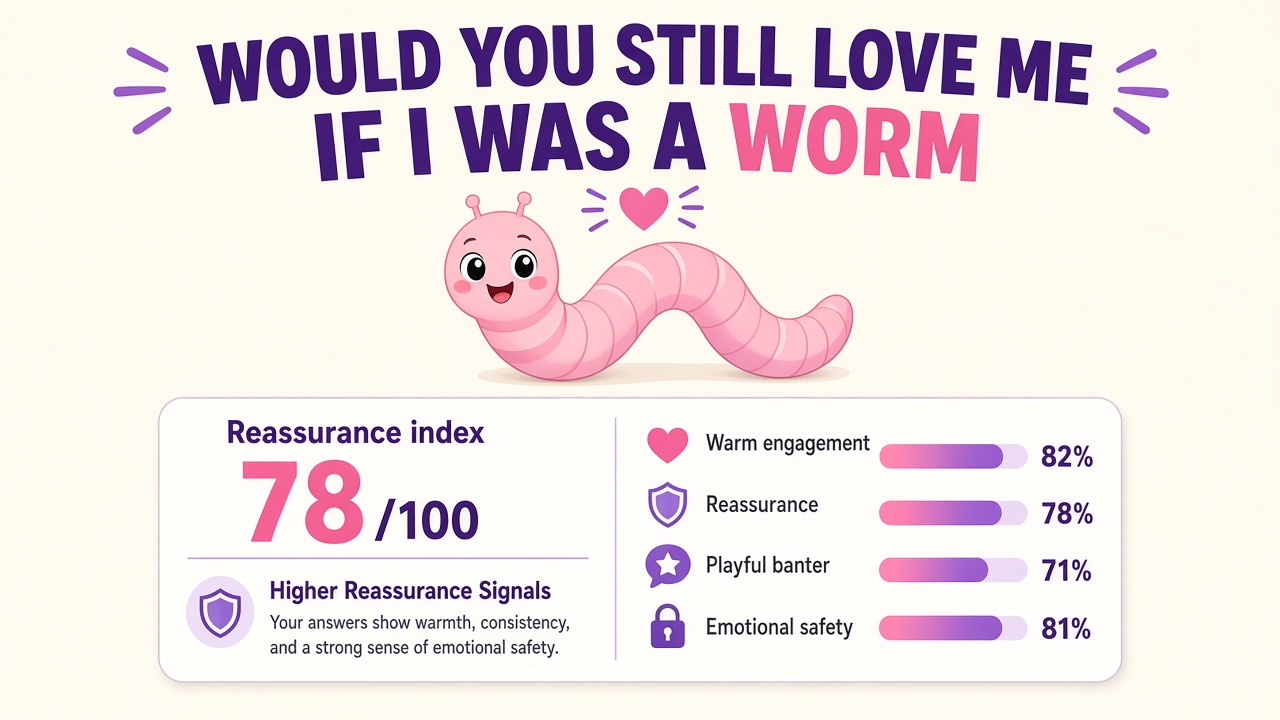
Warm engagement
Joining in, laughing, and treating meme hypotheticals as fun bonding rather than shutting them down.
Reassurance
Clear care and affection without making you feel childish for asking playful reassurance questions.
Playful banter
Matching your tone, riffing back, and avoiding irritation when you joke about wild scenarios.
Emotional safety
Kind responses that help vulnerable-feeling jokes feel safe, chosen, and not mocked or judged.
How it works
Three steps from first question to your reassurance report. Click Start Quiz to open the interactive quiz in a full-screen modal.
Answer 22 frequency items
Rate how often your partner responds each way when you ask silly hypotheticals, from Never to Almost always. You click Next after each answer; nothing auto-advances.
Items map to four reassurance domains
Your answers accumulate percentages for warm engagement, reassurance, playful banter, and emotional safety, plus an overall reassurance index.
View band and domain bars
Results show Lower Reassurance Signals, Mixed Playful Pattern, or Higher Reassurance Signals with domain bars and conversation prompts.
Take the would you still love me worm quiz
Rate 22 statements about how your partner handles silly hypotheticals and reassurance jokes. Your answers produce a reassurance index from 0 to 100, four domain scores, and a band label for reflection or couple conversation.
Opens in a focused modal. No account required. Results stay on screen.
What your result means
Your reassurance and playfulness index is the normalized total across all 22 items on a 0 to 100 scale, with reverse scoring on dismissive and irritated items so higher scores mean more warmth overall. Domain bars show raw endorsement rates so you can see whether dismissal, low playfulness, or emotional safety drives your result most.
| Band | Index range | Typical reading |
|---|---|---|
| Lower Reassurance Signals | 0 to 35 | Silly hypotheticals often feel shut down, brushed off, or met with irritation on this screener |
| Mixed Playful Pattern | 36 to 65 | Some playful engagement with noticeable gaps; stress seasons can widen the mix |
| Higher Reassurance Signals | 66 to 100 | Absurd jokes often met with warmth and play; still not proof conflict will never happen |
What your reassurance report looks like
After all 22 items, you get a reassurance and playfulness index from 0 to 100, a band label, and four domain bars for warm engagement, reassurance, playful banter, and emotional safety. Percentages reflect how you experience playful reassurance, not a clinical verdict about your partner.
What this quiz can and cannot tell you
Can tell you
- How you experience your partner's responses to silly hypotheticals and reassurance jokes
- A reassurance index and four domain bars for warmth, reassurance, play, and safety
- Which reassurance pattern feels strongest in your playful interactions
- A starting point for calm conversation about humor, reassurance, and meme banter
Cannot tell you
- Whether your partner truly loves you or whether your relationship will last
- What your partner thinks, feels, or intends without their own words
- Whether abuse, contempt, or clinical relationship pathology is present
- Whether your partner will change without honest dialogue and mutual effort
The worm meme, playful reassurance, and absurd hypotheticals
The "would you still love me if I was a worm" meme spread across TikTok and Twitter as couples tested whether partners would play along with absurd transformation hypotheticals. Social media researcher Crystal Abidin has written about how viral relationship memes turn private reassurance rituals into public humor formats. The joke works because silly questions often hide a real wish: please take my vulnerability seriously even when I dress it up as comedy.
The Quiz Hub built this worm quiz as an original self-report screener inspired by that trend, not a copy of any single viral post. Readers often compare it to broader tools on this site. Our does he love me quiz screens observed care, consistency, and future orientation. The does she love me quiz maps similar behavior patterns from your perspective. The orange peel test reflects a separate viral care-behavior meme about small favors. The bird test relationship quiz measures Gottman bid responsiveness to everyday shares. This worm quiz stays narrow: playful reassurance when absurd hypotheticals are the bid.
| The Quiz Hub test | What it adds |
|---|---|
| Does he love me quiz | Broader care and commitment signals, not meme-style playful reassurance |
| Does she love me quiz | Observed affection and reliability patterns, not silly hypothetical banter |
| Orange peel test | Small care gestures and errands, not worm-style absurd jokes |
| Bird test relationship | Everyday bid responsiveness to ordinary shares, not meme hypotheticals |
| This worm reassurance quiz | Four-domain reassurance index for warm engagement, reassurance, play, and safety |
Sample item types include frequency ratings such as whether your partner laughs and adds their own silly twist, or whether they dismiss your hypotheticals as childish. High warm engagement with low irritation often lands in Higher Reassurance Signals. Chronic eye-rolls during meme jokes may raise playful reciprocation concerns even when date nights still feel fine. Read how we review quizzes in our editorial policy or browse more tools on our relationships and dating hub.
Would you still love me worm quiz FAQ
What is the would you still love me if I was a worm meme?
The worm meme is a playful relationship joke where you ask an absurd hypothetical to see if your partner will reassure you with humor and warmth. It became a viral TikTok and Twitter format because the answer reveals how someone handles silly bids for affection. This would you still love me worm quiz measures whether your partner engages, reassures, plays along, and keeps you emotionally safe during those moments.
What does this worm quiz measure?
Twenty-two original Likert items ask how your partner responds when you ask silly hypotheticals and reassurance jokes. Scores map to four domains: warm engagement with absurd scenarios, reassurance without dismissiveness, playful reciprocation versus irritation, and emotional safety when jokes feel vulnerable. You receive a reassurance and playfulness index from 0 to 100 and a band from Lower Reassurance Signals through Higher Reassurance Signals. It reflects your experience, not your partner's secret intentions.
Can this quiz prove my partner loves me?
No. The reassurance index describes playful reassurance patterns on this screener. It cannot prove love, predict breakup, or judge whether you should stay or leave. One online quiz is not a relationship verdict. Use results for reflection and conversation, not ultimatums. For broader care signals, try our does he love me quiz or does she love me quiz.
How is this different from the bird test relationship quiz?
The bird test relationship quiz measures Gottman-inspired bid responsiveness when you share ordinary everyday moments like "I saw a bird today." This worm quiz focuses on absurd hypotheticals and meme-style reassurance jokes. A partner may turn toward small shares yet sound irritated when you ask silly transformation questions, or vice versa.
Who should take the would you still love me worm quiz?
Anyone in a relationship who uses playful hypotheticals to feel close and wonders whether their partner meets those moments with warmth or dismissal. It works best when you answer about your current partner's typical habits, not one bad week. If you are single, try our attachment style test or am I ready for a relationship quiz instead.
Who reviewed this content?
Dr. Priya Sharma, PhD, reviewed the test framing and result explanations. See our editorial policy for review standards.
Reviewed by