What this libido test measures
This sex drive test screens seven trait-level domains researchers and sex educators associate with baseline libido. Every item asks about typical patterns over the past year, not a single moody afternoon. Results describe where your answers cluster today, not a permanent label or medical verdict.
Desire frequency
How often sexual interest, thoughts, or appetite show up during a typical week.
Initiation patterns
Comfort initiating intimacy and taking the first step toward sexual connection.
Sex in relationships
How central physical intimacy feels to romantic satisfaction and connection.
Desire style
Balance of spontaneous desire before touch versus responsive desire after warmth begins.
Context sensitivity
How strongly stress, health, hormones, and timing shift your sexual interest.
Partner mismatch distress
Emotional tension when your desire level differs from a partner expectations.
Communication about needs
Openness discussing wants, pacing, and boundaries with a trusted partner.
How it works
Three steps from first statement to libido drive index plus domain bars. Click Start Test to open the interactive quiz in a full-screen modal with session autosave.
Answer 22 statements
Rate agreement on a five-point scale about your typical patterns over the past year. There is no timer and no auto-advance.
Items map to seven domains
Your answers accumulate percentages for desire frequency, initiation, relationship importance, desire style, context factors, mismatch distress, and communication.
View index and band
Results show libido drive index, context sensitivity index, domain chart, desire style signals, and one of four bands with reflection next steps.
Take the sex drive test
Rate 22 statements about desire frequency, initiation, relationship importance, desire style, context sensitivity, partner mismatch, and communication habits. Your answers produce a libido drive index plus a band label.
Opens in a focused modal. Adults only. Results stay on screen.
What your result means
Your libido drive index (0 to 100) averages desire frequency, initiation, relationship importance, and desire style domains. Context sensitivity and partner mismatch score separately. Context-Dependent Drive is assigned when context factors dominate a moderate or mixed overall pattern.
| Band | Score range | Plain-language reading |
|---|---|---|
| Lower Libido Tendency | 0 to 32% | Lower baseline sexual drive on this trait screener |
| Moderate Drive | 33 to 58% | Middle-range libido with mixed domain signals |
| Higher Libido Tendency | 59 to 100% | Stronger baseline drive, not the same as hypersexuality distress |
| Context-Dependent Drive | Pattern-based | Drive shifts strongly with stress, health, hormones, or timing |
Libido domains and the drive spectrum
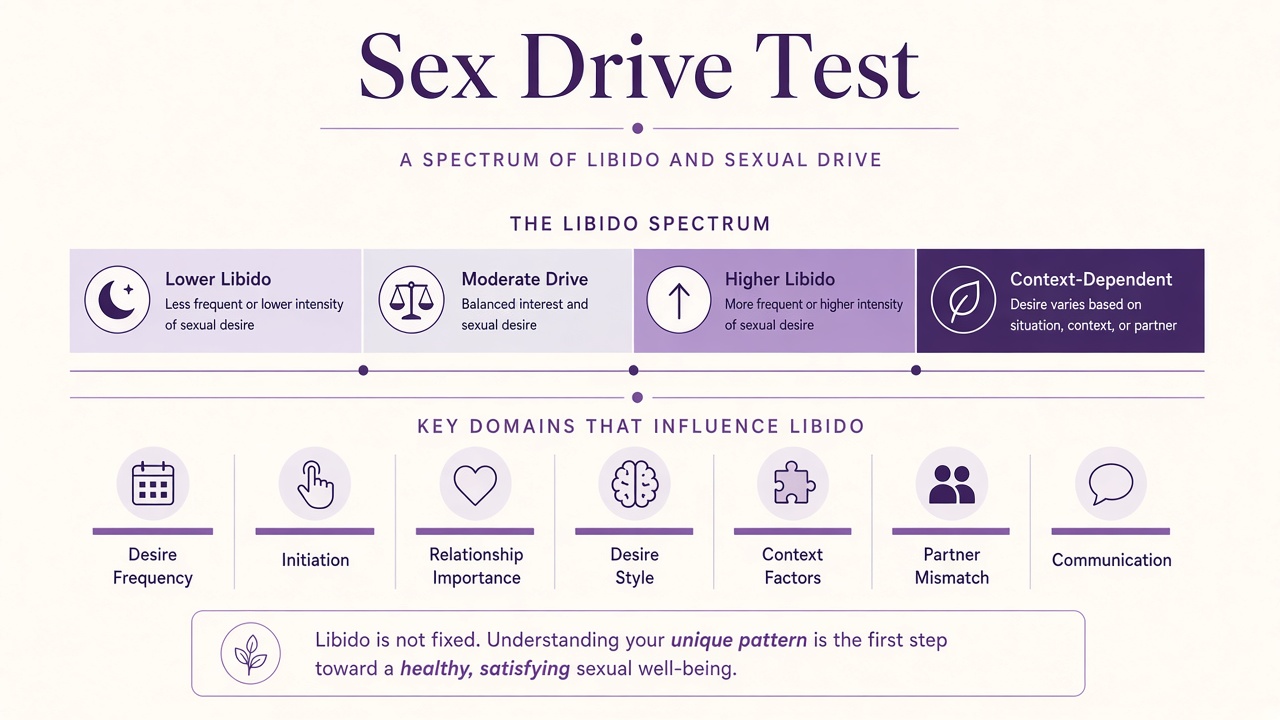
The diagram below shows how seven domains feed your libido drive index alongside context sensitivity. High context scores with moderate trait drive often produce a Context-Dependent Drive band even when desire frequency alone looks average.
What this test can and cannot tell you
Can tell you
- How your answers lean on trait-level libido domains today
- Whether spontaneous, responsive, or mixed desire style signals appear
- Whether context factors or partner mismatch distress scored high
- When to pair with our horny test or hypersexuality test for sibling context
Cannot tell you
- Hormone levels, testosterone, estrogen, or any lab result
- Whether you have hypoactive desire disorder or any DSM diagnosis
- How often you should want sex morally or medically
- What any specific partner wants or owes you sexually
Libido, context, and how this screener fits
Sex researchers such as Rosemary Basson have described how desire can be spontaneous or responsive, and how stress, sleep, and relationship safety shape whether interest appears at all. The American Association of Sexuality Educators, Counselors and Therapists emphasizes that libido varies widely without automatically signaling pathology. The Quiz Hub built this sex drive test to mirror that nuance: trait domains score separately from context sensitivity and partner mismatch distress.
Popular searches mix libido test intent with horny test mood checks or hypersexuality concern screeners. This page stays focused on trait-level drive. Our horny test captures state-level arousal. Our hypersexuality test screens distress and impairment, not baseline drive. Pair them when you want three lenses instead of one.
| The Quiz Hub test | What it adds |
|---|---|
| Horny test | State-level arousal and mood in the moment versus trait libido here |
| Hypersexuality test | Distress, control difficulty, and impairment themes separate from drive level |
| This sex drive test | Libido drive index, context sensitivity, and seven domain bars |
Sample item: agreeing that stress lowers your sexual interest raises context sensitivity without automatically lowering your libido drive index. Agreeing that you initiate intimacy comfortably raises initiation patterns. If partner mismatch items score highest, communication domain bars deserve attention even in moderate drive bands. Browse more adult quizzes on our kink and BDSM hub or read how we review them in our editorial policy.
Sex drive test FAQ
What does this sex drive test measure?
This libido test measures trait-level sexual drive across seven domains: desire frequency, initiation patterns, importance of sex in relationships, spontaneous versus responsive desire style, context sensitivity to stress and health, partner mismatch distress, and communication about needs. Results show a libido drive index, context sensitivity index, domain bars, and one of four bands. It describes self-reported patterns, not hormone levels or medical diagnoses.
What is the difference between a sex drive test and a horny test?
A sex drive test like this one focuses on stable libido traits over time: how often you want sex, how you initiate, and how context shifts your interest. A horny test typically captures state-level arousal or mood in the moment. Pair them when you want both baseline drive and current arousal context.
What does Context-Dependent Drive mean?
Context-Dependent Drive is assigned when stress, sleep, hormones, or life timing strongly shape your sexual interest while other drive domains land in a moderate or mixed range. It highlights that libido can be situational rather than uniformly high or low.
Does a Higher Libido Tendency result mean hypersexuality?
No. Higher trait libido is not the same as distress or impairment about sexual urges. Our hypersexuality test screens shame, control difficulty, and relationship harm separately. High drive without distress is common and not automatically a clinical concern.
How long does the libido test take?
Most people finish in about six minutes. There are 22 agree-disagree items on a five-point scale. You can pause and return in the same browser session thanks to autosave.
Who reviewed this content?
Dr. Morgan Chen, PhD, reviewed the test framing and result explanations. See our editorial policy for review standards.
Reviewed by